The massive displacement of September 23, 2024, represented the first serious test of the long-discussed emergency plan since the start of the Israeli aggression on border villages in October 2023. The Ministry of Interior and Municipalities’ response demonstrated a complete failure to facilitate the movement of hundreds of thousands of displaced people northward. Southern displaced people spent nearly 12 hours on the roads to leave Sidon and head to Beirut and other areas. Despite the Ministry of Interior’s justifications, people with disabilities, the elderly, those with chronic illnesses, and pregnant women all struggled to reach their destinations. Several sources on social media noted the disappearance of traffic police officers!
Months before “Displacement Monday,” the union, represented by its president, Sylvana Lakkis, had requested from caretaker Prime Minister Najib Mikati, “in the emergency file and in light of the difficult circumstances Lebanon is currently experiencing, to establish a specialized unit for the integration of disability within the disaster management system.” Prime Minister Mikati responded positively to the request.
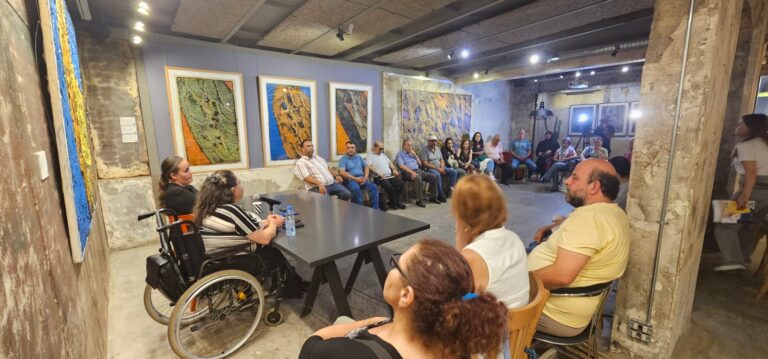
Building on its experiences from the civil war through the Beirut Port explosion in 2020, the Federation recognized the importance of establishing a Disability Inclusion Unit at the core of disaster risk management. Shortly after the start of the first limited displacement in the fall and winter of 2023, the Federation, within the framework of the Observatory for the Rights of Persons with Disabilities, organized a workshop on “The Rights of Persons with Disabilities and Comprehensive Humanitarian Assistance” on December 22, 2023. The workshop was attended by the Minister of Environment, Dr. Nasser Yassin, who heads the Disaster Risk Management Department at the Presidency of the Council of Ministers, along with representatives from municipalities, the International Committee of the Red Cross, the United Nations Children’s Fund (UNICEF), international organizations operating in Lebanon, organizations of persons with disabilities, and human rights associations. The Federation emphasized the importance of establishing a Disability Inclusion Unit, on the one hand, and the necessary recommendations to ensure that displaced persons with disabilities enjoy their independence in a manner that guarantees their human dignity, on the other. This was disseminated in the “Let’s Be Safe” video. In the same context, the Federation and the International Rescue Committee (IRC) signed a strategic cooperation agreement on May 21, 2024. One of the most important short-term objectives of the signed strategic agreement is to enhance knowledge exchange between the two organizations, with a focus on diversity, equality, and inclusion, as well as to promote inclusion in the IRC’s operational management.
The problem does not lie in the availability of knowledge and expertise, as the Federation possesses a wealth of it, accumulated over the repeated Israeli attacks on Lebanon. Nor does it necessarily lie in the government’s long-standing scapegoat for organizations of persons with disabilities, namely the lack of funding. What the recent war, which lasted for more than two months, demonstrated is that it still resides in the exclusionary mentality of the Lebanese ruling elite. The government translated this into its intervention and treatment of displaced persons with disabilities throughout their displacement.
This report summarizes the work of the 2024 Emergency Program during its sixty days of operation, from the outbreak of the recent war until the ceasefire was declared on November 27. It also includes the conclusions reached by the programme team and proposes the best future solutions to address the difficulties that prevent displaced persons with disabilities from enjoying independence in conditions that guarantee a minimum level of human dignity, under the title: Towards the Integration of Persons with Disabilities into Humanitarian Action Priorities in Lebanon.