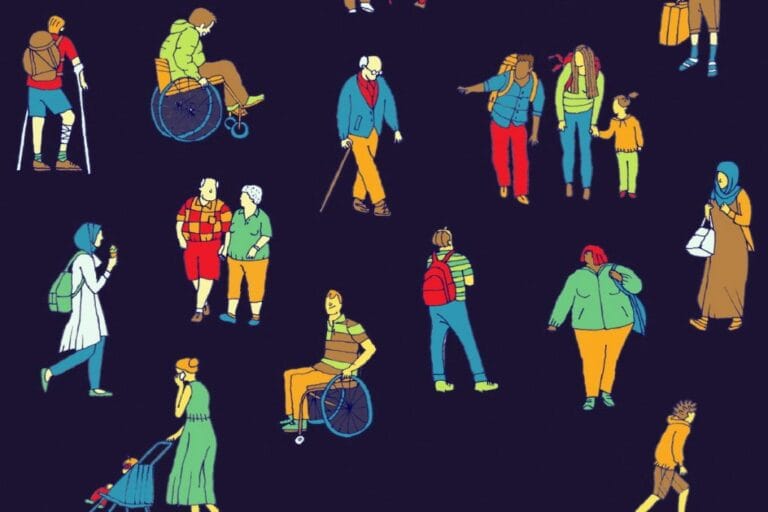
The Inclusive Tourism Program is a strategic, integrated approach that goes far beyond simply providing ramps or elevators to create a comprehensive and respectful tourism experience for everyone. It serves as a framework aimed at adapting Lebanon’s entire tourism environment to ensure that persons with disabilities (mobility, sensory, or intellectual), older people, and others with specific needs can enjoy tourist destinations without barriers or discrimination.
Core Components of the Program
Accessibility and Infrastructure
- Site assessment and retrofitting: A team of engineers and specialists assesses tourist sites (hotels, resorts, restaurants, museums, archaeological sites, beaches) according to rigorous international and local universal design standards.
- Engineering consultations: The program provides direct consultations to institutions to ensure correct modifications, including clear pathways, accessible restrooms, designated parking, visual and auditory signals, and easy access to information.
- Focus on the complete experience: Work is not limited to the facility itself but also includes accessibility to surrounding areas and tourist transport.
Training and Human Skills Development
- Changing culture: The program holds intensive workshops for hospitality and tourism professionals, from reception staff and drivers to managers, training them on proper etiquette for interacting with persons with disabilities.
- Comprehensive service: The goal is to equip staff with the skills to provide sensitive, appropriate assistance that goes beyond duty and delivers a genuinely welcoming experience, reinforcing the visitor’s dignity.
Information and Promotion
- Planning tool: A key output of the program is a guide or digital platform (sometimes an app or interactive map) that clearly indicates the accessibility level of each assessed tourist site, with detailed information on available services (e.g., wheelchairs for pools or beaches). This empowers persons with disabilities to make informed decisions before booking or visiting.
- Promotion: The program promotes these accessible destinations locally and internationally to attract a new segment of tourists who often avoid inaccessible locations.
Advocacy and Policy Development
- Partnership with the state: The program plays a pivotal role in pressuring and advocating with government bodies (Ministry of Tourism, Public Works, Interior) to make accessibility standards mandatory in licensing laws for new and existing tourist facilities.
- Awareness raising: The program runs broad awareness campaigns for the public and civil society on the importance of tourism for all as a human right and an economic driver.
Expected Impact of the Program
- Economic: Opening new markets and attracting family tourism that includes a person with a disability, thereby boosting tourism revenues and extending visitor stays.
- Social: Strengthening the sense of inclusion and full citizenship for persons with disabilities, and presenting Lebanon as a socially advanced nation.
- Shifting perceptions: Transforming the view of disability from a matter of “charity” to one of “rights and design.”
In short, the Inclusive Tourism Program is not a charitable project but an investment in rights and sustainable development. It aims to transform Lebanon’s tourism landscape into a welcoming, accessible destination for everyone without exception.
Related Content

Architectural Consultation
Toward accessible buildings that open their doors to everyone. Do you find it difficult to use a place because of too many barriers? Does an entrance, a staircase, a narrow corridor, an unclear sign, or an unsuitable design prevent you from moving, getting around, understanding, hearing, or communicating easily? We can help. The problem is […]
ESCWA: “Inclusive Tourism” is a best practice
09 / 05 / 2019The Lebanese Wheelchair Union participated in the Disability and Work Conference, organized by ESCWA at its headquarters in Beirut on December 14, 2017. At the conference, ESCWA’s Executive Director Dr. Khawla Matar spoke, the head of the Department of Disability Affairs, Ms. Mary Al-Hajj, delivered the Ministry of Social Affairs speech, and the head of […]

Tourism for All in Lebanon
26 / 12 / 2018Inclusive tourism is the creation of an enabling environment that should meet the needs of all people, regardless of their abilities, disabled or non-disabled, temporarily or otherwise (mobility, hearing, visual or intellectual), families traveling with children, or elderly people, especially in light of the increasing aging of the global population (in 2050, the elderly over […]
Accessible Hotel
04 / 06 / 2018The Platinum Hotel, located in the Tyre area, is currently preparing 4 rooms to welcome all customers with different needs. This step comes within the framework of the existing cooperation between the project and the hotel management, where a cooperation protocol was signed and a work plan was developed that started from assessing the place […]
Tourism for All “Best Practices for Inclusive Tourism”
04 / 06 / 2018The Lebanese Union for Persons with Motor Disabilities (formerly the Lebanese Wheelchair Union) won an international award where its model project “Tourism for All” was categorized as one of the best practices for inclusive tourism, funded by the European Union within the AFKAR3 project and managed by the Ministry of Administrative Development and in partnership […]
Tourism for All in Lebanon
Strengthening the role of the tourism sector as an important asset for socio-economic development, with the aim of adopting a methodology to integrate people with disabilities in Lebanon.
Baalbek: Launching the practical steps of inclusive tourism
26 / 11 / 2017On July 12, 2017, the Lebanese Wheelchair Union launched the practical steps towards inclusive tourism in Baalbek, as part of the “Tourism for All” project, funded by the European Union and managed by the Office of the Minister of State for Administrative Development Affairs, in the presence of the mayor of Baalbek, Hussein El-Lakkis, represented […]
The typical summer tent in Tyre
26 / 10 / 2017On September 14, 2017, the Lebanese Wheelchair Union, in partnership with the Municipality of Tyre, launched the first pilot experiment in Lebanon that allows all people with different needs to access the sea and enjoy marine tourism services, entitled “Tyre Beach for All”, in an official ceremony at tent number 19 on the beach of […]