
Prepared by: Imadeddine Raef, Media Unit Coordinator
The Struggle for Equal Opportunities in Lebanon
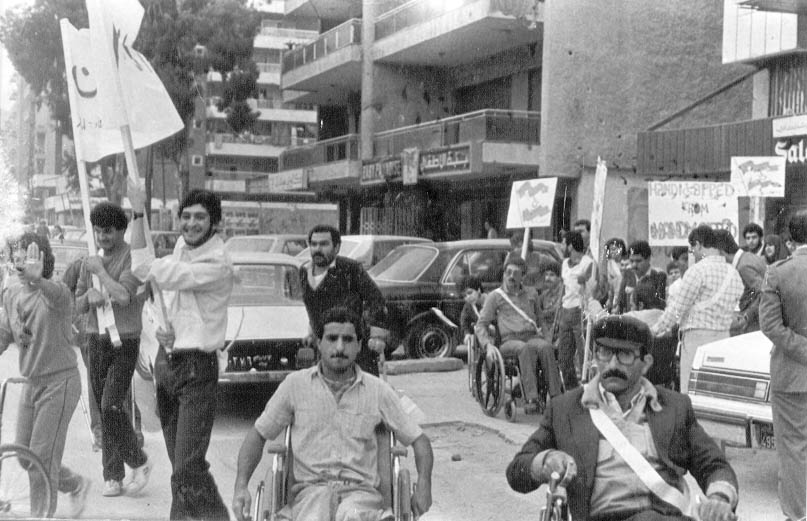
When the Lebanese Union for People with Physical Disabilities was born in Beirut in 1981, it carried the name “Union of Lebanese Wheelchair Users.” It was founded by a band of activists with disabilities who, despite the raging civil war (1975–1991), dared to raise the banner of their own rights, and never let it fall.
A quarter of a century later, as the LUPD celebrated its silver jubilee, its newsletter Waw began telling its story for the first time, chapter by chapter, in six heartfelt installments (2006–2008). These pages traced the journey from those early days of struggle to our proud push to place disability at the heart of Lebanon’s development agenda.
Table of Contents
- The Beginnings
- Phase I (1981-1991)
- Phase II: Law 220/2000 Accomplishment, Calls for Implementation (1991-2004)
- Internal Conferences: A Gateway to Change
- The Correct Scientific Movement
- Analyzing Target Stakeholders
- Protests and the Law
- Research and Media
- Right-based Work – The Continuous Campaign
- The Right to Access is the Mother of All Laws
- Emergency: 1993 and 1996 Aggressions
- Rights-based Development Camps (1991-2004)
- 4th Camp: Independence, Hrajel, 1992
- 5th Camp: Demands-Based, Ajaltoun, 1994
- 6th Camp: The Challange, Khiyarah, 1995
- 7th Camp: Determination, Aramoun, 1997
- 8th Camp: Hand in Hand, Khiyarah, 1999
- 9th Camp: Partnership, Maaser al Chouf, 2001
- 10th Camp: Dialog, Saghbine, 2002
- 11th Camp: Youth Participation, Deir Kousha, 2003
- 12th Camp: Participation Saghbine, 2004
- Strategic Plan
- Phase III 2005-2022 (being written)
The Beginnings
In December 1979, Dr. Ramez Hajjar -a wheelchair user- shared a bold idea on live TV: people with disabilities should organize like a union to demand their own rights.
A print worker named Zulfiqar Abdullah heard him and reached out. Soon, he and his colleague Abdul Aziz Al-Shaar were meeting Hajjar at the American University of Beirut hospital, ready to act.
Back then, institutions spoke on behalf of people with disabilities. But Zulfiqar and Abdul Aziz went to the streets, not as charity cases, but as free individuals, inviting others from workshops and factories to join them. Hajjar, meanwhile, connected with a growing circle of activists.
Their weekly meetings on the Manara Corniche grew, with new faces like Karim Al-Jawhari, Ziad Zein, Souad Soubra, and many more.
Phase I (1981-1991)
In 1981, Ramez Hajjar, Hassan Al-Bassat, and Bassem Hamdan drafted the union’s bylaws. Licenses were frozen that year, but Hajjar, ever resourceful, used a chance encounter with the Minister of Labor (who was recovering at the American University of Beirut) to secure the official license on October 26, 1981.
A friend, Nadia Zein, submitted the papers to the Ministry of Interior. Another friend, Khalil Dakash, designed the logo, which later evolved with the union’s name, refined by Fouad Hashem.
The vision was clear: each disability group would have its own union. So “The Lebanese Union of the Wheelchair Users” was born, uniting people with polio, war injuries, quadriplegia, paraplegia, and upper-limb disabilities. That year, board meetings were held in Hajjar’s room, general meetings gathered on the Manara Corniche.
An Organization Without an Office
Malik Khoury, manager of the “Club House” affiliated with the Ministry of Tourism, offered his friend Youssef Majed, a union member, to host the organization’s weekly meetings at the club. After a while, Khoury built a ramp suitable for wheelchair users. He also began building a network of relationships he placed at the service of the young union, connecting it with other organizations.
The weekly meetings continued at the Club House, as union members found it suitable. Even after its affiliation was transferred to the Ministry of Labor and union members were no longer allowed inside, they spread newspapers on the surrounding ground and held their meetings in the open air.
The early union members sought a permanent center for the organization. Dr. Salim Hoss took the initiative, offering them an apartment in the Douha Aramoun area, furnished through his advisor Samir Mansour. But the area was bombed days before they were to receive it, on June 4, 1982, the first day of the Israeli invasion.
Efforts also focused on securing small professional loans for union members who were craftsmen, on the condition that the union purchase the equipment and supplies, and that the loan recipient repay the amount in installments. Attention at that time was directed toward handicrafts, carpentry, and motor winding. Among the early supporters in that period, alongside Hoss, were Malik Khoury, Antoinette Kazan, and the late union member Hajj Nabih Dandan (Abu Riyad), through whom union members met lawyer Assad Bakkar. The union then moved to his office in the “Riviera Center” building on the Mazraa Corniche in Beirut.
Reviera Center Office
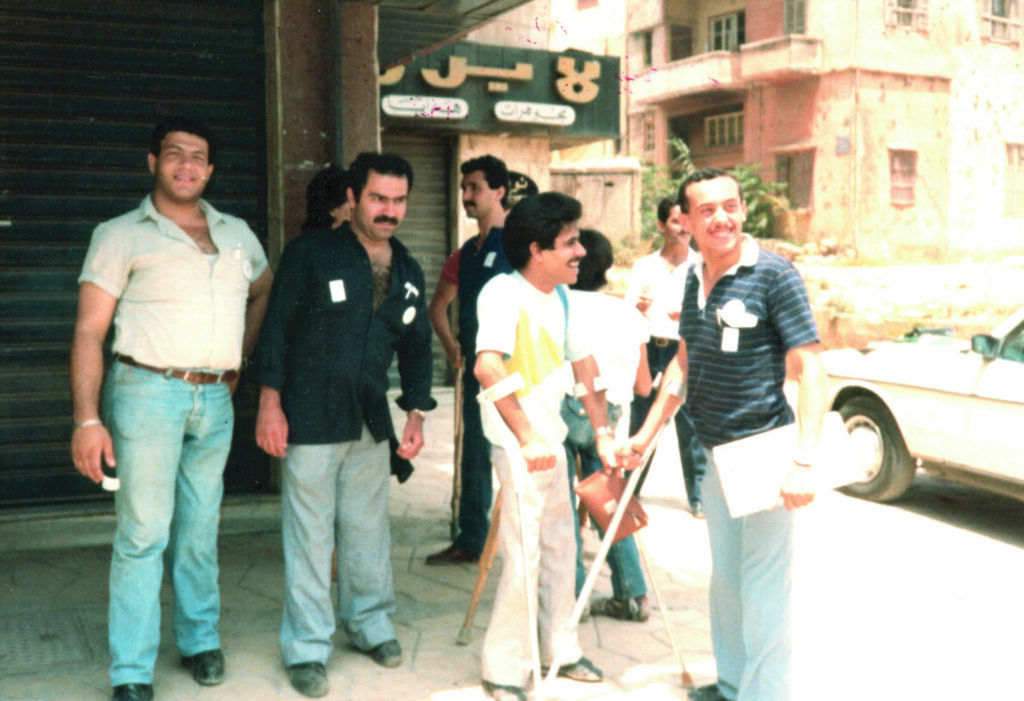
The fourth floor of the Riviera Center buzzed like a beehive. When the electricity went out, meetings and activities moved outside, to the parking garage and the sidewalks. Having a stable space allowed the organization to follow up on many dealings with ministries and to cover the gaps in what the Ministry of Health paid for medical care and hospitalization.
Dr. Hisham Baroudi offered steady cooperation in supporting the causes of people with disabilities from the very beginning. The Popular Rescue Organization also provided a pharmacy for the organization in the building and supplied it with medical materials and supplies often needed by people with physical disabilities. Members rehabilitated part of the building’s roof as a workshop for repairing wheelchairs and crutches. It operated under the supervision of Hajj Dandan, alongside the Ouzaai workshop, which had the same tasks.
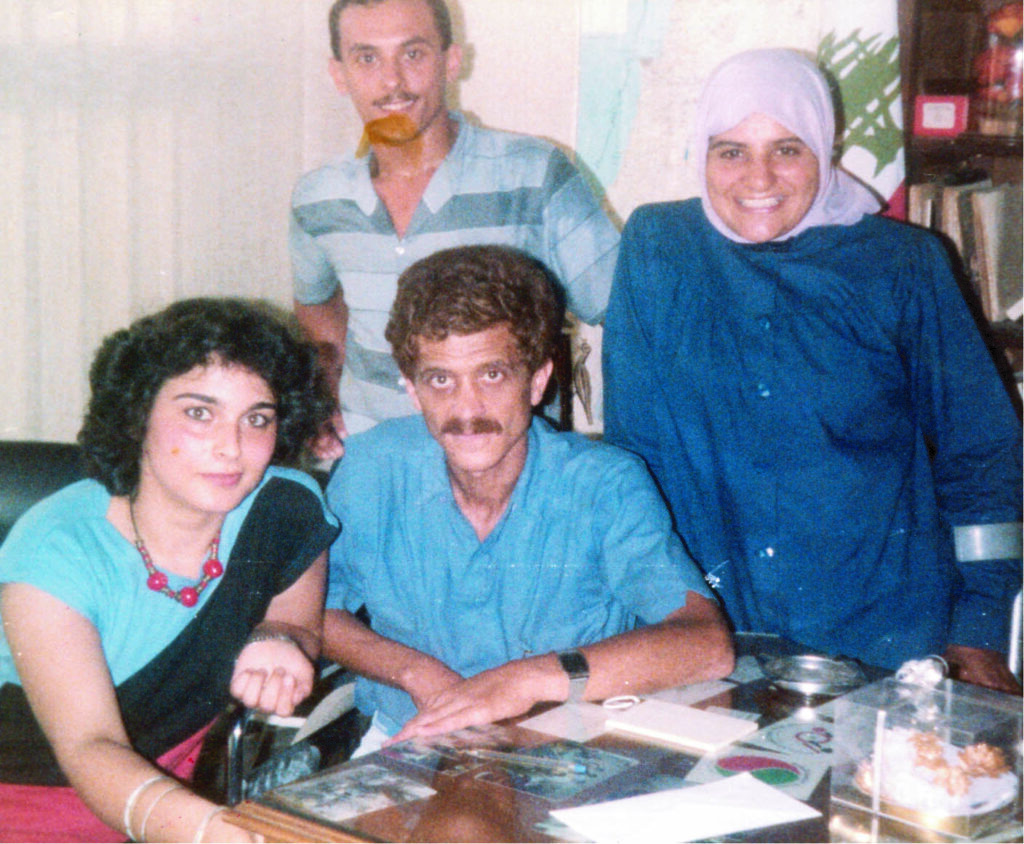
From the Riviera Center office, members went out to participate in meetings and seminars in Beirut and other regions. They presented some projects to international organizations, but they did not have enough financial capacity to keep those projects going. Among the activists in that period, between 1984 and 1986, were the late Mohammad Ali Harb, Adnan Oza, Abdullah Bahlaq, Amin Ibrahim, Badria Al-Asta, Hussein Jaber, Fatima Daaboul, and Iman Saab.
Some of the projects included the Ouzaai workshop, the Mreijeh workshop in cooperation with the Red Cross, a wood engraving project with the Amel Association, and exhibitions in the glass hall of the Ministry of Tourism in the Hamra area. One project that lasted and bore fruit was the integration of disabled children with non-disabled children. It was worked on by members Hanan Qaddouh and Izzat Ezzeddine, with the Red Cross in the southern suburbs of Beirut, and by Hassan Al-Bassat and Sylvana Lakkis in the Saida center.
Breaking Barriers
The organization went beyond the barriers that separated East and West Beirut during the civil war. Through steady work with Father Grégoire Haddad, and with the participation of organizations for the blind and the Social Work Association, the organization began its advocacy work representing the eastern side of the divided city.
And since division had already been dissolved among people with disabilities, because disability has no sect, why not move to bring down the imaginary division among all Lebanese?
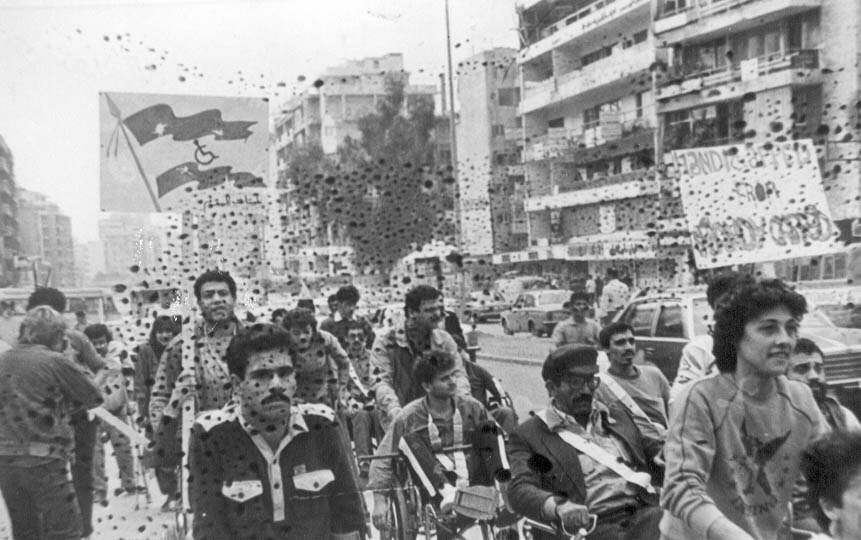
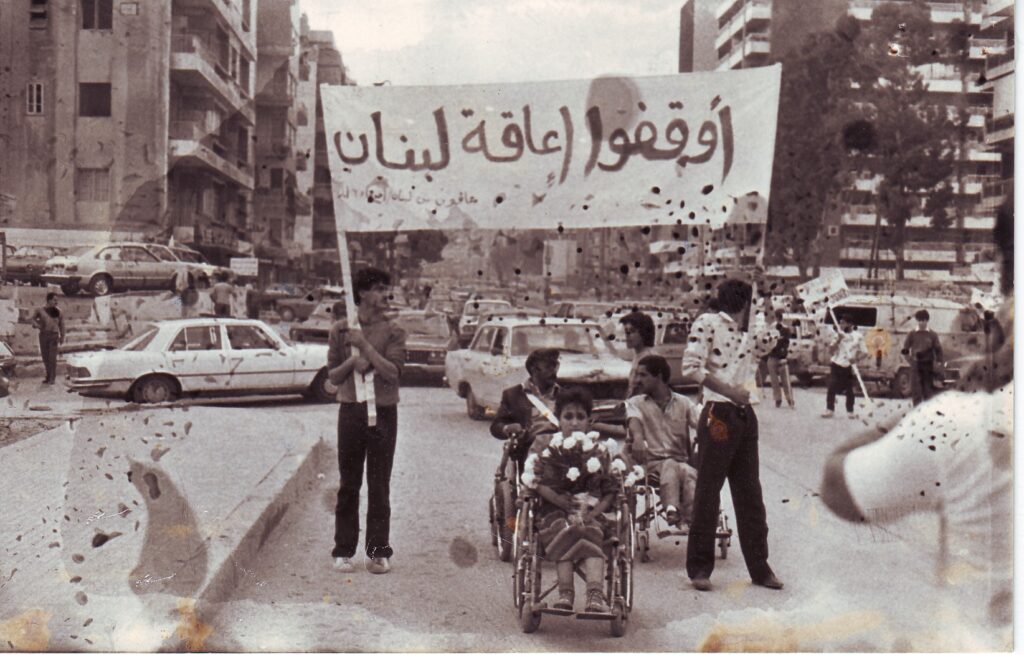
A march by the Union of Lebanese Wheelchair Users set off from in front of the Riviera Center building toward the security committee in the Museum area, coordinated with Mrs. Laure Moghaizel and non-violence organizations. The Museum area was a contact line between East and West Beirut. The idea was that members from all regions, including Beirut, the Bekaa, and the South, would carry a white lily to the fighters.
When the protesters returned, the first spark of what became known as the Battle of the Flag broke out. Members rushed toward their headquarters and were besieged there for three consecutive days. They spent those days in singing gatherings, while fighters burned the areas of Aisha Bakkar, Verdun, Kola, and even Barbir with their shells. From there, on the steps of the Riviera Center, the idea of a second march was born. A grand march that would bring together people with disabilities from Halba to Tyre.
Months after the first march, the idea of the second march began to be discussed. It was later named the Non-Violence March, with the participation of many civil society organizations. Large workshops were held, and the efforts of unified civil organizations bore fruit under the slogan of rejecting violence in 1987. That march covered about 200 kilometers through checkpoints, factions, and conflicting groups, carrying hope for a better Lebanon.
From the Van to Hamad Center
The members left the Riviera Center office and found themselves without a center in Beirut. In 1986, most meetings were organized on the sidewalks, and activities started from in front of the Riviera Center, with meetings held in the building’s parking garage and at the entrance. Then the members bought a van and turned it into a fixed center for them in the Aisha Bakkar area. Some meetings were also held in Badria Al-Asta’s room and at Zulfiqar Abdullah’s home. From the van, the organization’s activities and projects were launched, including its major public appearance through the seminar on marriage and disability in late 1987.
In late 1988, thanks to many supporters, including the International Fund for the Rehabilitation of People with Disabilities, the Save the Children Federation, Norwegian People’s Aid, engineer Abdul Raouf Alawiya, and others, the members were able to buy a property in Beirut in the Hamad neighborhood. So after eight years of moving from one place to another, the organization finally had a center from which activities and participation could be launched. The members worked hard to renovate the property, equip it, and purchase the necessary supplies.
The organization’s work in the first phase, between 1981 and 1989, was limited to assistance and relief during the war, and community development, because that was a basic need and medical supplies were not available from official bodies. Even though the organization’s message was fundamentally about rights and advocacy, in those years the state had no significant role, and no effective work was done by ministries to push for laws specific to people with disabilities. So the members prepared themselves through service programs, by welcoming a larger number of people with disabilities into the organization’s family, by connecting with other rights organizations, and by spreading a culture of inclusion. During that period, they searched for international laws related to disability in preparation for drafting a Lebanese law on disability, which was originally one of the reasons for the existence of the Union of Lebanese Wheelchair Users.
Establishing the Bekaa Branch
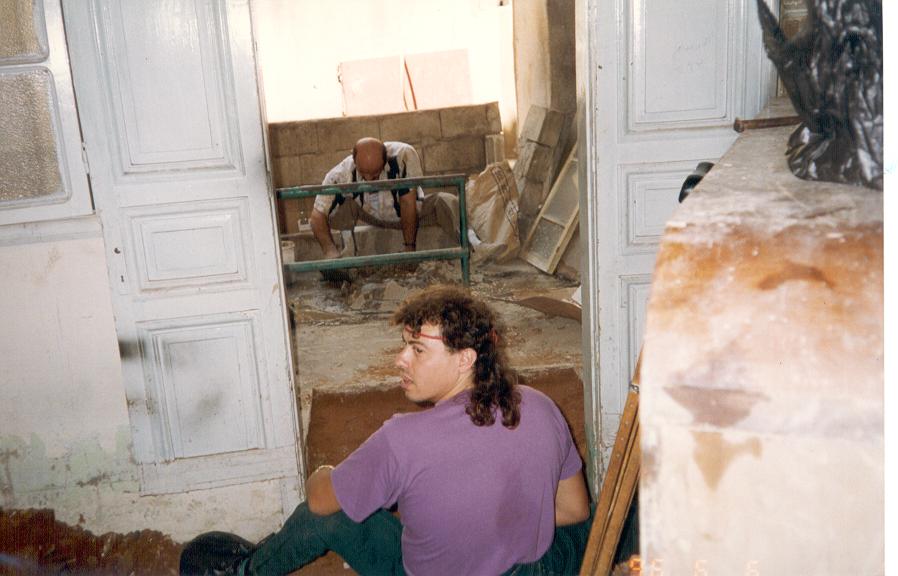
Hind Harb’s efforts in the Central Bekaa bore fruit after a short period of her constant commuting to Beirut. In 1984, the first meeting was held at her home, bringing together Fayez Akasha, Mahmoud Al-Rifai, Omar Nasser, and Umayya Ruqayya. The first goal was to attract as many people with physical disabilities as possible. At the meeting, those present received the organization’s internal bylaws and agreed to rotate the meeting location, holding it at one of their homes each time.
Lebanon’s Bekaa region was divided into two parts at that time due to the Israeli occupation. This pushed Umayya Ruqayya to work under occupation, so she moved toward the Qaraoun area with the help of Ahmad Abdul Latif Issa and Amer Subhi Suleiman. Meanwhile, the rest of the members focused their efforts on the Central Bekaa.
Once the number of members grew, their first concern was finding a center for the organization in the Bekaa. They made many contacts with sports and social associations, until the Al-Wahda Sports Club in the town of Al-Marj hosted their meetings. They began using one of the club’s rooms regularly. Then they moved toward securing transportation for the organization, and their contacts succeeded when the Hariri Foundation provided a suitable car.
A good relationship with the club president provided a suitable place for people with disabilities, which helped the branch’s activities grow quickly. By 1985, general assembly meetings became monthly, and people with physical disabilities started coming to the organization’s center to learn about the association and join it.
The branch organized many recreational activities in the Bekaa during that period. There were trips that included people with and without disabilities to Ras Al-Ain and Ain Baraka. But the most prominent activity was in cooperation with the Ministry of Health through the national campaign to combat polio. During the campaign, the organization secured vaccines from Beirut and provided a volunteer medical team. Vaccinations took place at the organization’s center and in schools, where the team moved from one school to another carrying its equipment in the organization’s car. The organization also organized a photography course in 1986, supervised by photographer Habib Zayadi.
The members succeeded in making use of the organization’s founding anniversary on October 26. They celebrated it every year with a gathering to which they invited friends and wealthy individuals to support the organization’s work financially. Donations also increased during Ramadan. But support that was no less important than financial backing came from the Omar Al-Mukhtar Center. The Social and Cultural Development Association provided a hall for general assembly meetings and activities through this center, as well as large vehicles with drivers.
Among the activists in that period, in addition to those already mentioned, were the late Ismail Al-Boustani, Naji Al-Boustani, Ahmad Sati, Bashir Waked, Yahya Qassas, Mariam Zarour, Amer Amer, and others.
The organization’s center remained in one of Al-Wahda Club’s rooms until 1987, when the club’s management decided to open a dispensary there. The center then moved south to the town of Ghazza Al-Biqaiyya, where two activists lived: Nadem Al-Majzoub and Salim Abu Jakh. The place was modest, consisting of two rooms. Members distributed aid coming from Beirut during that period, as well as assistive devices and food supplies to those in need. In the small Ghazza center, the organization held several handicraft courses and branch general assembly meetings.
The two rooms could not accommodate the group, whose numbers grew significantly after Israeli forces withdrew from the villages of the Western Bekaa. Umayya Ruqayya’s efforts and those of activists there had succeeded in attracting a large number of people with disabilities and bringing them into the organization’s ranks under Israeli occupation.
The idea of moving the center to the city had matured among the members. The Bekaa branch moved to the town of Chtoura, where members found a suitable house in the town of Jdeita. But the organization’s activities at that time, between 1989 and 1991, were focused on the Western Bekaa, so it was necessary to find a midpoint between members due to the difficulty of movement. The administration was forced to move the center to Bar Elias, where the center remains today.
Establishing the South Branch
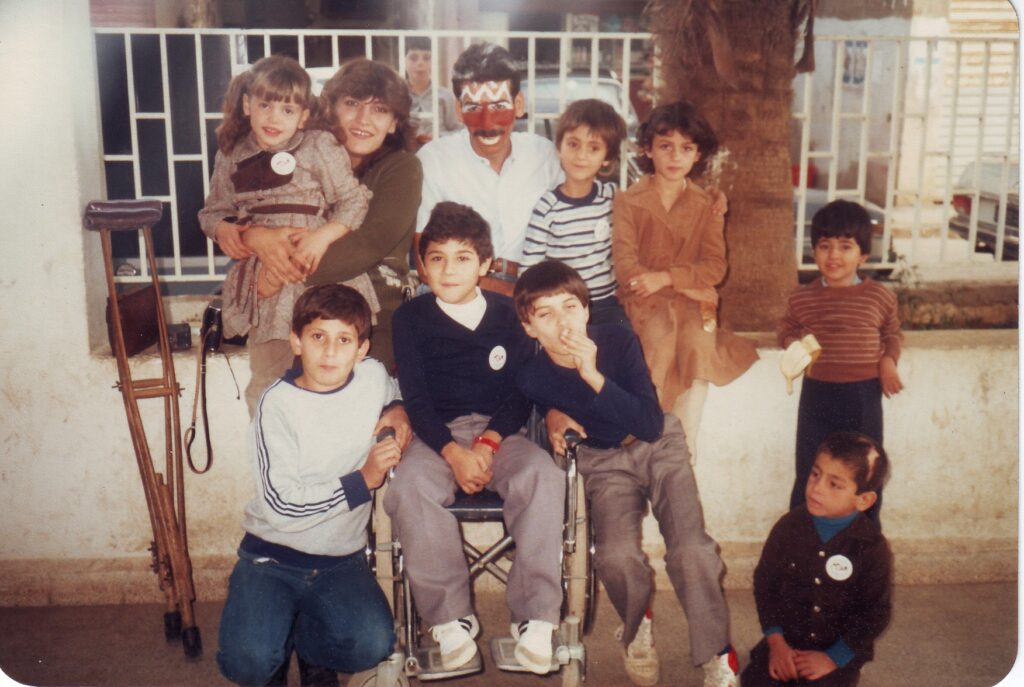
The founding of the Southern branch in the city of Saida went hand in hand with the launch of the organization’s projects. These started with medical visits to people with disabilities, the project to integrate disabled children into the local community, donation campaigns to fund the organization’s activities, long recreational gatherings, leisure trips, and vocational and handicraft training. These projects aimed to bring people with disabilities together, develop their abilities, and break down stereotypical barriers and society’s view of persons with disabilities.
Projects and Activities
In its first phase, the organization’s efforts were mostly focused on community development, through awareness and relief during the civil war, because that was a basic need. Medical supplies were not available from official bodies. With no effective role from the state, the members prepared themselves through service programs, attracted as many people with disabilities as possible, and spread a culture of inclusion among them. The organization’s journey during that period included several projects and activities, the most important of which were:
Medical Visits Project (1986-1991)
The visits aimed to secure essential medical supplies for people with disabilities, especially since these materials were expensive and there was no national source providing them. The organization worked with international institutions like Doctors Without Borders to secure medical materials, accompanied by volunteer specialists during the visits to treat wounds. The program started from the Saida center, with visits regularly held every Tuesday and Thursday. A large number of members and volunteers worked on the program, led by Hassan Al-Bassat, Sylvana Lakkis, Hassan Kahil, Nader Nema, Nazha Sbeiti, and Christina from Doctors Without Borders.
Assistance was limited to medical materials, securing school grants through supporting institutions, social intervention, and awareness about health conditions. The medical visits project continued for seven years, from 1986 to 1991. Most of those who benefited from it later joined the organization’s ranks and became active members, including Adib Hayek, Hassan Hdib, Khadija Chokroun, and others.
Children With Disability Inclusion Project (1985-1986)
This project started in 1985 at the Saida center, with member Hanan Qaddouh responsible for it. Members would bring children from their homes during school holidays on Saturdays and Sundays. They brought them to the Saida center to draw, play, and interact. Sylvana Lakkis and Fatima Qawwas took over responsibility for the project, then Sonia Lakkis and Nader Nema worked on it. The number of children gradually increased, and colleague Hussein Kahil joined the team. In Beirut, Hanan Qaddouh continued her work on the project with Izzat Ezzeddine, with weekly meetings and activities held at the Lebanese Red Cross center in Mreijeh. This project was a great success and produced many activities, including plays, trips, and holiday celebrations.
Donations Campaigns (1986-1995)
Fundraising activities began in 1987 and continued until 1995. Their goal was to support the organization financially so it could sustain its existence and work. They were preceded by a preparation phase for the activity and obtaining the necessary permits. On execution days, the team studied any developments during the work, secured food for volunteers, and maintained communication between groups.
The first fundraising campaign was organized in the Bekaa, in the form of “love checkpoints,” with many members participating, including Fayez Akasha, Mohammad Bayram, Nader Nema, Hussein Kahil, Naji Al-Boustani, Yahya Al-Lahib (known as “Ghareeb”), Wafaa Hamieh, Osama Ghaddar, Sonia Lakkis, Ali Shahin, and others. The campaigns moved between regions and were held every year in stages, lasting three days in each governorate. After Beirut, they moved to the South, then to the Bekaa.
Long Entertainment Get-togethers (1986-1990)
Members called it “Open Day.” It was held on the last Sunday of each month, with the aim of providing entertainment, connection among members and their families, and exchanging information. These activities continued until 1990. Members prepared for this day weeks in advance, searching for equipped venues, securing funding for transportation and food, and setting the program. Open Day was held in different places across Lebanon, where participants spent the day playing, singing, dancing, and showcasing various talents through educational games and competitions with prizes distributed.
Entertainment Trips
In addition to discovering different Lebanese regions in the Bekaa, the South, and the North, members reinforced the concept of inclusion through recreational trips for both old and new participants. During the war, entertainment was the most important means of attracting people. The goal of these activities was not only to provide relief and a sense of safety. The recreational trip itself carried meanings that only people with disabilities could understand. Many participants had been prevented from leaving their homes for long periods because of their disabilities. Others had families and relatives who were ashamed of their appearance in society and felt embarrassed simply because others knew they had a son or daughter, or a brother or sister, with a disability. Many people with disabilities had no form of communication beyond the narrow boundaries of their homes. If we imagine all of that, we can understand what a recreational activity meant in the 1980s.
Vocational and Artisan Training
During the war, job opportunities for people with disabilities were very scarce. The organization managed to secure sewing machines, organized training courses, and graduated a small work team. Selling the products was not easy because production costs were high, and imported goods were highly competitive with lower prices. The organization organized some exhibitions to sell handicraft products, including sewing and painting on mirrors, and sometimes participated in exhibitions organized by other associations. The organization also secured spaces where producers with disabilities could place their equipment and work on their small projects, such as sewing, packing salt bags, and other crafts.
Marriage and Disability Seminar 1987
The American University of Beirut hosted the “Marriage and Disability” seminar organized by the organization in late 1987, which spanned seven weeks. The seminar addressed everything surrounding the issues of marriage and disability from different perspectives, including medicine, religious laws and faiths, law, psychology, and sociology. Three speakers took turns at each session. Colleague Ziad Zein coordinated the seminar, assisted by Fadia Bouab, Yahya Aandour, Mohammad Hamieh, Iman Sannou, and Jihad Ismail. This specialized seminar was a great success, as for the first time the topic of marriage for a person with disability was raised in a comprehensive way and then discussed in detail by specialists from different fields.
Rights-Based Development Camps
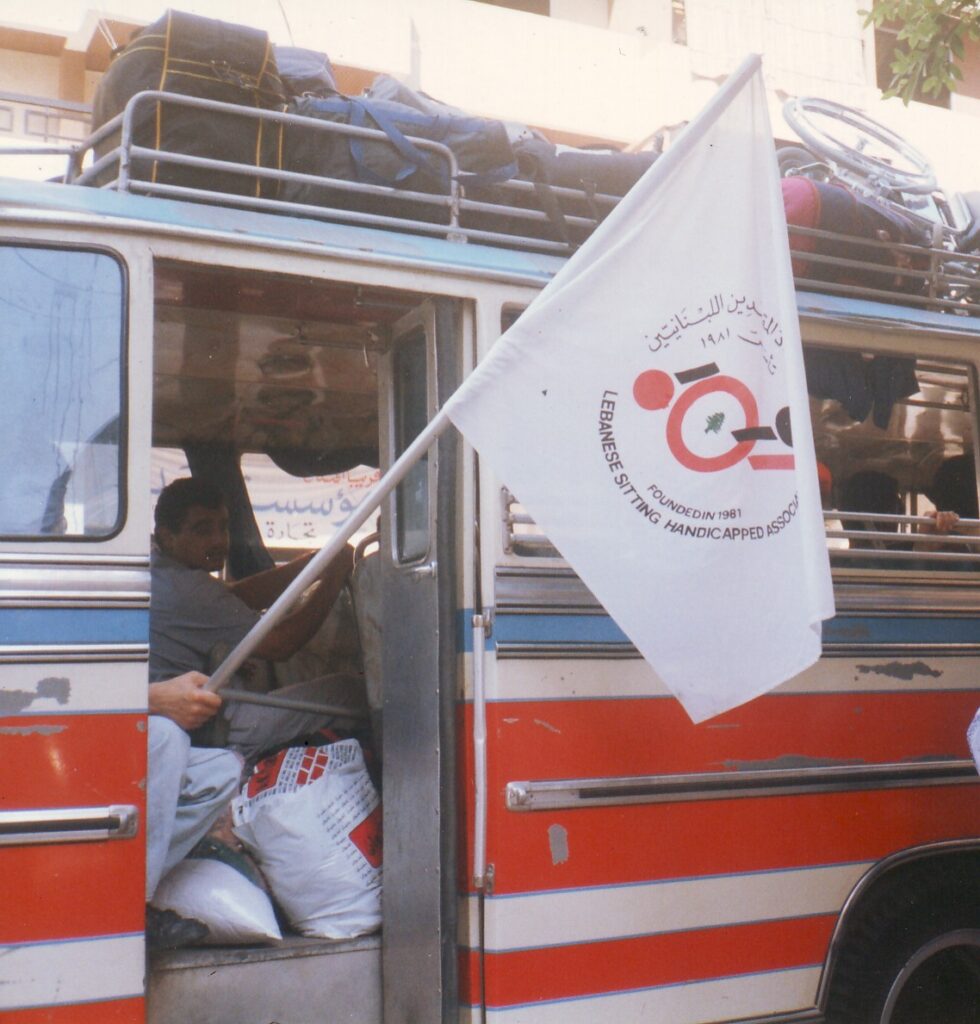
Since its founding, the organization paired its rights advocacy with a developmental approach aimed at creating laws to secure the rights of people with disabilities. Training and recreational camps became a core summer activity that members and friends looked forward to each year. These camps lasted several days, with workshops to sharpen personal skills, train cadres in advocacy around disability rights, renew connections across branches, and spread inclusion among local and Arab civil society groups. Above all, they broke society’s inherited views on what people with disabilities can do, opening a new phase in how disability issues were handled and in practical social inclusion.
The organization chose camp locations to spread the cause and attract supporters. Teams built relationships with key figures in prospective villages months ahead, announced the camp, invited villagers to join recreational activities, and drew media attention from visual, audio, and written outlets. Training topics matched the needs of the year’s programs. Each workshop ran at two levels, one for those familiar with the topic and one for newcomers. Some workshops were mandatory, others optional. The results fed directly into the organization’s broader training vision. After each camp, volunteer numbers grew at the centers, whether through new friends, university students, or members of other associations who adopted the cause. Team performance also improved across all programs.
The first decade saw three developmental and rights-based camps:
1st Camp: We Work to Persevere, Joun, 1989
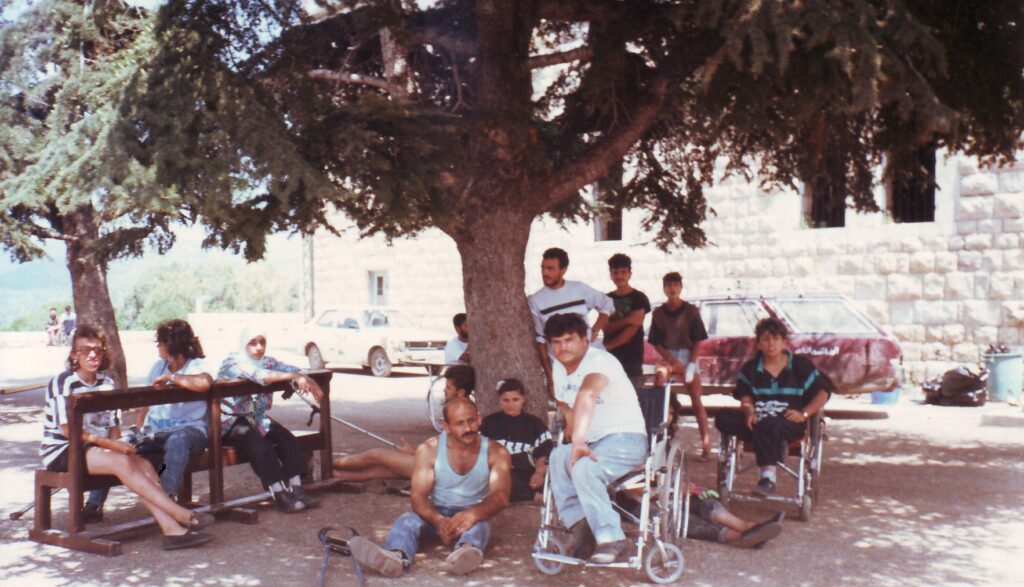
The first camp remains etched in the memory of the hundred people who took part. It launched from the town of Joun in the Chouf, at Deir Al-Moukhalas, in August 1989. Its slogan was “We Work to Persevere” and its anthem, written by colleagues Hussein Kahil, Mohammad Bayram, Sonia Lakkis, and Nader Nema, went: “We came to camp, come beloved, let our nights gather and our hearts rejoice.”
The preparation team, made up of the most active volunteers from the Saida branch, worked fifteen days before the opening to clean and equip the site for participants coming from different Lebanese regions. The program focused on vocational training, theater, film screening, handicrafts, driving, and sports. Work was divided across stages and groups six months ahead, with weekly meetings to ease coordination. Tasks varied. Some volunteers wrote support requests to associations and food companies, others approached shop owners for in-kind and financial support. Another team developed a training plan and coordinated with lecturers to fit the camp schedule, while another searched for a location accessible to wheelchair users.
The setup team consisted of thirty volunteers, both with and without disabilities, including Mohammad Ali Harb, Mohammad Bayram, Ghareeb Al-Lahib, Hussein Kahil, Nader Nema, Abdullah Kahil, Sharif Daher, Walid Badir, Fouad Badran, Osama Ghaddar, Wafaa Hamieh, Sylvana Lakkis, Sonia Lakkis, Ani Lakkis, Ziad Lakkis, Hayat Lakkis, Hassan Al-Bassat, Abdel Halim Sarhan, Fadia Al-Samra, Yasser Bayram, Sawsan Bayram, Abdullah Bahlaq, Adnan Oza, Fayez Akasha, Fatima Qawwas, Mohammad Moussa, Jamil Moussa, and Abdo Haidar. They built ramps, secured electricity and water, cleaned the area, set up tents for participants, and constructed bathrooms. The team felt joy with each tent pitched, knowing the immense effort involved, and they worked together to move from the campsite to the training area.
The camp administration included Hassan Al-Bassat, Mohammad Ali Harb, Sylvana Lakkis, Abdel Halim Sarhan, Mohammad Bayram, Fouad Badran, and Saleh Chaker. Group leaders assisting the administration were Ghareeb Al-Lahib, Hussein Kahil, Nader Nema, May Aitani, Abdullah Bahlaq, Adnan Oza, Rima Aitani, and Fayez Akasha.
Some participants left their homes for the first time to attend the camp, whether due to overprotective families or the lack of an accessible environment. Others came in response to announcements distributed at universities through friends, partner organizations, or beneficiaries of the organization’s programs, forming the largest part of the organization’s family.
A typical day began with Fairuz’s voice on Radio Ouz, coffee prepared by the break team, and morning exercise. The cleaning team worked in rotation for half an hour, then each person attended their training workshop until lunch. Afternoon recreation followed until dinner, an evening meeting, and a campfire night. Two recreational trips took participants outside the camp in buses not equipped for wheelchairs. But beneath the recreational surface, heated discussions arose about the harsh reality of people with disabilities, searching for solutions linked to changing laws and the general situation. Participants often turned to awareness activities spreading their rights in society, or activities rejecting the war, which prevented protective laws and increased the number of people with disabilities. Their positions and concerns appeared in skits and songs they composed during training workshops and performed at night gatherings.
Through daily contact in the camp, love stories began under the huge plane trees in the monastery courtyard. Colleagues Ali Badra and Fadia Al-Samra met and married soon after the camp ended. Others fell ill from love or work pressure, and the administration had to transfer them to hospitals or dispensaries.
The campfire nights featured educational games aimed at building connections. News bulletins prepared during the day were broadcast, recounting funny events everyone awaited, as they shared anecdotes and secrets in a playful, critical way. Skits criticizing the war and society’s treatment of disability were performed. The night lasted until midnight, the official bedtime, often accompanied by much mischief.
The theater team, a harmonious group, rehearsed throughout the camp to perform the play “Summer 840” at the closing night before participants and invited officials and friends, led by the late colleague Nader Nema with Sonia Lakkis assisting. They delivered a strong performance, praised for its acting, set design, and costumes.
The next morning, all participants left by buses to different parts of Lebanon. The setup team stayed alone at the site. The courtyards were empty, and the team packed up in a heavy silence that was very hard to break.
2nd Camp: We Work to Persevere 2, Joun, 1990
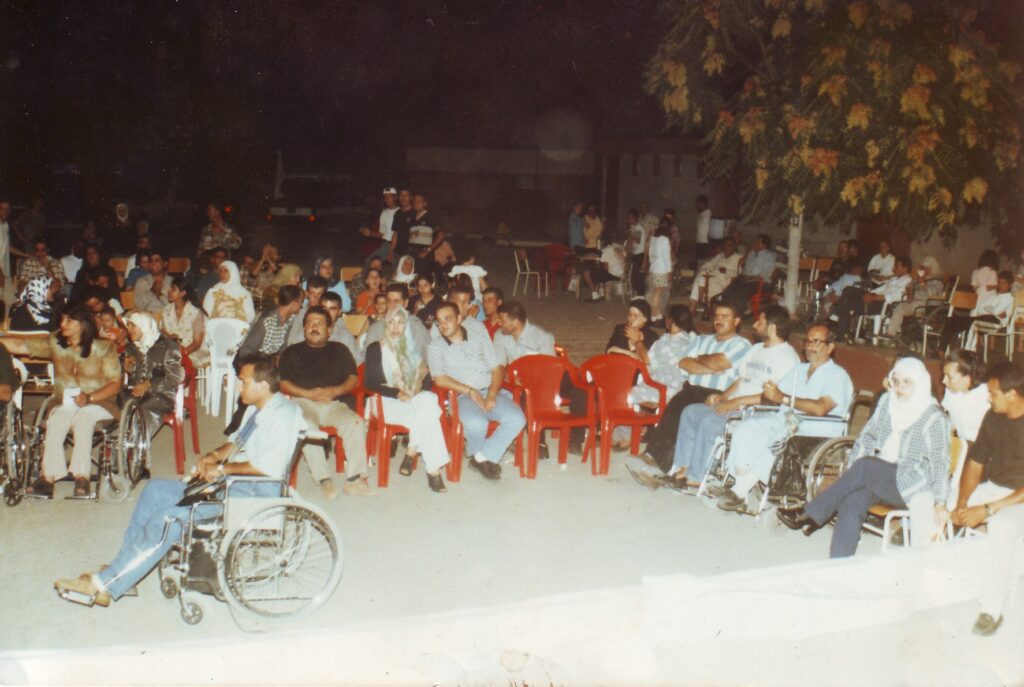
After two months of continuous searching, the preparation team could not find an equipped location. The Saida office administration decided to hold the camp in August 1990 under the title “We Work to Persevere 2,” at the same location as the first camp at Deir Al-Moukhalas, since the required ramps were still there. The setup team only needed to clean and rebuild outdoor bathrooms accessible to wheelchair users. The second camp came more organized due to the experience gained from the first. Each administrator became responsible for their own program and tasks, and the general camp coordinator made final decisions on any problem.
Campers stayed in the spacious rooms of the monastery building. Some rooms were allocated for training courses, while a large hall for meals remained, accommodating over a hundred people, the number of participants in the camp. The training program was intensive with lectures and workshops, and the recreational programs were purposeful. As usual, the lecturers and trainers were skilled specialists in their fields. Everyone participated with enthusiasm, and the new participants were excited about union work since it was a new topic for them.
This camp had a special quality because it attracted the villagers, who stayed up in its courtyard every day, amazed to see wheelchair users organizing their own lives, competing in running and racing on wheelchairs. A culture spread among the people about the ability of people with disabilities to be independent, and the organization gained volunteer friends from the village after the camp ended.
Training varied through workshops on different topics, including union work, the Universal Declaration of Human Rights, administrative training, report writing, gender, economics, development, and participation in decision-making. Vocational workshops covered theater, expressive drawing, driving, and handicrafts.
The night gatherings reflected the workshop atmospheres through various art forms expressing the reality of disability in Lebanon. These performances were prepared by participants who took turns creating them based on the daytime workshop themes, along with the news bulletin. Often, scout teams were welcomed to enliven the nights. The goal of hosting visitors was to spread awareness about the rights of people with disabilities and their ability to integrate into all sectors of society.
The camp administration included colleagues Sylvana Lakkis, Adnan Oza, Mohammad Ali Harb, Mohammad Bayram, Fouad Badran, Ghareeb Al-Lahib, and Yasser Bayram. Assisting them were group leaders Ghada Al-Sandakli, Sonia Lakkis, Mona Nasr Eddine, Fayez Akasha, Abdullah Bahlaq, Ali Badra, Zohdi Nassar, and Fatima Qawwas. At the closing night, a play by the late Ghassan Kanafani was performed, followed by a singing concert by the camp choir performing Fairuz songs, led by Mohammad Aqil who accompanied the choir on the oud, with Sonia Lakkis on keyboard. The theater team for this camp had prepared for the performance during the camp days under Aqil’s leadership, and the theater courtyard was packed with visitors from organizations, families, officials, and journalists.
3rd Camp: A Promise, Dalhamiyyeh, 1991
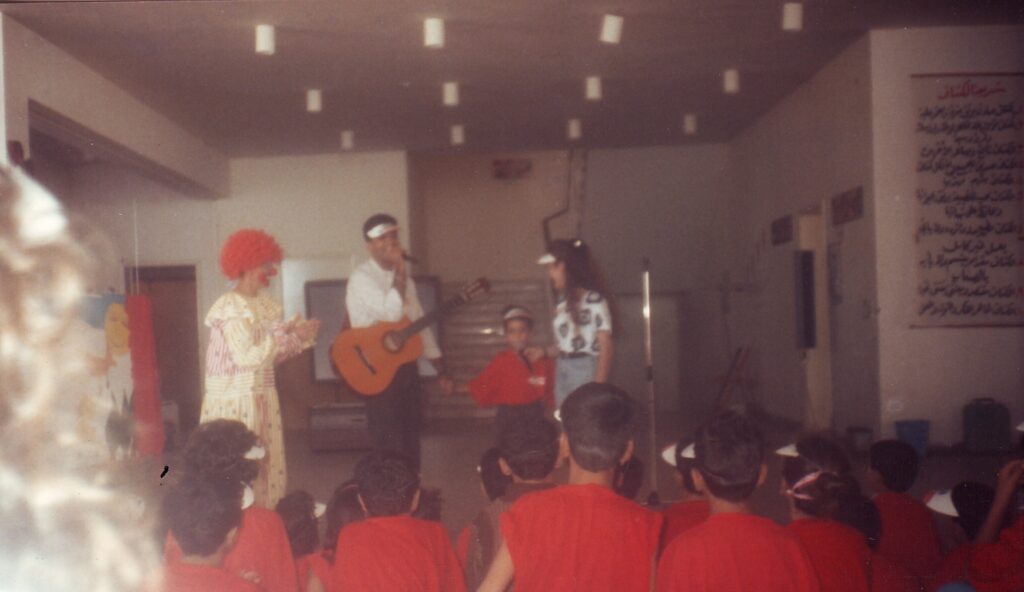
The continuous activity of the organization’s children’s program in the 1980s, in the South and Beirut, worked on by colleagues Izzat Ezzeddine and Hanan Qaddouh, revealed urgent needs among children with disabilities for entertainment and integration into non-curricular summer activities. Most of them were outside regular schools, and another group lived in care institutions. The organization’s administration decided to create a children’s camp aimed at integrating them into a diverse community. Around sixty children participated, half of them with physical disabilities. The camp’s slogan was “Promise.” The camp, which included many recreational activities, simplified training, and interaction with the children and their needs, was managed by colleagues Hussein Jaber, Ali Al-Saghir, Mona Nasr Eddine, Wissam Rahal, Ghareeb Al-Lahib, and Naji Al-Boustani. The camp program included developmental games that strengthened the spirit of community, simple expressive handicrafts, sports courses, and concluded with a large celebration.
Publications That Traced the Path
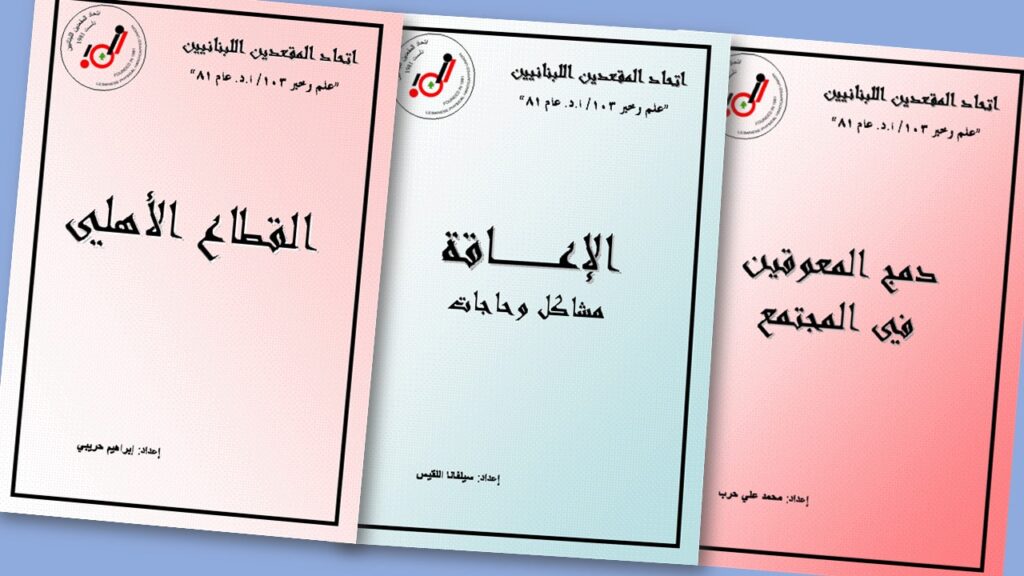
During the “Hand in Hand” campaign in 1989 and 1999, members submitted papers outlining the reality of people with disabilities and laying the first legal foundations for an inclusive environment in Lebanon. The law issued in 2000, bearing number 220, drew mainly from these papers.
The first paper, submitted by the late Mohammad Ali Harb, was titled “Integrating the Disabled into Society.” It covered three axes: society’s view of disability, rehabilitating the disabled person for integration, and preparing society to accept and employ them. It touched on laws, religion, education, technology, politics, philosophy, industry, engineering, health, and customs.
The second paper, by the late Ibrahim Hreibi, was titled “The Civil Sector.” It examined the reality of civil society, its role, its problems, its relationship with the public sector, and proposed ways to organize coordination among specialized organizations.
The third paper, by Sylvana Lakkis, was titled “Disability: Problems and Needs.” Drawing on eleven years of field experience, she distinguished between the needs and problems of different disabilities, including polio, war injuries, amputations, and genetic conditions. She analyzed the geography of physical disability, health services, and solutions on shared regional issues. She then proposed service programming across medical insurance, social, educational, vocational, and sports rehabilitation, ending with future planning.
Phase II: Law 220/2000 Accomplishment, Calls for Implementation (1991-2004)
After the security stability that followed the Taif Agreement, members began gathering information on disability issues in Lebanon through field surveys, in order to organize their demands and give them a scientific form as required by their ongoing advocacy campaign strategy. They collected data on the number of people with disabilities, the four types of disability, their needs, and their living conditions. Two major surveys were conducted in the Bekaa and the South. At the same time, volunteers were trained on rights through intensive courses, with summer camps playing a big role. Camp programs included workshops on rights, advocacy, union work, and legal training, comparing Lebanon’s situation with countries that already had disability legislation.
Trainees collected, organized, and analyzed information from various sources. They planned the advocacy campaign strategy by defining the problem and breaking it into demands suited to each ministry, analyzing targets within ministries, examining social factors around people with disabilities, identifying political and legal obstacles for each step, setting media goals, and planning through preparatory conferences with administrations, branch offices, and active volunteers. Then they moved to producing advocacy actions. Through specific programs, they could monitor results, identify gaps, and evaluate. Those most knowledgeable about disability issues are people with disabilities themselves. The personal knowledge of the first generation of members, who gathered scattered demands and shaped them into a cause, was the best source of information on the problem.
Internal Conferences: A Gateway to Change
After the Lebanese war ended and a new government was formed to manage the country, the organization had to shift its work from a service and relief approach to a rights-based advocacy approach, in line with its original mission. This required amendments to its internal bylaws, as well as a new structure for strategic planning and a mechanism allowing all members and cadres to participate in decision-making and planning. The structure was to be decentralized, with decisions coming from the grassroots base. Internal conferences became the entry point for change, opening the door for broader participation by everyone.
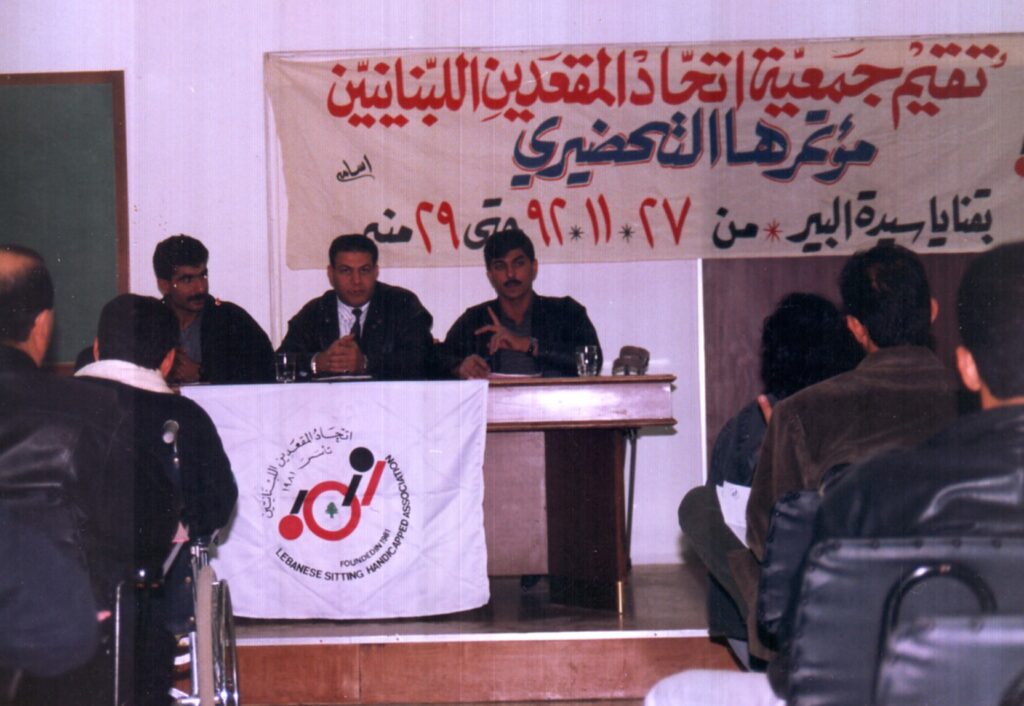
1st conference in Saydet el Bir
The first Saydet Al-Bir Conference was held in Bqanaya in November 1992, with 63 members and volunteers attending. It included a speech by the late president Ibrahim Hreibi, election of a committee, decisions and recommendations, and a final statement. The conference focused on how to approach the creation of the Ministry of Social Affairs, the organization’s future direction, internal policy on social principles, and a strategy for working with associations.
The final statement called for involving people with disabilities in the ministry’s management and committees, holding meetings with other disability associations to organize the ministry’s work, meeting with associations led by people with disabilities to organize their internal work, including people with physical disabilities in the ministry’s structure, conducting comprehensive statistics on people with disabilities, making contacts with political, economic, media, and social figures, developing the organization’s system to align with new developments, and raising slogans for the rights of people with disabilities, including equality, participation, freedom of thought and movement, a dignified life, and moving the level of engagement from humanitarian to practical.
The conference produced committees and working teams that linked all branches and allowed decisions to be made with member participation, working to implement the recommendations.
2nd Conference in Ghineh
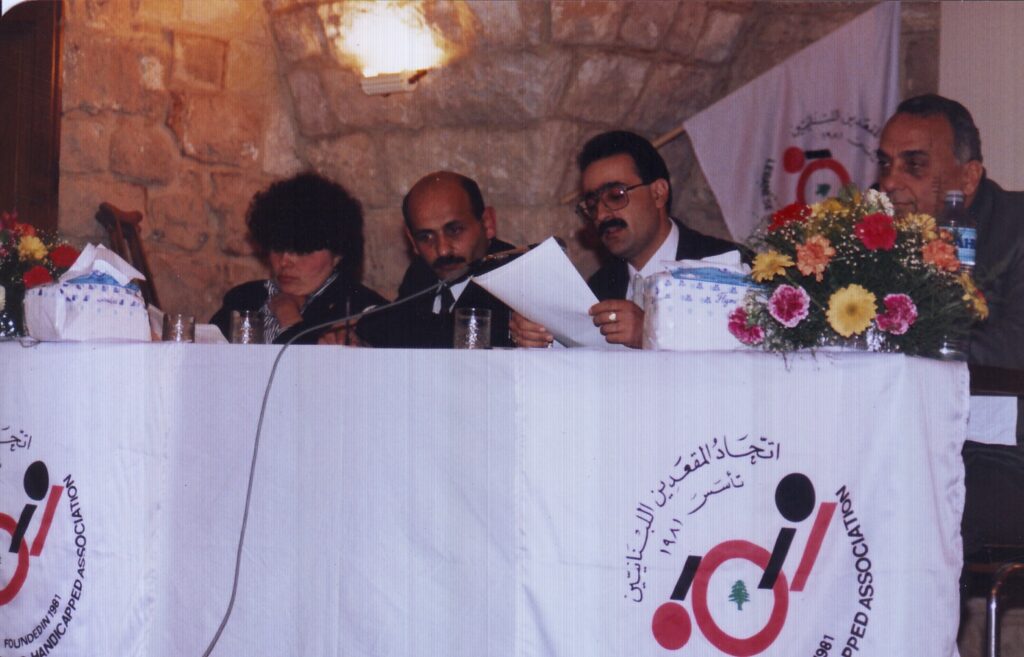
The second conference was held at the Francis Hotel in December 1993, a year after the teams and committees from the Saydet Al-Bir Conference had been working. It was necessary to evaluate the results and the structure of the teams to correct their work, raise difficulties and challenges, and develop work programs to reach labor unions, industrialists, engineers, doctors, teachers, the Ministry of Social Affairs, and parliament members, with the aim of preparing society generally for launching a draft law specific to people with disabilities.
The conference program included:
Developing the teams’ structure, how to build relationships, and developing a self-development program. Through preparatory conferences, members worked on analyzing the issue into its basic rights elements, relying on accumulated experience and available information from primary and secondary sources, and the possibility of allocating specific campaigns for each demand separately. The demands were large and needed specialization. The marginalization that had affected people with disabilities required work on several main axes: awareness, health, work and employment, inclusive environment, and political rights. They analyzed the elements of the issue to understand the size of the demands, the objective and subjective reasons for the historical marginalization of people with disabilities, those affected by marginalization including people with disabilities and families with one or more disabled members and the local community around them, the nature of obstacles preventing the removal of this historical injustice and full integration into society, the various alternatives with local civil society and international organizations to issue legislation guaranteeing the rights and dignity of people with disabilities, possible solutions and how to reach them through central planning for time-limited campaigns rich in legally qualified people trained in advocacy work, and how to choose the best possible solutions to pursue their implementation.
After 1993, the organization’s cadres were in great momentum to raise and impose demands on the state. Conferences and activities were organized to include a large number of civil society organizations through networking with non-governmental organizations and non-Lebanese organizations. The organization also joined rights organizations in their campaigns, such as the “My Municipality” campaign, and worked with some parliament members to draft a law. Communication with the media and its interaction with the rights cause played the biggest role in establishing rights, and this popular mobilization continued until the birth of Law 220 in 2000.
Among the activities and programs that took place between 1993 and 2000 were:
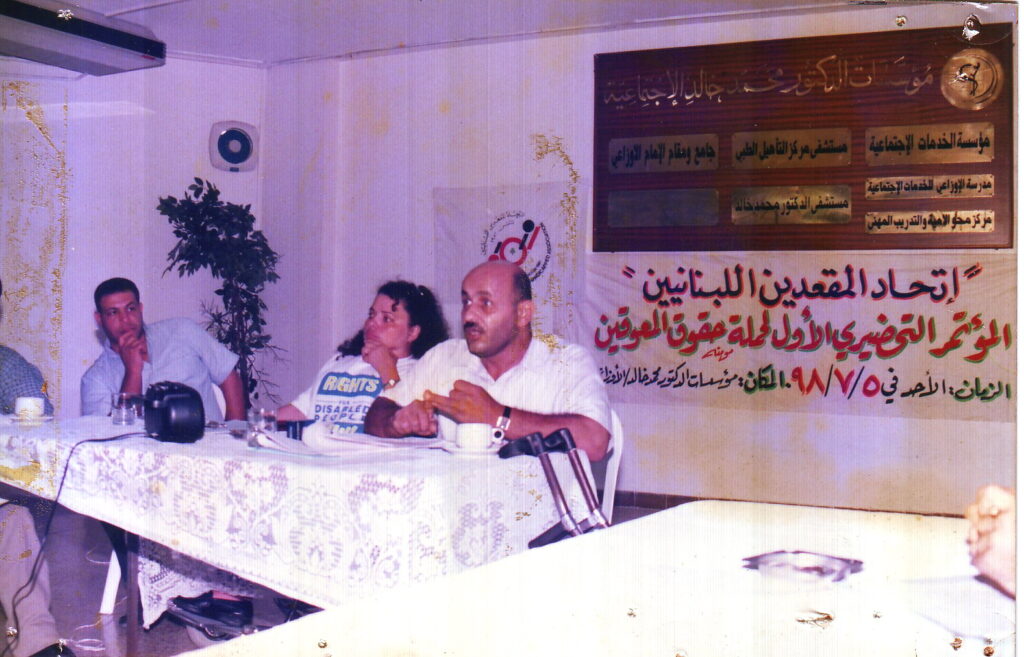
The first preparatory conference for the rights campaign at the Mohammad Khaled Foundation in 1998, the Saydet Al-Maounat Conference in Jbeil, the Saida Conference, the “My Right” campaign, the Arab Sports Festivals, and the Partnership Conference. This was accompanied by participation of rights organizations in all their advocacy activities, participation in external conferences, and various media campaigns organized and launched by members who sought to create successful models to present to the state as proof of the necessity of establishing an inclusion policy, as well as internal training courses and workshops to develop skills, leading to the proposal of a draft law.
The Correct Scientific Movement
Before starting any advocacy action, it was necessary to study the spatial and temporal reality, public opinion, and target groups. All of this required specific sources of accurate information. Observation, field surveys, sample selection, and interviews formed the primary sources that members relied on in planning advocacy campaigns. It is important to note that available information about people with disabilities, regarding the nature of their disabilities, their personal data, statistics on the type and degree of disability, and the nature of their productivity, was completely absent and unavailable from official institutions. Members had to collect this information themselves in order to build clear plans after analyzing it.
Observation
To obtain information on disability issues through direct observation, which had a significant impact on targeted stakeholders, and because gathering information through observation is more accurate than collecting data, members had worked intensively in Beirut, the South, and the Bekaa during the 1980s. They accumulated important information about disability, its nature, the local community, services provided by official institutions and civil organizations, and other matters that could be used in the planning process.
Field Surveys
Members used surveys extensively to gather information through personal interviews and door-to-door campaigns, as in Nabatieh and the Central Bekaa, as well as through interviews. With the support of sociology experts, they created questionnaires and forms. Volunteers traveled across regions and villages to fill them with documented information, then collected them for analysis. One benefit of these surveys was that they provided credible information that enabled members to outline advocacy actions, forming a practical way to obtain diverse information about the needs of people with disabilities and their future aspirations in the presence of a state that could be demanded rights from. However, the administrative body of the organization at that time was aware that one drawback of surveys was their reliance on spoken and written verbal communication, which gave useful and credible information but not very precise data.
Sampling and Interviews
The growing number of members, their friends, and those targeted in field surveys provided rich material for limited statistics on people with disabilities. This helped identify a sample to receive focused rights awareness and training, so they could spread awareness among people with disabilities and the public, and train in advocacy methods. These trainings were accompanied by televised or written interviews expressing the needs of people with disabilities and the obstacles they faced, forming a valuable source of information on disability issues and how to break down demands.
Secondary sources included books, magazines, newspapers, reports, government documents, research centers, and information banks. But information on disability in Arab libraries and press was very scarce. Members had to rely on foreign sources documenting the social movements of people with disabilities in their societies, and compare that with Lebanon’s reality after the civil war.
Analyzing Target Stakeholders
The unionists launched their work through self-education on rights, with dozens of training workshops teaching them how to draft laws, the stages of preparing drafts, how parliamentary committees work, and how to pressure parliament members as representatives of the nation. They benefited from their spread across the country, from north to south, from Beirut to the Bekaa, to work with local parliament members and spread awareness on disability issues while working to break inherited views toward disability. They also used their personal and family relationships to understand the personal traits, tendencies, attitudes, emotions, moods, and habits of those they targeted. All of this had a significant impact on decision-makers in Lebanon, sometimes greater than political orientation. Social, demographic, and regional characteristics directly influenced those they approached.
In parallel, intensive work was done on preparing organization members on rights. This started with pride in belonging to a just cause, their own cause, developing their relationships with others with and without disabilities inside and outside the organization, building self-respect, a sense of worth, competence, self-confidence, importance, status, and appreciation. The goal was a sense of self-fulfillment and control over their surroundings and destiny. This came from their deep understanding that the energies of people with disabilities were latent or dormant, and could be awakened and fully used in a society that believes in diversity. It also came from their belief in their ability to achieve their demands through fair legislation that preserves their rights and dignity.
Protests and the Law
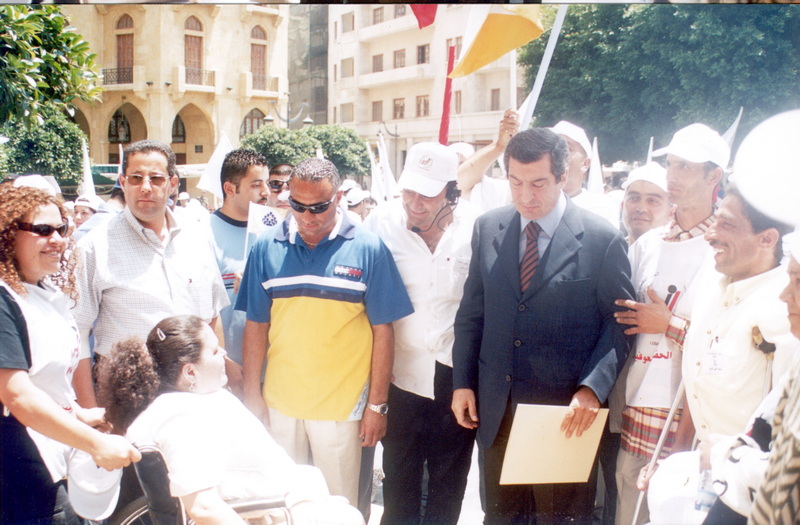
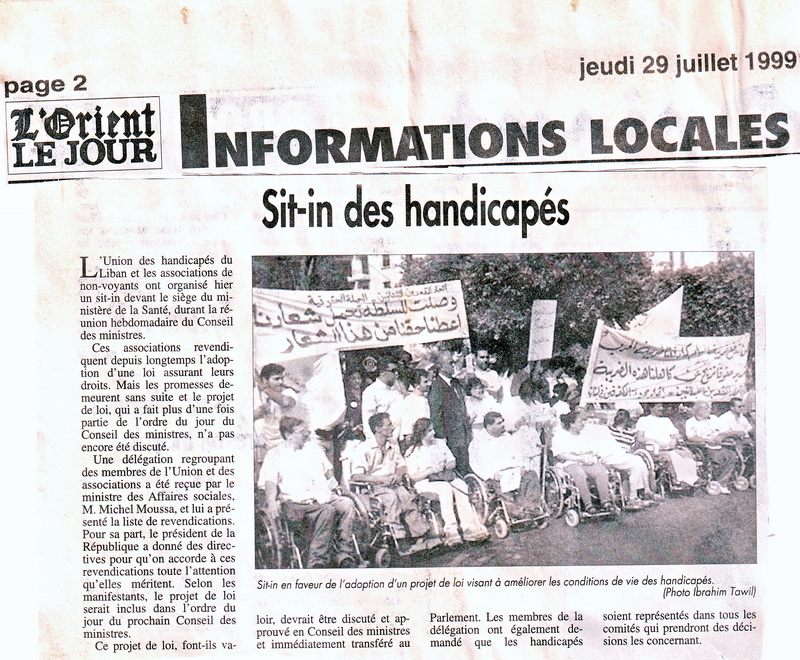
The concerted efforts since 1989 contributed to drafting the first versions of the upcoming law, followed by advocacy sit-ins to push for its approval. To give a close look at that phase, the organization’s president, colleague Sylvana Lakkis, embodied the demands in her speech on the day of the sit-in on July 29, 1999, in front of the National Museum. She said:
“Our basic rights and essential services are not slogans. They are laws to be passed and budgets to be implemented. Years passed while we waited, demanded, and presented study after study, until our patience ran out, our dignity became threatened, and it seems what awaits us is even greater.
Laws in any country are an indicator of society’s progress and refinement. The budget allocated for social welfare is also an indicator of the level of social services received by marginalized groups.
Based on this, we ask: What laws have been passed regarding people with disabilities in the Lebanese state over the past twenty years, other than the law creating the founding body for disability affairs? What rights have been granted to people with disabilities in twenty years? What services are provided at a national level for people with disabilities outside care institutions? Has a national policy for integrating people with disabilities into society been approved? The painful answer is no, nothing!
Our movement today is not to hold anyone accountable for the past, but to protest the current premeditated directions against us, and to ring the alarm bell about expected future tragedies. Why does parliament not study the laws prepared by the National Body for Disability Affairs since 1996? Why do these proposed laws still hit the wall of the Council of Ministers? What is the use of passing laws if no budget is allocated for their implementation, unless laws are passed to approve slogans?
People with disabilities, their families who are sitting in, and the organizing bodies demand from those concerned, without compromise, that all accelerated measures be taken to achieve our demands, which we define and summarize as follows:
- First: Approve the draft laws related to people with disabilities in the Council of Ministers and refer them immediately to parliament.
- Second: Approve the draft laws related to people with disabilities in parliament at the first session of its general assembly.
- Third: People with disabilities, through their bodies that truly represent them, must participate with relevant authorities in everything related to disability affairs.
We inform you that this movement comes as a result of our pressing living and service conditions, and the chronic delay in dealing with our rights and affairs. We notify those concerned that this movement is the beginning of a long process of follow-up. It will be positive if you choose, and negative if you choose.”
Thus the sit-ins continued until the law was passed in 2000 under the pressure of a similar sit-in.
Research and Media
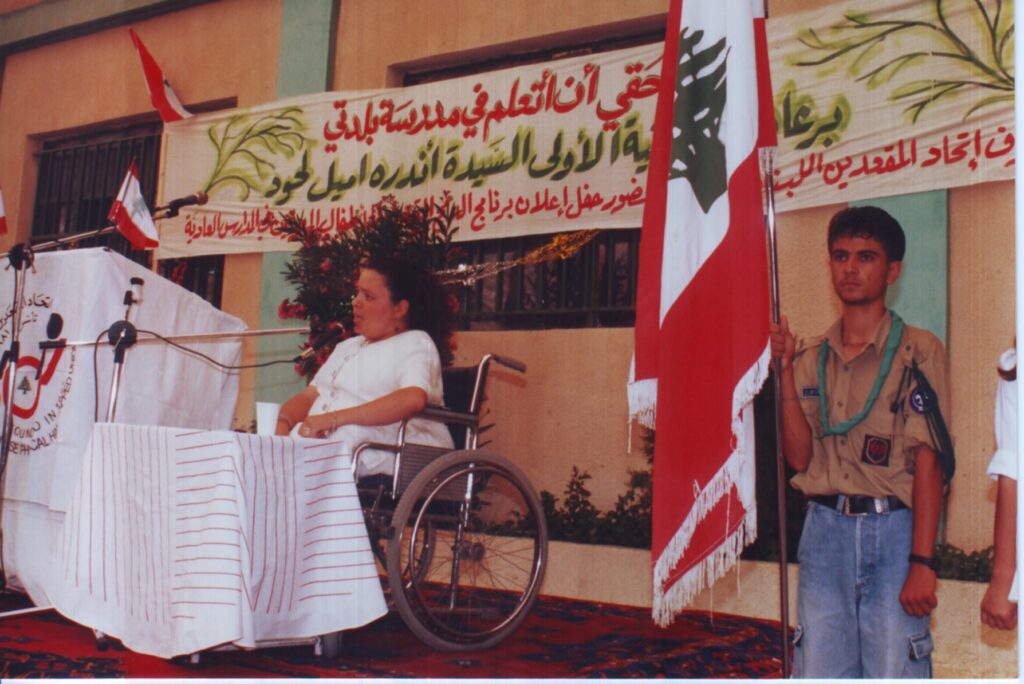
Members realized that a cause as large as theirs required removing major obstacles, and therefore needed deep research into the social factors preventing decision-makers from adopting these demands, and identifying those factors. It was necessary to understand the social characteristics of decision-makers who usually hide behind political decisions and pass the ball to others. They worked tirelessly on those targeted to assess their awareness of disability issues, the ongoing or phased campaigns, and their necessity and importance.
They also worked on involving them and seeking their opinions on possible alternatives and solutions. The attitudes of those targeted could be supportive, neutral, or opposed. Among the opponents were those with legal, moral, or religious authority to block or alter the campaign. Some opponents might also have social, economic, or political interests affected by the campaign.
On another front, the campaign could be affected by the opinions of gatekeepers who control media promotion, such as newspaper and magazine editors, directors, and radio and television managers. If these figures were not convinced of the campaign’s importance and benefit, they would stop its publication or distribution. Political, legal, or moral obstacles could significantly reduce the campaign’s effectiveness.
Therefore, from the early stages of their campaigns, members took the following into account: social acceptance of the campaign’s topic, media acceptance of its broad lines, possibilities of opposition from individuals or groups whose interests depended on maintaining the status quo, legal and political problems, and other possibilities of opposition. They also worked on defining the media goals of the campaign accompanying the advocacy effort.
Looking at the media campaigns the organization has run through various media outlets periodically, they appear to be of a good level. The duration is sufficient, and the approach is acceptable, but there is a need for more diversity in the methods used. The best approaches are those with practical, tangible aspects for the public, such as a national campaign for an inclusive environment free of architectural barriers. There is also a need to increase the warning and deterrence element regarding the continued marginalization of people with disabilities and their rights, as in the “My Right” campaign. On the other hand, there should be more encouragement and appeal in campaigns with a desirable nature, such as reaching out to employers to highlight the importance of employing people with disabilities and the benefits gained if the law were applied.
Based on the organization’s policy of correcting preconceived ideas and the cultural and social heritage regarding people with disabilities, the organization gave special attention to the media. Initially, the organization cooperated with media outlets to cover activities, without a strategic work plan. When these plans began to take shape, members recognized the media’s importance through workshops they participated in or organized. They moved from covering activity news to building relationships with journalists beyond a central information unit. These media professionals helped spread a culture of inclusion in society on one hand, and address disability from the social model perspective on the other.
The Disability Cause in the Media
In the 1970s, there was no official approach toward people with disabilities in Lebanon. Visual media at that time was limited to state official media through Télé Liban and Radio Liban, along with some political newspapers and cultural magazines labeled as social. People with disabilities were marginalized with no rights at all. There were no civil organizations focused on their rights. In the late 1970s, attention to people with disabilities began in 1977 with the creation of a department for disability affairs, but that was not enough. There were no organizations of people with disabilities, only care organizations that spoke on their behalf. With the ongoing civil war, this body was not activated until the Ministry of Social Affairs was established in 1993.
In the face of that official reality, people with disabilities were invisible to society, marginalized to the furthest extent. The organization’s launch came as an organization of people with disabilities expressing their hopes and demanding their rights. This gave those directly concerned an effective voice to define everything relevant to them, enabling people with disabilities to express their needs and demand their rights, and thus reach their goals, embodying full integration into society.
People with Disabilities and the Street
One of the first moves toward breaking the stereotypical image attached to people with disabilities was their own presence in the street. The organization has many experiences in this regard. People with disabilities appearing in public spaces together, under the barrage of mockery they faced in the 1980s, and under the prevailing assumption that a disabled person simply going out meant they were out to beg for money.
That was enough, in the organization’s early days since 1980, to bring media professionals into contact with them and get used to their regular meetings, which were held weekly in one of the busiest places in Beirut, on the Manara Corniche every Saturday and Sunday.
The activities grew beyond the weekly meeting to recreational trips and “open day” gatherings outdoors, which made everyone who saw and interacted with the members in these activities feel that people with disabilities are people like any others, with the right, at the very least, to be present in all places.
People with Disabilities in the Media
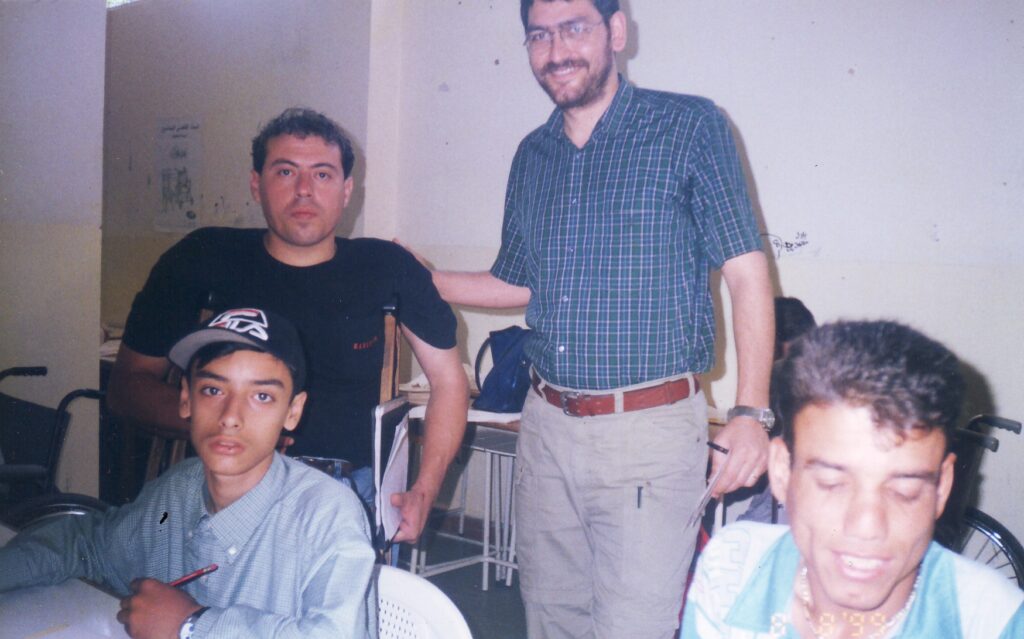
The media focused on the nature of disability and on some major movements led by civil society organizations during the civil war, including the peace march to the crossings between warring factions in 1985, the grand peace march in 1987, and the Marriage and Disability seminar in early 1988. These activities are considered among the most important developments regarding disability in that period.
But apart from these activities, the media focused on marginal issues in its treatment of people with disabilities. It did not approach them from a societal rights-based perspective as human beings enjoying full rights guaranteed by international charters, but rather as medical cases to be handled with pity and care.
The Union’s Movement Towards Media
The organization’s approach to local media was scattered at the beginning. It invited journalists to cover some activities and programs, and communication happened through the institutions they belonged to. But the organization’s core goal, making the media an active partner in the advocacy campaign for the rights of people with disabilities and their right to a dignified life under the umbrella of human rights, was not properly activated until the media unit was established.
Before that unit was founded in 1992, members from the Bekaa branch had a radio experience. They ran “Radio Sky,” which broadcast on FM in the Bekaa Valley. The experiment lasted ten months and involved colleagues Fayez Akasha, Ali Badra, Rasmiya Al-Hindi, Nada Al-Jarrah, Hind Harb, Fatima Nasser, and others. During this period, members gained experience in networking with media outlets and used the opportunity to bring their voice to listeners from the region and other distant areas across the valley.
In the same year, through a seminar that was the first of its kind in Lebanon on media and disability, the organization highlighted the disability cause, inviting active institutions from both civil and governmental sectors. The seminar received wide media coverage, with the Minister of Information attending. Through this seminar, members sought to convey the concept of “person with disability” according to the organization’s vision, and the concept of social inclusion for people with disabilities.
Establishing a Media Unit
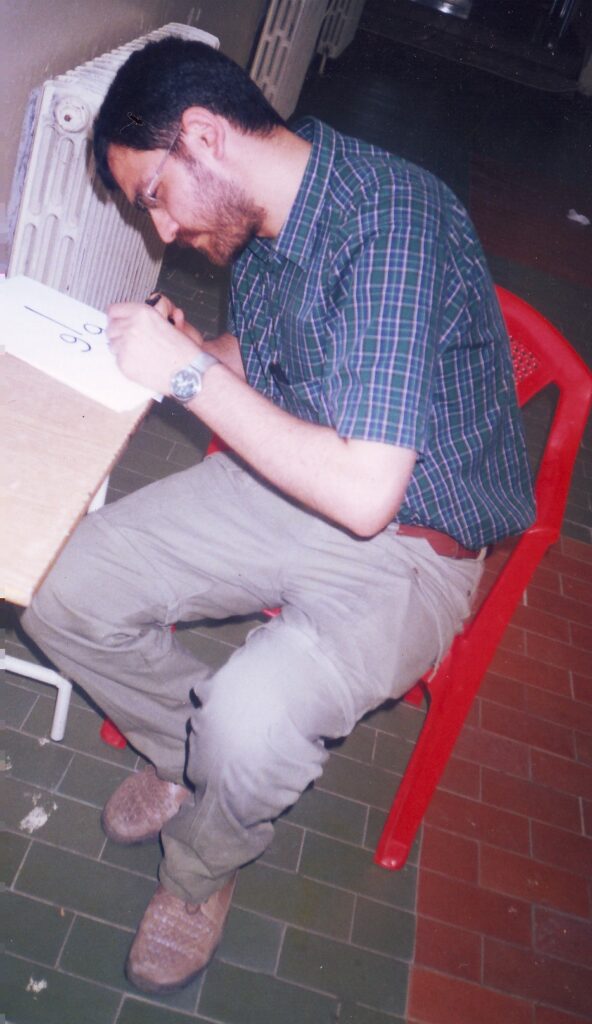
The organization participates in all activities related to civil society in Lebanon. Its network of media professionals involved in these activities keeps growing. It also joins other organizations in joint activities and often takes on the task of communicating with media professionals, as it is the most experienced and prepared for this role. This became possible thanks to the establishment of its media unit in 2001, after a large number of workshops that accompanied long organizational activities in summer camps, which included training courses in the media field.
The media unit worked through a clearly framed program to build a cohesive network with journalists working in Lebanon, based on direct and personal relationships, regardless of the media outlet they belonged to. It also built relationships with media advisors in ministries, using these contacts to spread the culture of inclusion adopted by the organization and leveraging them as a gateway to reach centers of political decision-making.
Print Publications
The organization has issued a number of publications. Some are periodic, such as “Waw Magazine” and “Diversity in the Workplace Guide.” Others are non-periodic, including studies, conference and seminar reports, training guides, and publications accompanying advocacy campaigns.
Among the periodic publications was WAW Magazine, whose first issue, issue zero, was published in June 1999. It served as the organization’s voice to promote the policy of inclusion in Lebanon, replacing the isolation policy in place, by pushing for fair legislation for people with disabilities and expressing their hopes for a dignified life.
The magazine came into being due to several key factors: the absence of a voice advocating inclusion, the lack of a legal rights-based media outlet calling for the rights of people with disabilities based on the Universal Declaration of Human Rights, and the need to convey the organization’s message to people with disabilities themselves, then to those around them, and to society as a whole. The magazine is published quarterly and covers various topics typical of community journalism, advocating for the rights of people with disabilities.
Another publication is “Diversity in the Workplace.” Work on this guide began in 2004, driven by successive governments’ failure to implement the law’s provisions on the right of people with disabilities to engage in all work fields they are able to practice. The first issue was published in May 2005, following the accumulation of expertise from an integrated team of media professionals, social specialists, and occupational therapists, as well as coordination with “An-Nahar” newspaper, one of Lebanon’s largest, for distribution.
Development, Training, Cooperation and Partnerships
The organization distributed its publications and materials free of charge, in an organized manner across the capital and regional centers. Distribution lists included ministries, parliament members, politicians, civil society figures, civil organizations, political parties, media outlets and journalists, organization members, supporters, and individuals. The organization relied on experienced journalists for supervision, editing, and consultation across all its publications. Many committed to volunteer work with the organization and continue to do so, reflecting the high credibility in the relationship between seasoned journalists and the organization, given that experienced journalists adhere to global standards and their full commitment to the public’s right to know.
The importance of working toward establishing specialized journalism on disability lay in following the first steps of media students, especially since specialized journalism curricula taught in these faculties might not include a single word about disability. The organization worked to attract media students to raise their awareness on all levels regarding disability issues and develop their ability to write in disability-specialized journalism that adopts the policy of full inclusion in society. Meanwhile, the number of volunteers from media students and journalists in the organization grew, and through their volunteering, they became familiar with the policy of full inclusion and addressed this issue in their writings and interviews.
The organization also launched courses titled “Toward a Waw Team” to empower a group of young people with disabilities in journalistic writing. Friends of organization members without disabilities, as well as their classmates, joined the working group. The group worked to gain as much experience as possible through intensive courses on writing and editing specific journalistic pieces. The organization also included hundreds of members with physical disabilities, along with groups of family and friends. It has significant youth capabilities and diverse expertise that it works to invest in its ongoing awareness media campaign toward an inclusive society.
The organization’s periodic and non-periodic publications and studies generally relied on supportive organizational groups across all regions. The organization relied on them for gathering information, documentation, monitoring, communications, interviews, and editing.
In parallel, the organization used electronic correspondence since the spread of the internet in Lebanon and the Arab world. It then established its own website in 2002. The site became a link between organization members and supporters of the disability cause in Lebanon, allowing them to stay informed of the organization’s latest news and activities, while also introducing the organization’s goals, directions, and projects, and documenting activities aimed at strengthening the policy of inclusion in Lebanon.
During the organization’s major activities and those of its partners, it worked on an advertising protocol with one of the largest advertising design companies to design, print, and distribute various billboards. The company provided the printing and installation value of these boards, reflecting the accumulated personal knowledge and credibility the organization enjoys in Lebanon. On television and radio, some stations offered their technical services to the organization. It also worked on a protocol with the Municipality of Beirut to hang the organization’s boards on roads during the second film festival in 2004, in which the organization was a major partner.
In cooperation with partners in the “Inclusion Network,” the organization launched “Our Voice,” a media program directed at youth directly, starting in early 2003. It was based on the belief in youth participation and their right to expression, and in the abilities of people with disabilities to practice and learn everything related to media. A group of young people with physical, hearing, visual, and intellectual disabilities (including Down syndrome and autism) gathered. The project began with twenty-five young people of various ages, from ten to twenty years old, with different disabilities, along with university and school students without disabilities. This group received intensive training for six months in dealing with all means of filmmaking, and produced two documentary films without relying on outside expertise. The project then moved to its second phase, seeking to open the first media room specialized in disability in Lebanon.
Right-based Work – The Continuous Campaign
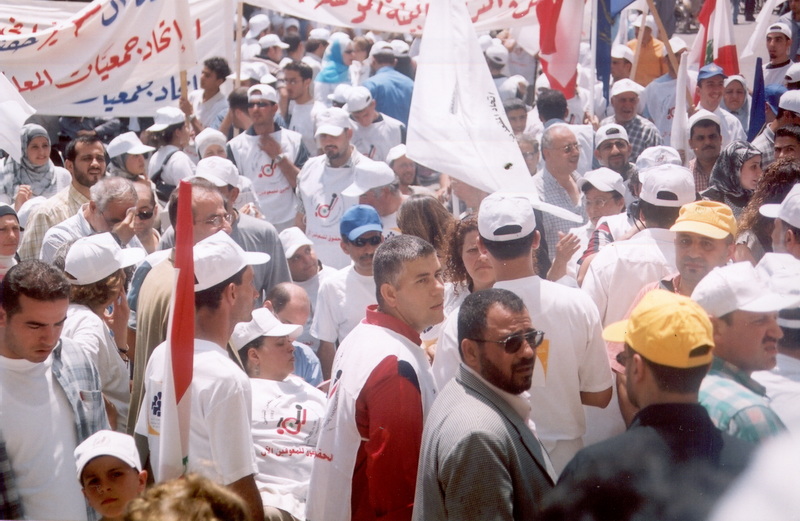
Under the title “Toward Achieving Economic and Social Inclusion and Equal Opportunity,” the organization works to demand the rights of people with disabilities, mobilize public opinion to follow their causes through various available means, and push people with disabilities toward self-reliance and independent living, seeking to achieve economic and social inclusion and equal opportunity.
When parliament approved the Rights of People with Disabilities Law No. 220 in April 2000, the rights of people with disabilities were established in education, rehabilitation, employment, medical services, sports, and transportation facilitation, and the right to participation was affirmed. Employment opportunities for people with disabilities were strengthened based on the provision “people with disabilities have the right to work,” by including Articles 73 and 74 specifically, which set a 3% quota requiring the employment of people with disabilities in both the public and private sectors.
But since the approval of this law, no plan has been announced by the government to implement it. It is not enough to pass laws without completing them with implementation mechanisms applied to all official and private departments, along with a plan and an awareness campaign promoting this law and spreading a culture of inclusion and rights.
The country also entered a phase of major economic transformations with the trend toward privatizing state institutions. These elements combined threatened the human rights of people with disabilities and added new burdens and further causes for marginalizing this group. This was reflected in the practices and positions of concerned government institutions, most notably the suspension of the tax imposed by the law on private sector companies if they did not comply with employing 3% of people with disabilities, and the deactivation of incentives that companies benefit from each time they employ people with disabilities, which the law also established. This was in addition to the public sector’s failure to reserve the percentage allocated for employing people with disabilities, which was absent from all competitions conducted by the Civil Service Board since the approval of the Rights of People with Disabilities Law No. 220.
Here, the organization had to act after achieving success in establishing the rights of people with disabilities through the approval of Law No. 220/2000. The organization launched a new phase of its rights campaign toward implementing these rights, prioritizing the right to education and the right to work and employment. Through its activities, it sought to respond to needs and face the challenges encountered by people with disabilities each time they tried to exercise their right to obtain work.
The campaign started from the understanding that the right to work is a human right recognized internationally, in covenants and the Universal Declaration of Human Rights, and in Law 220 approved in 2000. Its goal was to create a pioneering model in promoting employment opportunities for people with disabilities through an awareness and adaptation campaign that continues through advocacy activities targeting both the public and private sectors. Additionally, the partnership experience in this project was itself pioneering for Lebanon and beyond. The campaign distributed its activities across three axes:
Awareness
This section included various activities, such as organizing dialogue sessions with student bodies in different universities and with educational institutions, roundtable discussions with economic and government bodies and civil organizations, and regular grassroots meetings for families and people with disabilities. The organization also issued publications including posters, greeting cards, and a pocket calendar, all aimed at spreading a culture of inclusion and the right of people with disabilities to work.
Capacity Building
Among the most prominent activities under capacity building were organizing workshops on rights work and disability law, holding a national conference on disability and employment on September 5 and 6, 2002, at the Engineers Syndicate building, conducting a survey on the professional skills and academic abilities of people with disabilities, and launching the project “Opening Employment Opportunities for People with Disabilities in Lebanon,” accompanied by the Diversity in the Workplace guide.
Advocacy and Rights Work
Key activities under this section included documenting the experiences of individuals with disabilities in the context of implementing the law, continuing pressure on decision-makers to issue implementation decrees for Law 220/2000, and organizing local and central meetings with rights organizations, especially the Inclusion Network, to inform them of the work strategy and ensure their support. The organization also carried out field campaigns across all Lebanese regions, distributing leaflets and collecting signatures to mobilize support for implementing Law 220/2000.
The Right to Access is the Mother of All Rights
Members felt an urgent need for engineering accessibility, as the unadapted environment was a major obstacle limiting the movement of people with disabilities and preventing many from leaving their homes. But they were at the mercy of a devastating civil war that spared no one and only increased the number of people with disabilities daily. During the war, members were unable to act within advocacy pressure frameworks. Their efforts focused on finding simple ways to ensure their daily movement so they could reach their workplaces and weekly meetings. With the end of the civil war, advocacy work began during the reconstruction period, without the organization neglecting the model adaptation of many public places, schools, and homes.
In 1990, with the guns falling silent in a dirty war, the Lebanese government had to rebuild what had been destroyed and work on updating laws. The organization began working to integrate disability into reconstruction by demanding that the Ministry of Public Works, the Ministry of Social Affairs, and the Prime Minister’s office establish engineering standards suited to the needs of people with disabilities, and by demanding inclusive laws in society. These demands met only with promises that remained ink on paper, despite contacts and meetings that continued for about three years.
The Ramp.. The Turn
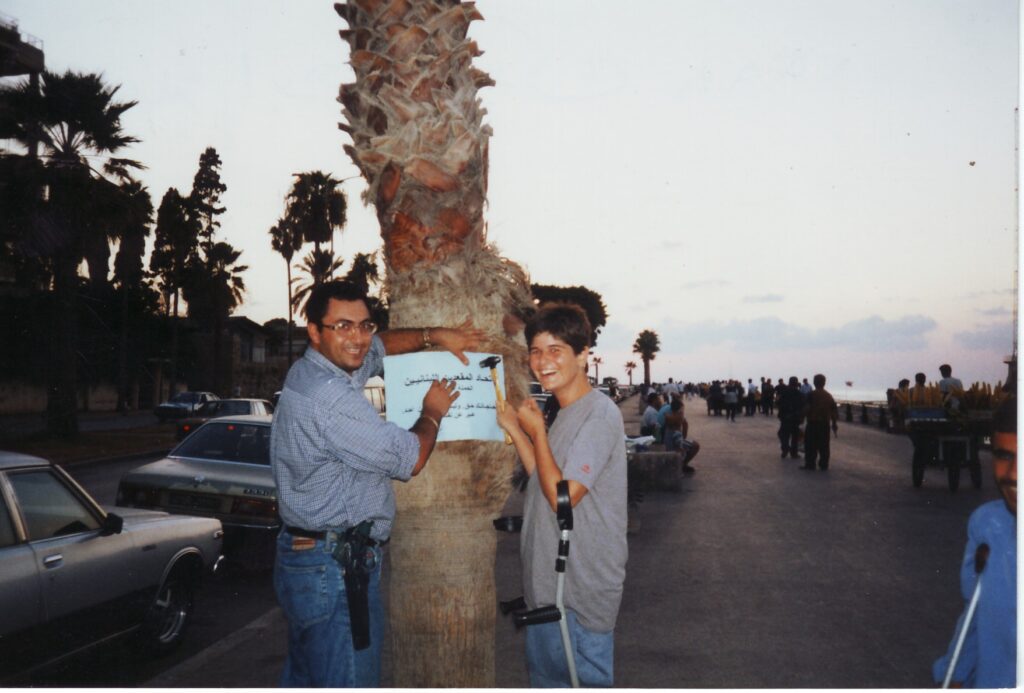
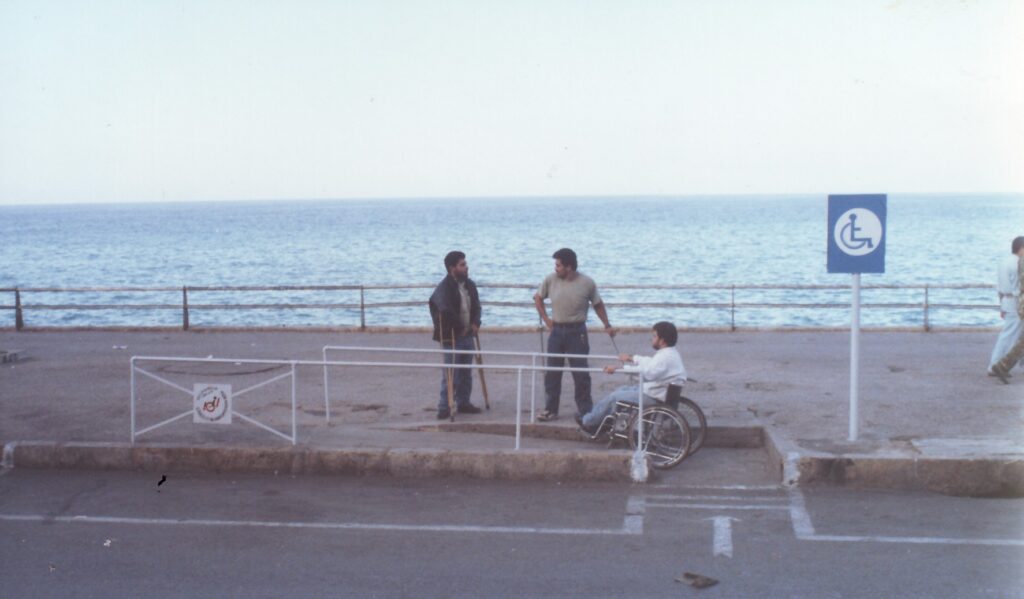
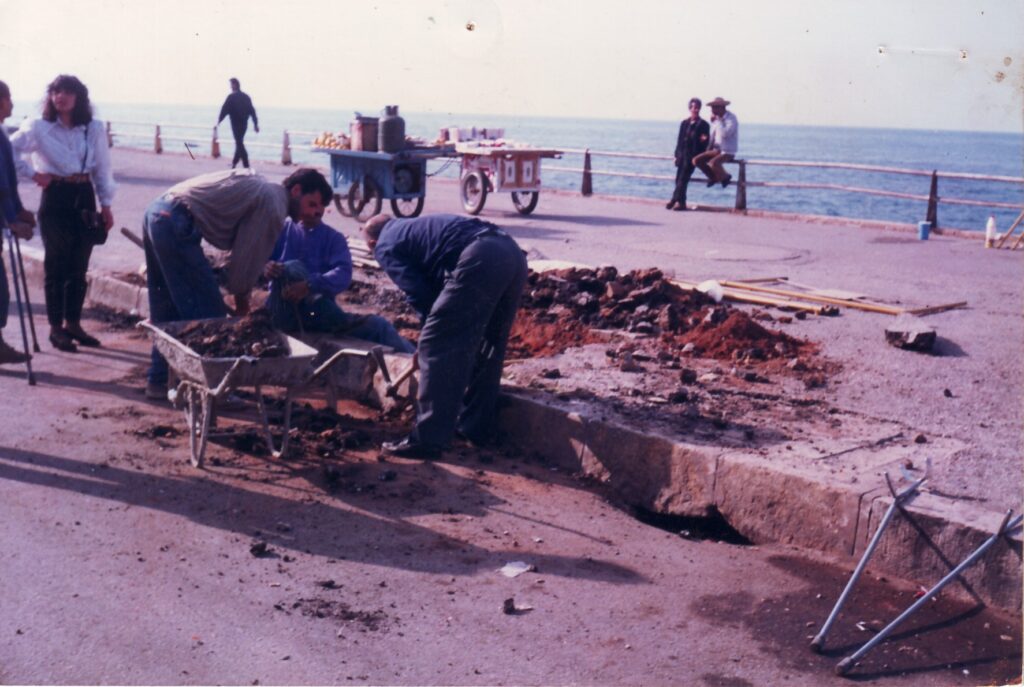
The members decided to seize one of their rights with their own hands, setting a model for the first ramp used by people with disabilities, to open the way for further crossings that would raise the pace of their demands. They took the necessary legal steps with the Municipality of Beirut and the security forces, resulting in the decision to equip the Ain Mreisseh sidewalk in 1992. This action aimed to draw attention to disability issues, as the Ain Mreisseh sidewalk was a destination for people from everywhere, practicing free morning or evening exercise and casting their daily worries onto the water’s surface.
Colleagues Adnan Oza, Abdullah Bahlaq, Hussein Jaber, Fouad Badran, Mohammad Ali Harb, Ibrahim Hreibi, Amin Ibrahim, Assad Hanoun, Hassan Bahlaq, Ali Al-Zein, and Qassem Bahlaq moved. These young men from the organization’s family decided to break the sidewalk with their own hands, without any outside assistance, to level it with the ground. This would allow their wheelchairs and crutches to cross to the other side of the sidewalk. Their joy was indescribable as they seized their right to access all places.
By four in the afternoon, the task was accomplished, and they began testing the ramp with wheelchairs, going up and down one after another, taking photographs and celebrating their “great victory.” Without warning, a military officer in civilian clothes arrived, stopped his car in front of the ramp, and spoiled their joy. The young men politely asked him to move the car after showing him the license papers stating that parking was prohibited in front of the ramp. The officer did not stay calm. He brutally attacked them, beating them until blood splattered everywhere, along with the glasses of colleague Abdullah Bahlaq, which flew into the air as he was beaten. Another officer arrived and took the young men to the Hbeish police station, where they were detained for nine hours under interrogation despite their bleeding and their need for medical care. Nine hours passed between one investigator and another until the station chief, who had been aware of the young men’s mission since he had given them the license, arrived, apologized, and released them.
The next morning, despite the events the members had gone through, the official opening of the ramp took place under the patronage of the Minister of Public Works, Sobhi Fakhoury, with a large media presence and the attendance of former minister Bachara Merhej.
After that opening, the government equipped twelve ramps matching the specifications of “the blood-stained ramp of the organization’s members” along the same sidewalk. That ramp became a turning point toward the beginning of change.
Construction… Not For All
The government continued its reconstruction process while ignoring the engineering standards for people with disabilities, despite continuous communication between the organization and official and syndicate bodies concerned with the issue. Everything remained as it was. People with additional needs had to pay the war’s bill with their bodies, whose movement was prevented by shells, and they also had to pay the peace’s bill by being denied integration into society due to “irresponsible” political decisions.
Reconstruction had reached the Sports City, so the members decided to stop a crime being committed against about 10% of the Lebanese people, preventing them from accessing all official and unofficial places since these were not engineered to receive them. The choice of the Sports City was appropriate for protesting the policies that hindered their integration and their effective participation in building society.
The year 1993 was a time of suppressing freedoms and freedom of expression, and banning any form of popular gathering. The members decided to break this suppression, challenge the political decision, and take to the street to gather in front of the Sports City and block the road with wheelchairs and struggling bodies. About 150 people blocked the road and distributed leaflets demanding the right to a dignified life protected by laws. This gathering did not escape the attack of security forces and agencies. Security men pounced on the organization’s president, the late militant Mohammad Ali Harb, trying to throw him into one of their military vehicles in an inhumane way, indifferent to his body resting on crutches, then started pushing people to the ground.
The image remains in the minds of everyone who participated in the sit-in. It was strange and unique to see bodies unable to move lying flat on the ground, staying in place alongside wheelchairs that blocked the path of military vehicles, preventing the arrest of any individual from the solidary group. Angry and rightful voices rose, refusing to leave the place until the Minister of Interior arrived to hear all the demands for an equipped environment respecting the needs of this marginalized group, and handing him a paper with rightful demands based on the Human Rights Charter. Their paper at that time addressed how to equip public places to be accessible to everyone.
The security forces complied with the demands and could not stop any of the protesters, who amazed passersby unaccustomed to seeing people with additional needs sitting in the street. A large crowd gathered in sympathy with them. The sit-in continued until the Minister of Interior’s representative arrived, received the document from the protesters, spoke with them at length, and promised to address the rightful problems in the “near future.” This “near future” continues to swing from one minister to another, from one political decision to another, and people with additional needs remain ready to defend their rights at any possible moment.
Architectural Preparation and Trials
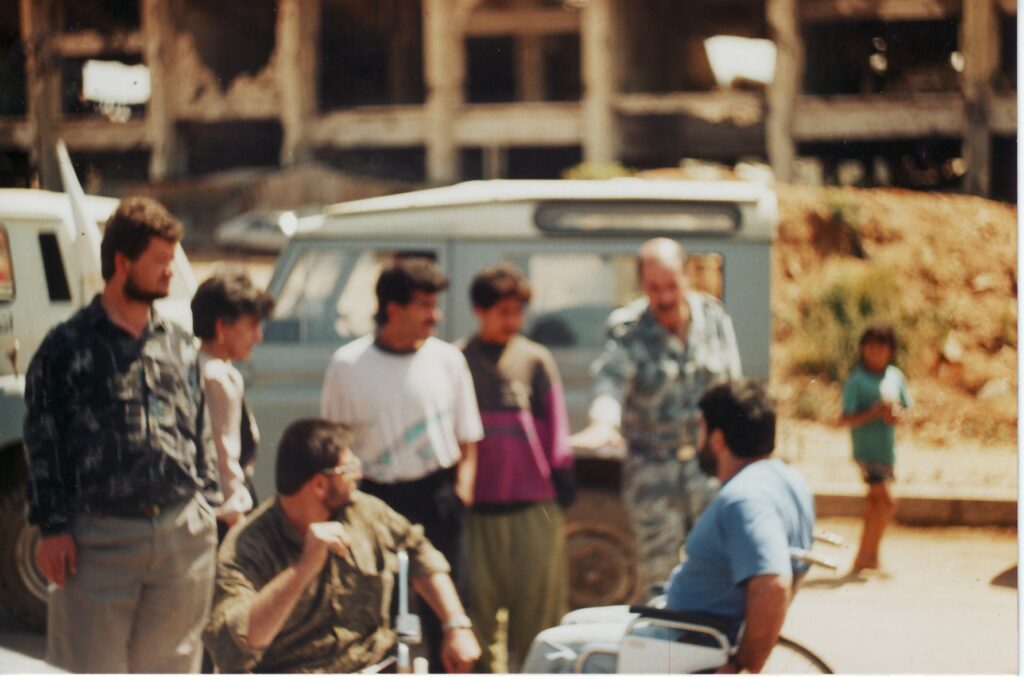
Alongside its advocacy work, the organization also pursued a policy of engineering accessibility, aiming to present models that would help establish inclusive standards for all people when laws are legislated.
It was a pioneer in equipping public spaces, including sidewalks, gardens, municipalities, schools, universities, private schools, and banks, whether through consultations or direct implementation. It also adapted private homes for people with disabilities by installing external elevators, ramps, and expanded bathroom units.
Among the places the organization supervised were the Mashghara Secondary School, in cooperation with the town’s residents for material costs and labor; the official school in Mashghara; the first primary school in Bar Elias; the official school in Arsal; and other official schools in Beirut. Also the Hadt Municipality building and ramps in its public garden, in addition to equipping venues for the organization’s own activities, such as summer camps, seminars, and meetings. In the same context, the Esterel and Beyrouth theaters were equipped at the Jesuit University’s audiovisual complex, and the organization supervised equipping the Parliament building during the second Arab Parliamentary Conference on Disability Legislation. It also provided consultation during the equipping of Solidere sidewalks, and equipped workplaces for people with disabilities in cooperation with employers, such as the Al-Akhbar newspaper.
All the organization’s offices and its engineering models workshop were also equipped, with support from international and local organizations, and supervised by a volunteer team from the organization, including engineer Bashar Abdel Samad, engineer Rami Al-Qaisi, and engineer Badria Jumaa.
Emergency: 1993 and 1996 Aggressions
1st: Why the Emergency Program?
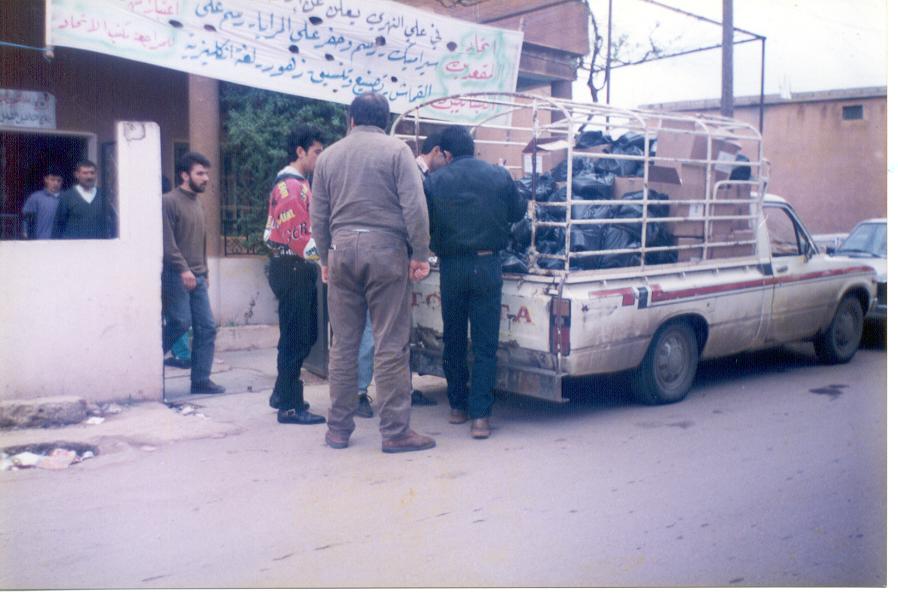
The union belongs to the family of rights-based advocacy organizations. It has struggled toward achieving equal opportunity for people with disabilities and still carries this slogan, exerting every effort toward developing individuals and society to reach full social inclusion for people with disabilities. But the wars did not leave the small nation of Lebanon to rest.
Waves of violence keep returning whenever the country tries to regain some of its strength and catch its breath. The organization’s programs adapted with each round of conflict, whether during the crisis or after it passed while its effects remained. The union was born in 1981 in the midst of a brutal civil war between the children of one nation, amid a great division that engulfed Lebanon.
If the period following the cessation of what was known as the Two Years’ War (1975-1976) allowed some moments of calm and watchfulness within the divided regions, the contact lines between fighters would not stay quiet for long before erupting again. This produced thousands of dead and tens of thousands of wounded, many of whom lived the rest of their lives with permanent disabilities, not to mention the southern front that bled daily until 1978 brought the first Israeli invasion and its horrific massacres.
This repeatedly breached calm did not last long. The 1982 invasion was among the most violent wars the Arab world had seen, and its results were equally devastating. After months of networking and organizing among civil society organizations in the fragmented Lebanese regions, divided by contact lines, barricades, and sectarian and factional barriers, and after three main goals were identified, the Grand Peace March set off from the city of Halba in the north, with hundreds of people with disabilities, including blind and wheelchair users, and more than a hundred people without disabilities from all sects and denominations. It eventually reached the southern city of Tyre after thousands joined, where a large official and popular reception celebrated its arrival.
In Lebanon’s turbulent conditions of 1987, the many organizations that participated in organizing the march, including the union, had to overcome many difficulties, foremost among them the direct accusation that organizers would use the disability cause for political purposes. This stemmed from the historical marginalization of people with disabilities, who were usually seen as outside social participation.
Yet the march’s goals, first to show a strong will for unity among Lebanese, second to network all active organizations to organize advocacy activities, and third to work toward ending the historical marginalization of people with disabilities and seeking their inclusion in society, those goals carried by participants from north to south, topped by the slogan of peace, made the march larger than any narrow sectarian, factional, or interest-based doubt. These major activities, such as the Crossings March in 1985, the signature campaign launched by members calling for rejecting war and establishing peace, and the Peace March in 1987, received sufficient media coverage and follow-up, whether from local and international media outlets or from the union and its partners in civil society organizations.
2nd: 1993 Aggression… From the Destroyed Nabatieh Office to KfarSir
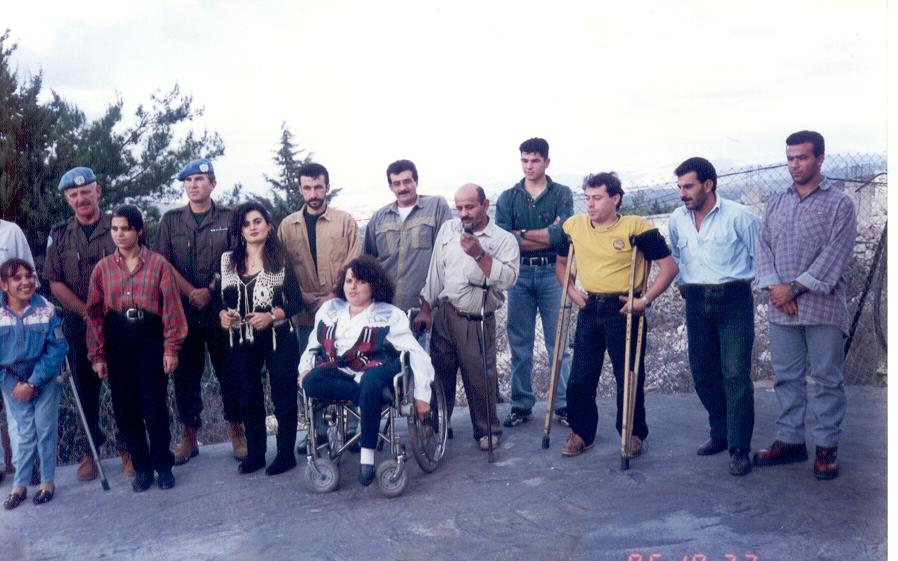
During the 1993 Israeli aggression, known as the “Seven Days’ War,” the union shifted from regular programs to emergency relief. Members, volunteers, and friends formed a large team to help displaced people, heading to Nabatieh where the union’s center was located, despite it being under rocket fire.
Many parties and organizations were distributing food and medical supplies, but they overlooked displaced people with disabilities. The union intervened differently. In addition to distributing food, sending field teams to treat wounds, providing disability-specific medical materials, and surveying damages, the union also repaired homes in Kfarsir, the hardest-hit town with many disabled residents.
Volunteers faced accidents, like Mohammad Moussa who broke his leg falling from a rooftop but kept working. In cooperation with the Democratic Youth Union and the Popular Rescue Organization (Dr. Hekmat Amin Hospital), the union helped villagers stay and resist displacement.
Villagers were amazed to see people with physical disabilities doing heavy repair work. This sparked a real partnership. Residents offered labor and donations, and women baked and cooked for the volunteers.
Work was divided into teams:
- An administrative team secured support from local and international groups like Oxfam, UNIFIL, World Vision, the Higher Relief Council, the Lebanese Army, the Popular Rescue, and friends. It supervised and managed tasks from the bombed Nabatieh center.
- A Kfarsir camp team, based at the official school, repaired homes for people with disabilities first. About 12 union members and 75 youth union members worked for 21 days, with food from the Popular Rescue Hospital.
- A field survey team filled forms designed by the union, working from Nabatieh.
- A medical home-visit team of doctors, physical therapists, and a nurse treated people with disabilities at home.
Distinguished volunteers included Mohammad Ali Harb, Sylvana Lakkis, Hassan Marwa, Fatima Marwa, Yahya Al-Lahib, Ali Al-Saghir, Mohammad Bayram, Ibrahim Hreibi, Hussein Haidar, Naji Al-Boustani, Ani Lakkis, Sonia Lakkis, Fatima Qawwas, Mohammad Ghaddar, Osama Ghaddar, Mohammad Moussa, Ali Badra, Moussa Saad, Hussein Jaber, Adnan Oza, Abdullah Bahlaq, Amin Ibrahim, Souad Sarhal, Abdel Karim Sarhan, Yasser Bayram, Khader Al-Ali, Sharif Daher, Jihad Ismail, Abdullah Kahil, and Walid Badir.
3rd: 96 Aggression: “Grapes of Love” From Saida to Ali Nahri
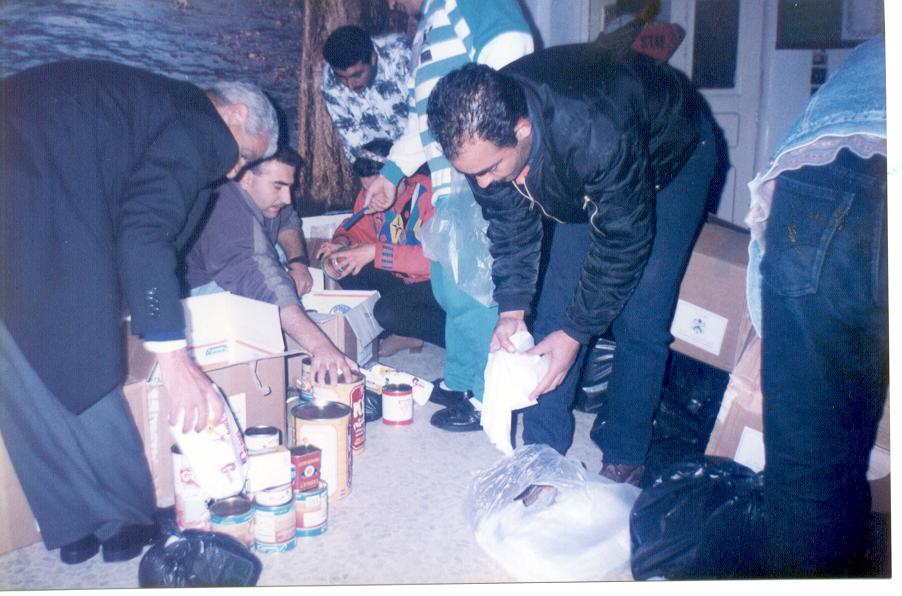
During the 1996 Israeli aggression, known as “Grapes of Wrath”, the union’s Beirut center became an operations room for receiving displaced people and sending them to designated schools. The union’s nationwide presence made it a key relief partner. The Higher Relief Council worked through the union’s program, sending food, medical supplies, household items, and bedding, which the union distributed directly to schools through regional teams.
Union teams in Jbeil, Saida, Beirut, Bar Elias, and Ali Al-Nahri in the Bekaa conducted field surveys to count displaced people with disabilities and new injuries from the aggression. The union was the only reference working primarily for people with disabilities. Another team stayed in schools to coordinate with various organizations and parties working with the displaced.
Beyond relief, the union played a monitoring and accountability role. It intervened firmly against humiliating treatment of displaced people by some party members, prevented hoarding of food rations in supply warehouses, and exposed hidden stockpiles by pressuring relief authorities, local governors, and even media.
The administrative team managed public relations with supporting bodies like Oxfam, UNIFIL, Mimosa, the Lebanese Army, the Higher Relief Council, Conserva factories in Chtoura, the Popular Rescue Organization, former minister Mohsen Dalloul, and many friends and local residents. It also coordinated with the Higher Relief Council and the Lebanese Army to evacuate people with disabilities from bombed areas to safe schools and shelters.
A medical team visited schools and shelters to treat the displaced, accompanied by a physical therapist for people with additional needs. Another team followed up with free clinics and coordinated between them and displaced committees in each school to organize health and hygiene during displacement.
Journalists followed the union’s teams everywhere, surprised to see people with disabilities helping others on such a large scale across Lebanon. Many had only seen people with disabilities waiting for help, not providing it. This media attention helped Lebanese society realize that people with disabilities are citizens like others, with rights and duties. Society’s view began to shift, and many accepted their right to choice and inclusion, recognizing they need opportunities to prove their abilities.
During “Grapes of Wrath,” the union received broad popular and official support, and all institutions and parties contributed to relief and reconstruction. The union also contributed financially, fulfilling a national and social duty instead of the state. Its work continued for a year after the aggression, during reconstruction, across Beirut, Saida, Bar Elias, Nabatieh, Mashghara, and Ali Al-Nahri.
The Popular Rescue institutions employed several people with disabilities before Law 220/2000, including Haidar Fawaz (guard), Anwar Al-Amin (pharmacy assistant), Ali Qanso (IT department), Mohammad Farran (central operator), Hashem Shukr (maintenance), Zahra Nour Eddine (laboratory), and Manar Qanso (nursing department).
Rights-based Development Camps (1991-2004)
4th Camp: Independence, Hrajel, 1992
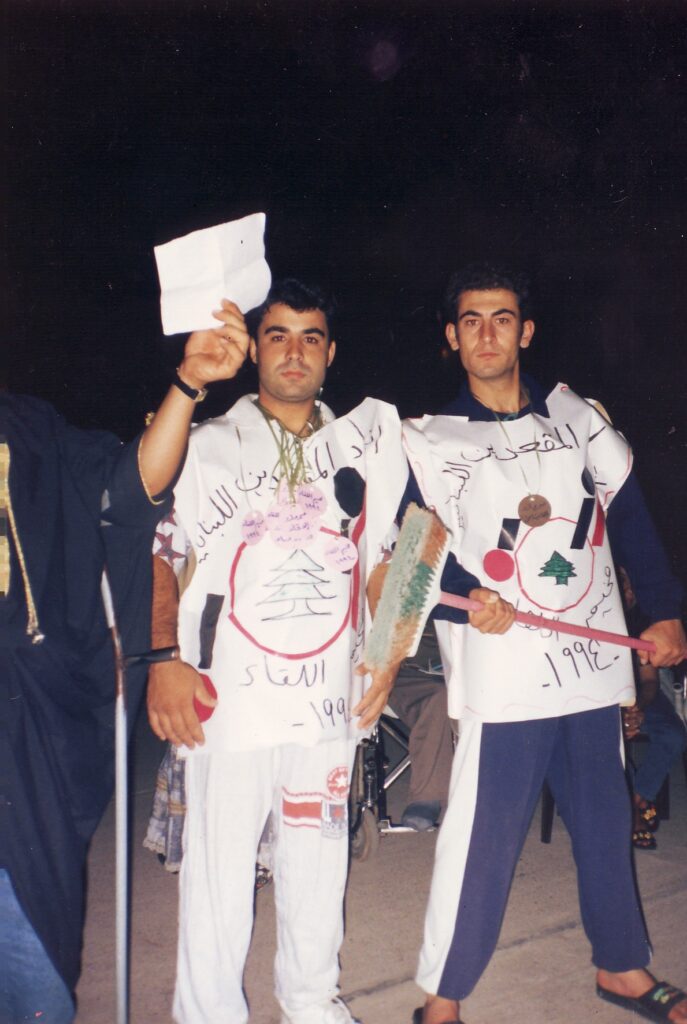
The town of Harajel in Keserwan was chosen for the union camp after a long search by the preparation team to secure a location meeting the required conditions. The team explored villages including Chabrouh, Douma, Tannourine, and Baskinta, reaching the highest mountains of Lebanon. The camp was titled “Independence.” It had a strong rights-based training character, with workshops focusing on the independence of people with disabilities and freeing their energies to rely on themselves for their needs.
A group trip took participants to Ghousta to join the Lady’s Day festival. Administrative colleague Rasmiya Al-Hindi participated in union activities for the first time, and colleagues Hassan Marwa and Fatima Qanso met, leading to their engagement shortly after the camp. At the grand closing ceremony, many residents from the town and neighboring villages joined, along with scout teams.
5th Camp: Demands-Based, Ajaltoun, 1994
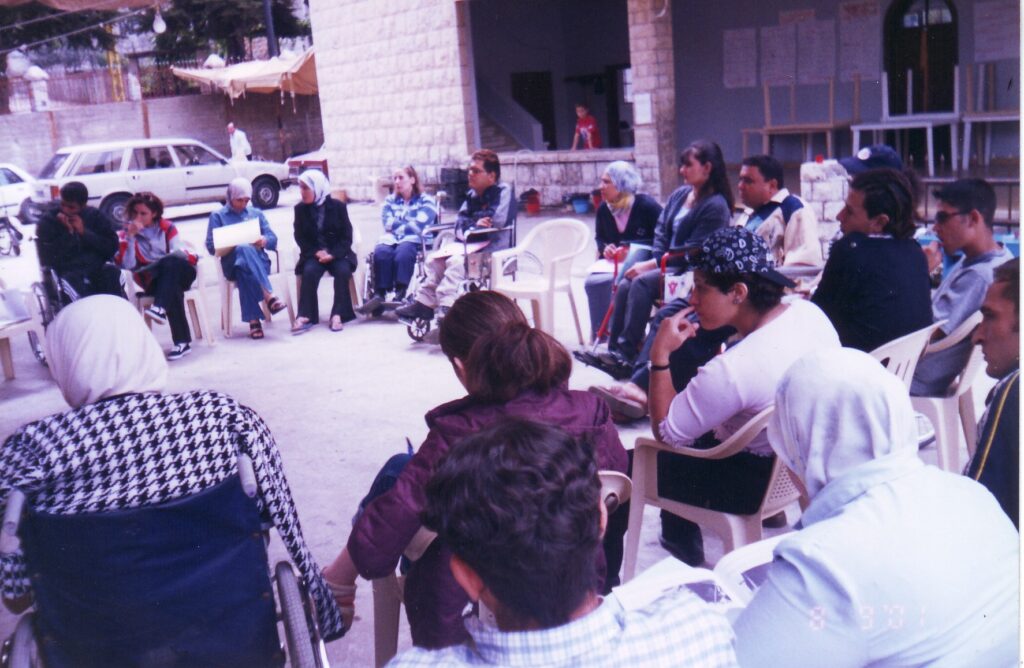
Under the title “The Advocacy Camp,” the union held its camp in the town of Ajaltoun in Keserwan, expanding invitations to include friendly organizations from Arab countries such as Yemen, Syria, and Palestine. The focus was on transferring the union’s experience in rights-based advocacy work to these organizations.
The main goal was to prepare for an advocacy campaign to establish a Lebanese law enshrining the rights of people with disabilities, as advocacy work was at its peak to secure fair legislation for a large segment of the Lebanese people. The camp included a recreational trip to the beach and training on advocacy work, including how to prepare for a protest. It also featured intensive sports training supervised by colleague Naji Al-Boustani.
6th Camp: The Challange, Khiyarah, 1995
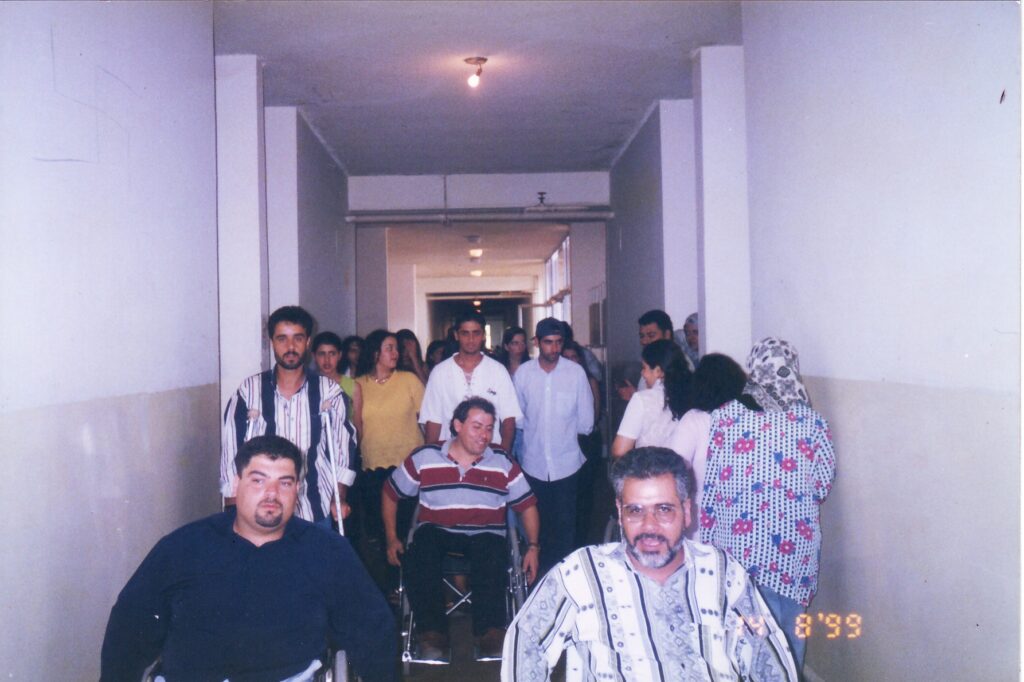
“We are the wheelchair users, we are the united / From the north, from the south, from the Bekaa we come / We have determination and resolve, we are the steadfast / And we raised the challenge as a slogan in the face of years” — this was the anthem of the “Challenge” camp, written and composed by colleague Ahmad Tlis from the Ali Al-Nahri branch, sung by eighty participants throughout the ten-day camp.
The camp was distinguished by the participation of Arab delegations from Yemen, Syria, and Palestine, alongside friendly organizations, union friends, and new members. The training program was rich with union courses in the mornings and vocational courses in the afternoons, including pottery painting, sports, theater, and handicrafts.
The camp received officials, including ministers and parliament members, daily for dialogue on the general problems facing people with disabilities, especially the absence of a law enshrining their rights. The union’s administration had prepared cadres for these meetings through three days of training before the camp. Dialogues began at five in the evening and lasted an hour or more. They were crucial for holding visitors accountable regarding their responsibilities toward people with disabilities, by presenting different examples of obstacles preventing inclusion in work, education, and health. Participants connected these problems to public policies and gave specific examples. At that time, a legal text prevented every disabled citizen from working in official departments. Officials promised to adopt the cause, delivering resonant speeches promising a bright future… but everything remained as it was.
Omar Al-Mukhtar School in the Bekaa town of Al-Khayara stood out for its green nature and spacious gardens, where participants gathered to work by day and stay up at night. The camp administration included colleagues Fayez Akasha, Ali Badra, Naji Boustani, Rasmiya Al-Hindi, and Sylvana Lakkis, assisted by group leaders.
The camp’s night gatherings were special, featuring participants talented in singing and playing various instruments, including oud, keyboard, and drums. The evenings lasted until midnight, the official bedtime, which was hated by all campers.
7th Camp: Determination, Aramoun, 1997
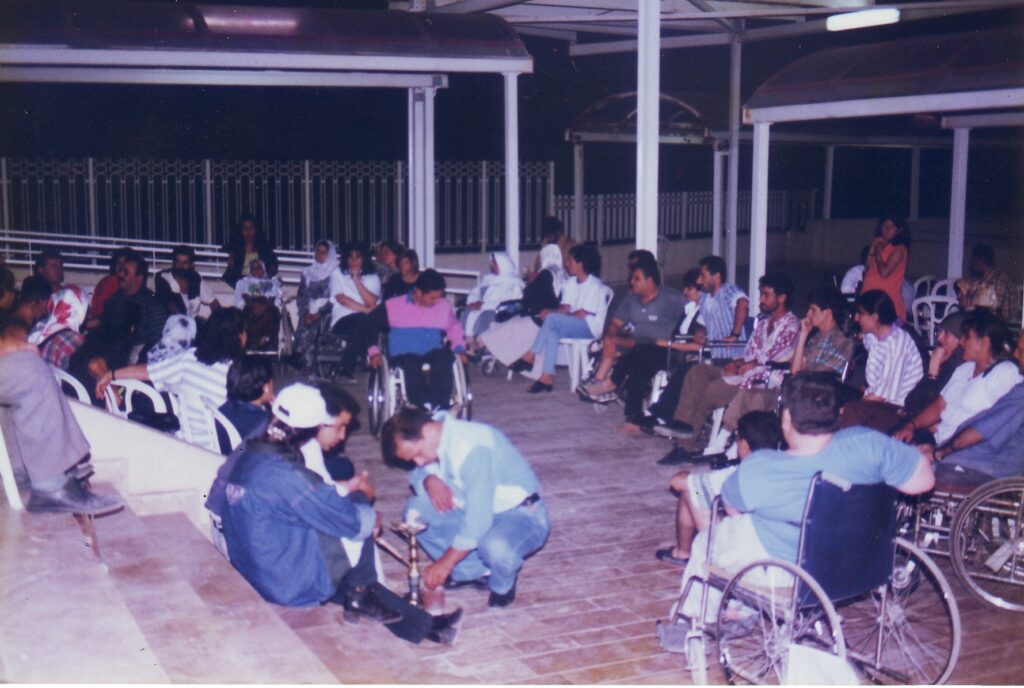
At Nazik Hariri School in Aramoun, the “Determination” camp was held in 1997. It was training-focused, with lectures before noon and workshops and seminars in the afternoon. Topics included advocacy work, rehabilitation, and administrative systems.
Many specialists lectured, including Aida Nasrallah, Paul Ashkar, Rasha Al-Salti, Dr. Hisham Baroudi, Adib Nema, Dr. Hassan Karim, Mervat Abu Khalil, Dr. Youssef Al-Khalil, Riad Issa, Ziad Majed, Ghassan Makhboub, Antoine Haddad, colleague Mohammad Ali Harb, Sylvana Lakkis, Fadi Al-Sayegh, and Ibrahim Hreibi.
Most participants were union cadres from all branches, plus Arab delegations from Yemen, Syria, and Palestine. Training ran from nine in the morning until seven in the evening. Evenings were spent in the school yard discussing program topics.
The administration included Fayez Akasha, Wissam Rahal, Jihad Ismail, Ziad Chamouri, and Ibrahim Hreibi. Facilitators included Rima Nour Eddine, Ziad Majed, Wissam Rahal, Sylvana Lakkis, and Mohammad Ali Harb.
After the camp, cadres committed to advocacy programs, pressured for a disability law, and the media team became very active with journalists.
8th Camp: Hand in Hand, Khiyarah, 1999
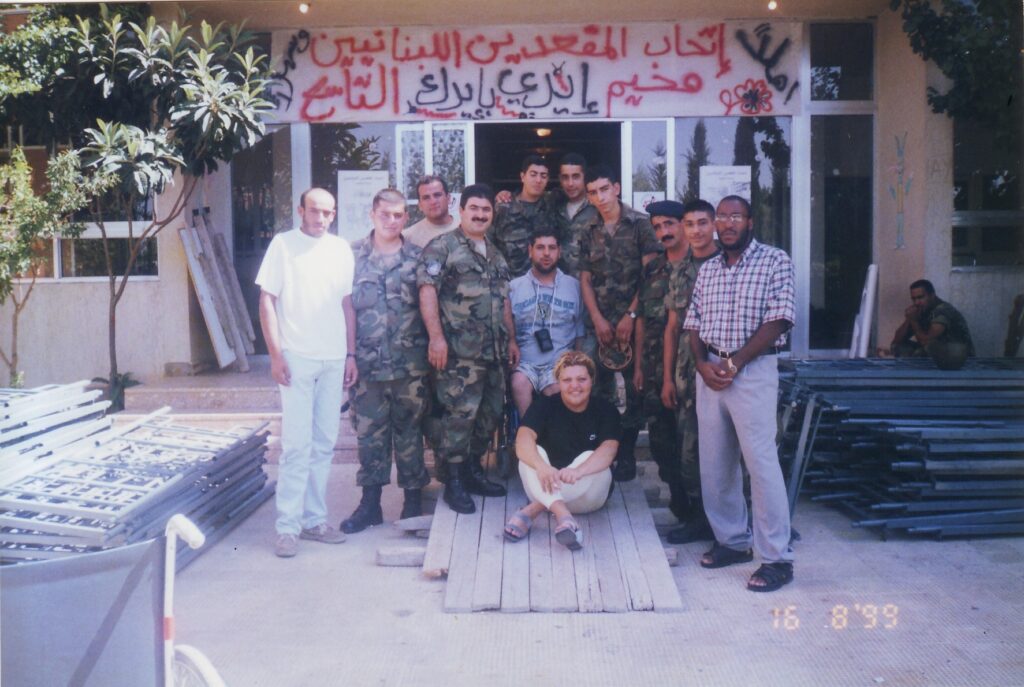
The engineering design of Omar Al-Mukhtar School suited the needs of wheelchair users, and with the growing number of Bekaa volunteers and the need for training, the union administration chose it again for another training and recreational camp. As usual, the preparation team began months ahead, led by Sylvana Lakkis, who handled the training program, secured trainers, sought funding, and created job descriptions for administrative tasks.
The camp administration included Rasmiya Al-Hindi, Sonia Lakkis, Souad Sarhal, Fadi Al-Sayegh, Jihad Ismail, and Fayez Akasha. During the camp, Law 220/2000 on the rights of people with disabilities was approved by the Council of Ministers, an event members had long worked toward. They celebrated the occasion, renewing hope for a dignified life protected by laws. Members continue working today to issue implementation decrees for the law.
The camp program focused on rights training before noon and practical vocational training after noon, including caricature drawing with artist Saad Hajjo, who discovered participants’ expressive drawing talents on their cause. Some drawings later became union publications. The program also included expressive theater addressing social problems faced by people with disabilities through short skits directed by artist Ayman Beitar with assistance from Sonia Lakkis, who covered for him during his five-day absence for a TV series shoot abroad. The theater team prepared for a very special closing night. Camp evenings also stood out for news bulletins, guest receptions, and educational games.
9th Camp: Partnership, Maaser al Chouf, 2001
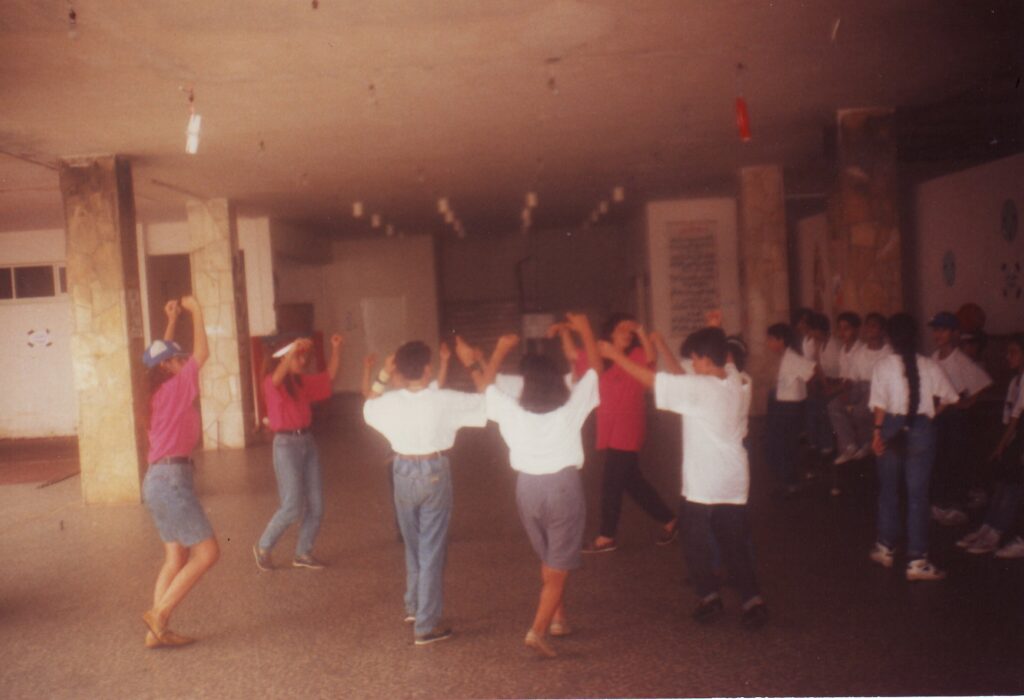
The “Partnership” camp at Deir Mar Mikhael in the Chouf stood out for its training topics, which focused on media, judicial integrity, experiences of detainees in Israeli prisons, globalization, gender, and development. Friendly organizations and social researchers joined the training. Participants included the Lebanese Red Cross, civil society members, university students, union members, and delegations from Arab countries including Morocco, Yemen, Syria, Palestine, and Egypt, which also sent trainers.
The camp administration included Jihad Ismail, Sonia Lakkis, Rasmiya Al-Hindi, Joseph Khalifa, Souad Sarhal, and Sylvana Lakkis. Each day began with diverse workshops, followed by lunch, then field work with vocational training in theater and drawing, and a rotating group preparing the evening program. Dinner was followed by lively gatherings featuring news bulletins, entertainment games, and many talents. Arab participation enriched the camp through exchange of experiences, exposure to different cultures, and building friendships.
10th Camp: Dialog, Saghbine, 2002
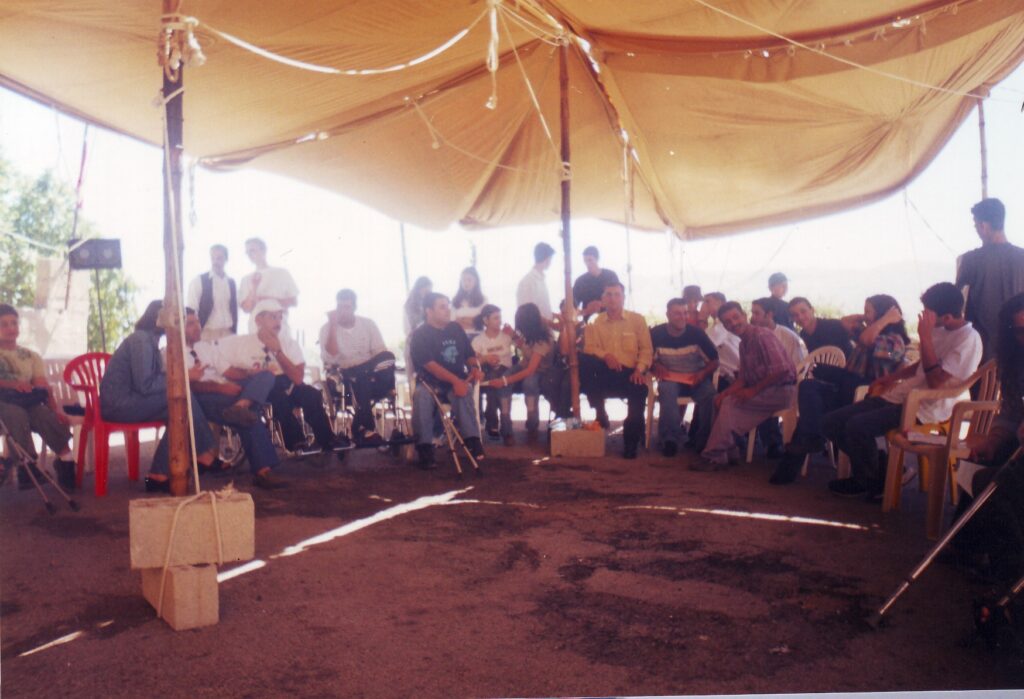
The “Dialogue” camp was held at Deir Ain Al-Jouza in the town of Sghbin, overlooking the Qaraoun Lake. It stood out for its union courses and for hosting officials from the Ministry of Labor and some parliament members, who were questioned about the implementation decrees for Law 220/2000 and how to issue them. These dialogues continued throughout the ten-day camp. Mornings were for training workshops, while afternoons were for meeting and dialoguing with officials. Participants raised general problems and pushed for practical solutions that involved officials and held them accountable.
These meetings resulted in a press conference by Deputy Parliament Speaker Elie Al-Ferzli after the camp, held specifically to urge other parliament members to adopt the disability cause as a priority in their work. Workshops covered topics including electoral law, with practical exercises, women and law, and other legal subjects. Afternoon practical exercises included a signature campaign demanding implementation of the disability law in Sghbin, Mashghara, and Ras Al-Ain.
Camp evenings were exceptional, with entertainment games, news bulletins, and dabke circles. Alongside friendly organizations and union members, Arab delegations from Morocco, Syria, and Palestine participated. Scout groups from Al-Mahdi Scouts and National Education Scouts also joined. The camp included a trip to Baalbek to visit the French Cultural Center, field tours in villages, and an evening by the Qaraoun Lake.
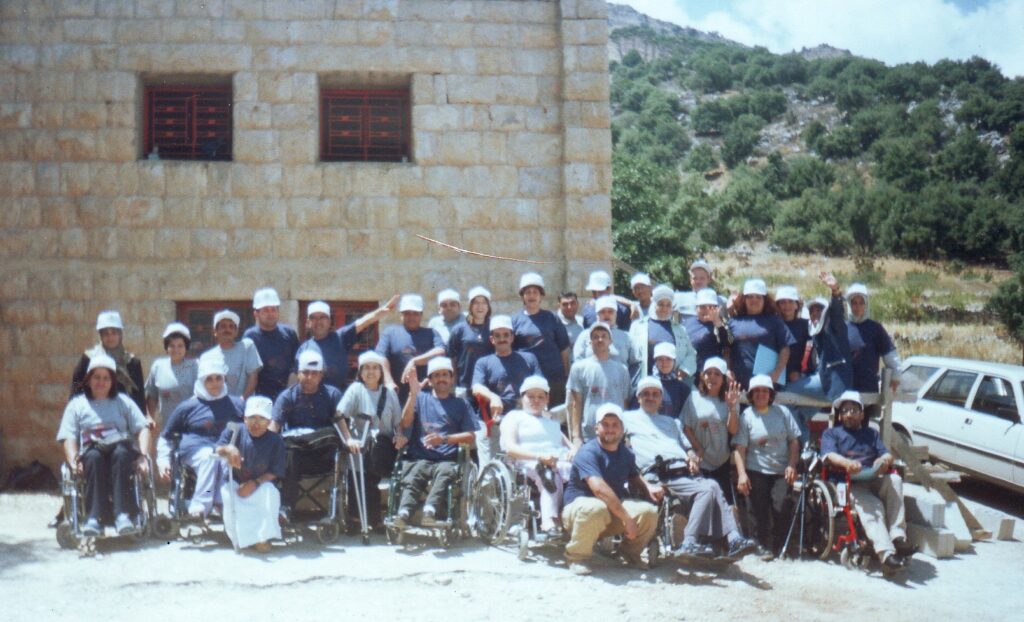
11th Camp: Youth Participation, Deir Kousha, 2003
Under the title “Youth Participation in Public Life”, two consecutive training and recreational camps were held in the town of Deir Kouche at the Village Revival School, for different age groups. The first camp lasted one week and included union youth, friends, and friendly organizations, with participants aged 18 to 23. The program featured workshops and union lectures on involving youth in decision-making before noon, followed by practical craft workshops in caricature drawing, theater, and handicrafts after noon. A media course was also held for cadres who would volunteer in the union’s media unit. About 70 participants benefited from the training, gaining administrative skills for later roles as coordinators in union offices or program managers.
Camp evenings were distinguished by the participation of members from the Youth of the Blind Association, which enriched discussions in workshops and night gatherings. The town’s residents were also remarkable hosts, bringing zaffeh groups daily to enliven the evenings with beautiful performances. The administration included Mohammad Al-Khatib, Jihad Ismail, Rasmiya Al-Hindi, Mohammad Lutfi, Amal Al-Hajjiri, Nada Al-Salman, Amal Salibi, Wissam Abdel Khalek, and Mohammad Khachroum, assisted by group coordinators Samira Fakhr Eddine, Wafaa Bliq, Hassan Haidar, Ali Zarqat, Ihab Ayoub, and Raif Allama. Daily meetings at six in the evening assessed the day’s work and addressed emerging issues.
The second camp followed the same program, but with participants aged 24 to 35, and theater training was replaced by singing lessons with artist Sami Hawat. The administration included Mariam Zarqat, Jihad Ismail, Rasmiya Al-Hindi, Sonia Lakkis, Amal Al-Hajjiri, Nada Al-Salman, Amal Salibi, Youssef Adi, Wissam Abdel Khalek, and Mohammad Khachroum, meeting at six in the evening for evaluation. The closing night featured a choir from the singing workshop led by Sami Hawat, a dabke group, a special news bulletin, and visitors welcoming campers with Lebanese zajal.
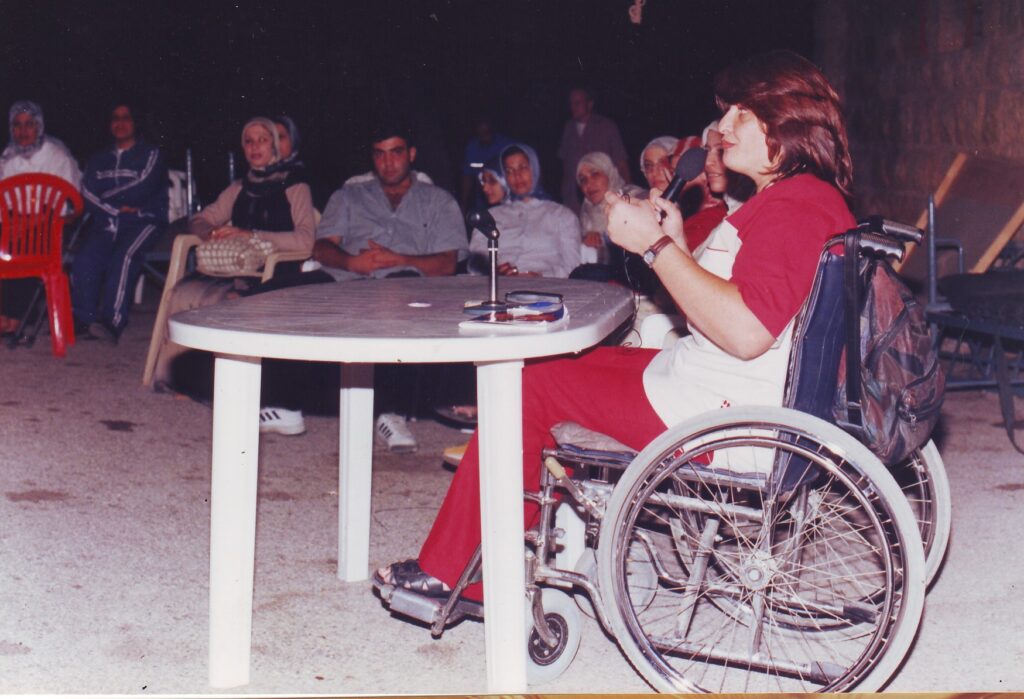
12th Camp: Participation Saghbine, 2004
The union organized, for the second time at Deir Ain Al-Jawzeh, in cooperation with the Human and Environment Development Association, three consecutive camps, followed by a fourth for its central and branch cadres.
The first camp was a three-day training for fifteen cadres, preparing them to run the children’s camp. Workshops covered how to interact with children, respect their privacy, and build communication between disabled and non-disabled children.
The second camp brought together eighty children with physical and visual disabilities alongside non-disabled children. For a week near Qaraoun Lake, they played, laughed, and had fun in groups they named themselves, such as Challenge, Anger, Butterfly, Joy, Strong Ones, First Ones, Bee, and Every Day. The children were divided into eight groups, each with a trained leader from the first camp. Mornings focused on inclusion concepts through simple stories, afternoons on applying them through drawings, plays, or songs composed collectively, and evenings on presenting their work to everyone. Children critiqued each other’s work through songs or the camp news bulletin, prepared by five standout children who gathered daily news for the evening broadcast. The closing night featured an exhibition of drawings and crafts, plays, songs, and face painting, with families and guests attending. The administration was shared between the union and the Human and Environment Development Association.
The third camp included eighty participants, with rights workshops before noon and craft workshops after. A large fire broke out in the nearby forest due to a cleaner’s negligence, nearly endangering participants. They formed a line passing water to extinguish it, and civil defense and the Lebanese Army arrived to check on them. The incident brought participants closer together.
The fourth camp brought thirty union cadres from branches and central administration for three days of specialized workshops on public policy drafting.
Strategic Plan
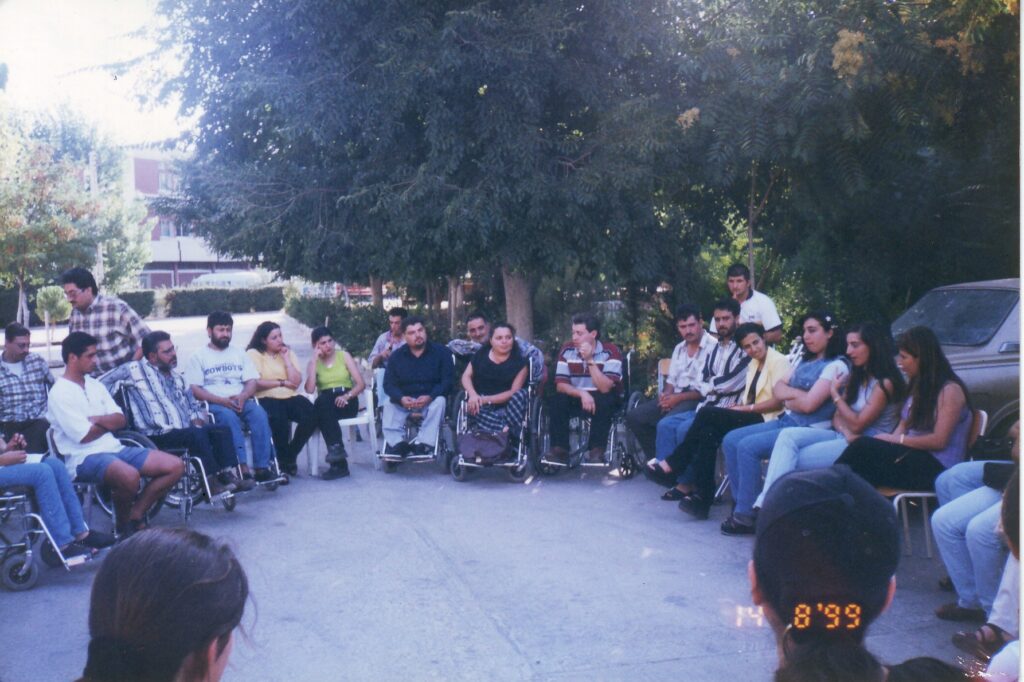
With the end of the union’s second phase (1991-2004), the issuance of Law 220/2000, and the unified advocacy sit-in organized by the union, the strategic plan for the next phase (2004-2009) was produced under the title “Strategic Plan for Rights Work of the Lebanese Union of Wheelchair Users.”
Key Lines:
- Government level: Set preconditions for inclusion in education and the labor market: equip 100 schools (56 new, 44 old), adapt curricula, reach an agreement with the Ministries of Education and Social Affairs on transitioning from care institutions to community-based services, provide statistics on people with disabilities in education and work, enforce the 3% quota tax, and secure jobs for 100 people with disabilities through the National Employment Office.
- World Bank and EU level: Allocate budgets for inclusion in education and work, and push for social security reforms that give disability proper attention.
- Private sector level: Create job opportunities, develop job descriptions for professions to be distributed to professional bodies and employers.
- Organizations level: Human rights organizations should treat disability rights as central, and work with development organizations on poverty and disability while monitoring budgets.
- General level: Conduct research and creative activities in regions alongside media to give people with disabilities space to express themselves and their dignity.
Principles:
Under the title “How Will the Union Achieve Its Goals? Work Principles?” the plan outlines how to implement the five key axes. The union will continue working according to principles that have long been the secret of its effectiveness and will adopt them in planning its rights goals for the five years ahead. These principles help the union affirm respect for the dignity of people with disabilities in daily life.
- Education-based programs: Use the union’s knowledge of marginalized groups in Lebanon to build a database for rights research.
- Quality: Work with experts in education, work, and human rights to ensure high standards.
- Participation: Build rights work on evidence-based research and wide-ranging activities like summer camps, newsletters, and film festivals that allow members to express themselves and participate.
- Solidarity: Disability problems resemble those of other marginalized groups, including isolation, discrimination, and lack of opportunity. The union works actively with other groups on disability rights and poverty.
- Human rights: Disability rights are part of human rights. The union uses human rights mechanisms, including the International Convention on the Rights of Persons with Disabilities, to link human rights and disability rights.
Phase III 2005-2022 (being written)
The union has never discriminated in its rights-based advocacy work, legal consultations, referrals, awareness services, in-kind support, or trainings. It does not distinguish on the basis of country, nationality, race, sect, region, gender, type of disability, social status, or educational level. Its projects have targeted both citizens and refugees.