The Universal Periodic Review was established when the UN General Assembly established the Human Rights Council on March 15, 2006 through resolution 60/251. This resolution mandated the Human Rights Council to “conduct a universal periodic review, based on objective and reliable information, of the fulfilment by each State of its human rights obligations in a manner that ensures universality of application and equal treatment of all States.” On June 18, 2007, one year after the first meeting of the new Council, Council members approved an institution-building package that provides a roadmap to guide the Council’s future work. One of the key elements of that package was the Universal Periodic Review (UPR).
The ultimate goal of the UPR is to improve the human rights situation in each country with significant consequences for people across the globe. The UPR is designed to strengthen, support and expand the promotion and protection of human rights on the ground. For this to happen, the UPR involves assessing states’ records on human rights and addressing human rights violations wherever they occur. The UPR also aims to provide technical assistance to States and strengthen their capacity to effectively address human rights challenges and to share best practices in the field of human rights among States and other stakeholders.
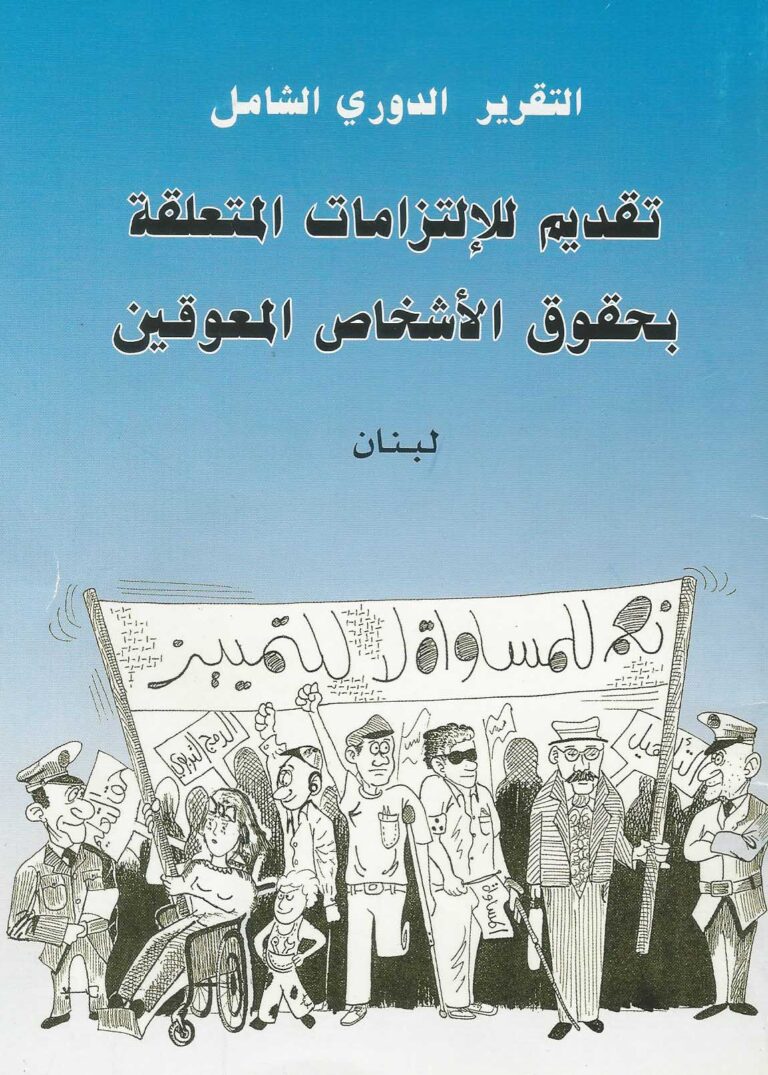
The Lebanese Federation of Persons with Motor Disabilities, along with a number of organizations of persons with disabilities, began submitting a report on the situation of persons with disabilities in Lebanon starting with the 2010 session of the Universal Periodic Review. The submission, which is submitted within the framework of a coalition of associations of persons with disabilities representing persons with motor, auditory, visual, and intellectual disabilities, focuses on the extent of the commitment of successive Lebanese governments to protect and respect the rights of persons with disabilities in employment, education, health, inclusive engineering environment, access to information, enjoyment of civil and political rights, and respect for the rights of Palestinian and Syrian refugees in Lebanon.
In practice, the Coalition of Organizations of Persons with Disabilities submitted its reports to the UN High Commissioner for Human Rights during the 2010, 2015, and 2020 sessions, as well as a mid-term report in 2013, 2018, and 2024.