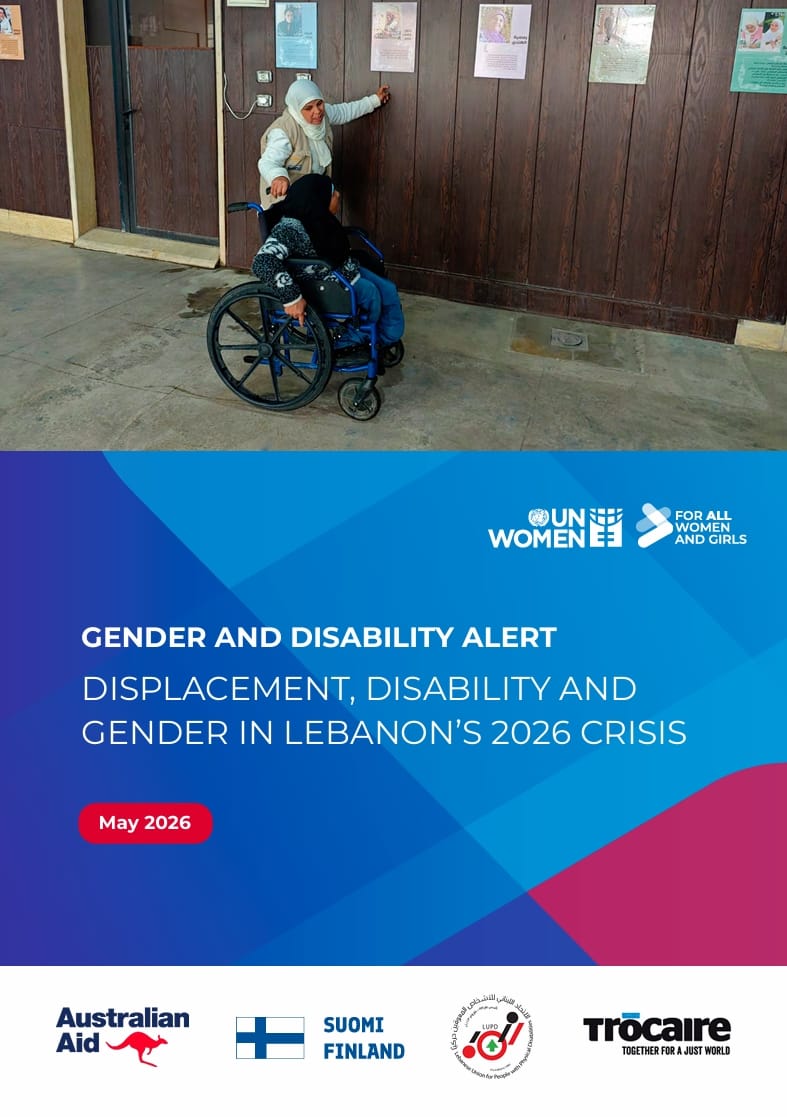
A Gender and Disability Alert entitled “Displacement, Disability and Gender in the 2026 Lebanon Crisis” was recently published. The UN Women Lebanon Country Office prepared the document in partnership with the Lebanese Union for People with Physical Disabilities and Trócaire, with financial support from the Australian Department of Foreign Affairs and Trade (DFAT) and the Ministry for Foreign Affairs of Finland.
The document comes amid the complex humanitarian crisis Lebanon has been experiencing since March 2026, when renewed hostilities led to the internal displacement of more than one million people. Around 87% of those displaced were living outside the formal shelter system, in rented accommodation, host communities, or unfinished buildings, making it extremely difficult for humanitarian assistance to reach them.
Samar Al-Tfeili, a colleague from LUPD, contributed to preparing the report. It focuses on a critical gap in the protection of persons with disabilities and highlights the disproportionate challenges they face in accessing safety, shelter, and essential services. It specifically highlights the experiences of women and girls with disabilities, who face compounded discrimination at the intersection of gender, disability, and forced displacement. This increases their exposure to violence and exploitation and limits their access to sexual and reproductive health care and protection services.
The report reveals significant gaps in data. Figures from the Ministry of Social Affairs indicate that only 28, 754 displaced people hold disability cards, a figure that reflects administrative registration rather than the actual number of displaced persons with disabilities. Applying the global disability prevalence rate of 15%, the number of displaced persons with disabilities is estimated to reach 157, 157,000, highlighting a major information gap that hinders planning for an inclusive humanitarian response.
In addition, a rapid assessment conducted by LUPD across 77 collective shelters found that only 14% were fully accessible to persons with disabilities. Significant barriers were identified in bathrooms, elevators, and sleeping arrangements, and cases were reported in which persons with disabilities were refused admission or placed in unsuitable facilities.
One of the report’s key conclusions is the need for a fundamental shift from fragmented interventions toward a comprehensive, rights- based humanitarian response grounded in the principle of “leaving no one behind.” Key recommendations include strengthening the collection of disability- and gender- disaggregated data; ensuring accessible shelter and evacuation systems; expanding flexible cash assistance that takes specific needs into account; and integrating accessibility standards across all response sectors, including health, protection, and education.
The report also emphasizes the importance of recognizing organizations of persons with disabilities as strategic partners in coordination and monitoring, and of providing them with adequate funding. These organizations play a crucial role in reaching the most marginalized groups and ensuring their meaningful participation in decisions that affect their lives.