
Inclusion Beyond Sympathy
Under this slogan that rejects confining people with disabilities to the framework of pity and works toward inclusion and integration, WAW magazine was launched in 2001, by the media unit at LUPD, to shed light on the reality of people with disabilities and carry their voice to both Lebanese and international society.
The magazine is categorized in the social journalism genre and specializes in human rights in general and people with disabilities in particular. Over two decades, it provided journalistic and documentary material about the disability rights movement in Lebanon, and through its dossiers and investigations it has covered all just social causes, because people with disabilities are an inseparable part of society and their needs should be respected and they should be integrated into it.
WAW is considered a rich and diverse source of information on the issues of people with disabilities, offering readers professional journalistic formats that are no less important than periodicals in the era of print journalism. It has also been, and still is, for activists in disability and social causes and for researchers an important reference for academic studies and scientific articles.
33 printed issues of the magazine were published.
WAW Online Magazine
Over the past few years, WAW has moved to become an online magazine, where we continue the journey of the past two decades of the print WAW, in order to promote the rights of people with disabilities in Lebanon and carry their voice to both local and international society. The online magazine is published under the supervision of LUPD director Sylvana El-Lakkis, and is edited by Imadeddine Raef. It welcomes opinions, articles, investigations, and contributions from people with and without disabilities, under the umbrella of human rights and the social model in dealing with disability issues.
Print Edition Issues
All issues from the print edition of WAW Magazine are only available in Arabic and in PDF format. As these PDFs were prepared a long time ago, they were not prepared with consideration for digital accessibility standards.
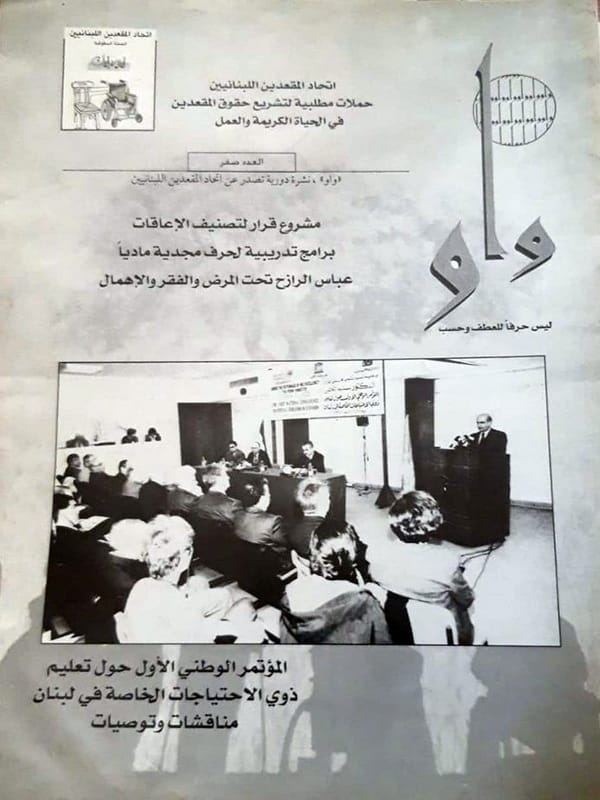
Issue 0
Issue zero came out in June 1999, after some prep work. It included an opening piece by the magazine’s editor and former LUPD president, the late colleague Mohammad Ali Harb, titled “We’ve Launched… and Continuity is What Matters Most.”
The issue covered many topics, most notably the advocacy campaigns to legislate the rights of people with disabilities to a dignified life and work, and the first national conference on educating people with special needs in Lebanon, along with other various topics. It also included a French summary translation by Suzanne Baaklini and an English summary translation by Ranwa Yahya.
Edited by Abir Jaber, with art direction by Omar Harqous.
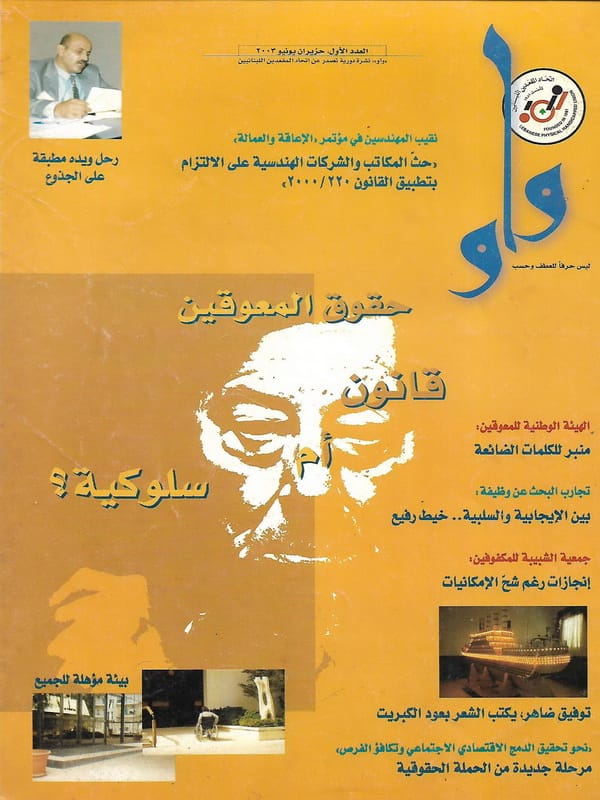
Issue 1
The first issue of Waw magazine came out in June 2003, after a long wait and preparation, four years after issue 0. It included an opening piece by former LUPD president, the late colleague Mohammad Ali Harb, titled “The National Council for the Disabled: A Platform for Lost Words.” The issue’s main dossier was dedicated to the rights campaign LUPD organized under the slogan “Towards Achieving Economic and Social Integration and Equal Opportunities.” The Institutions section featured LUPD’s partner, the “Youth Association for the Blind,” and its journey since 1987. The Conference section was dedicated to a report on the “Disability and Employment” conference, with an open call to apply the 3% quota set by Law 220/2000 for employing people with disabilities. The Activities section covered the Regional Dialogue Training Camp, a press conference on Labor Day on May 1, roundtables LUPD organized to apply Law 220/2000, and a number of related advocacy memos. The Investigation section was dedicated to the experiences of people with disabilities looking for jobs in Lebanon. The Your Guide to Accessible Places section covered Saint Joseph University and the UNESCO Palace in Beirut. The Cause section presented a mysterious illness devastating a Lebanese family, and the Craft and Profession section included a portrait of young disabled man, Tawfiq Daher, who entered the Guinness World Records. The issue also included regular sections like: Problems and Opinions, Sports, Internet, Entertainment, and ended with the Last Word.
Supervised by Hussein Ayoub. Editor-in-chief is Abir Jaber, preparation by Iman Khalifeh, caricatures by Basel Abdel Khalek, and layout by Omar Harqous.
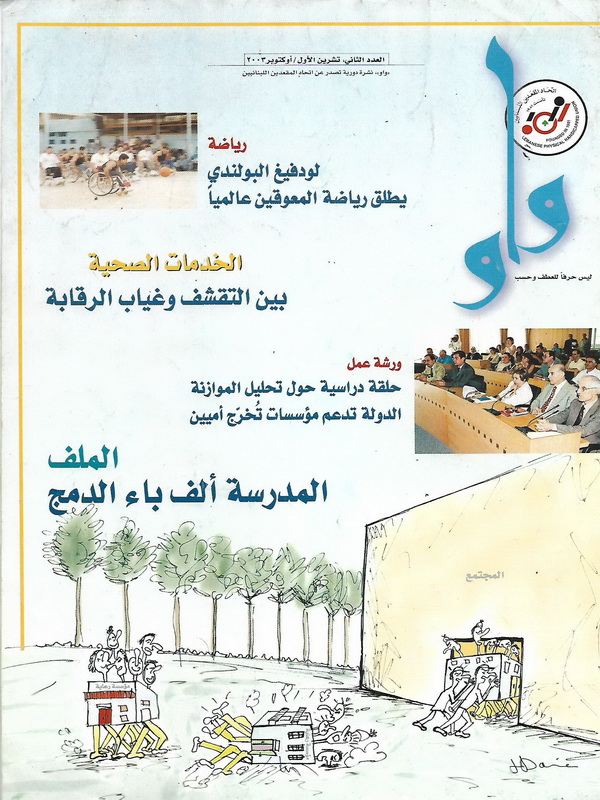
Issue 2
The second issue came out in September 2003. Its opening piece was titled “So We Don’t Become Victims of Austerity”, warning that the rights of people with disabilities were not being taken into account in the current government’s policies. The Investigation was dedicated to health institutions and the services they provide to people with disabilities. The Institutions section looked at the “Youth Policy Path” organization and its ongoing projects. The main Dossier was dedicated to educational integration in Lebanon, titled “School Is the ABC of Integration.” Among the Activities were: a roundtable with the Haret Hreik municipality, the Access to Information program, unemployment among people with disabilities in a roundtable, and LUPD’s summer camp. There was also a report from a workshop on a study analyzing the general budget.
The issue also included regular sections like: Craft and Talent, Problems and Opinions, Sports, Internet, Entertainment, and ended with the Last Word.
Supervised by Hussein Ayoub. Editor-in-chief is Abir Jaber, preparation by Iman Khalifeh, caricatures by Dunia El-Hajj, photography by Hussam El-Danaf, and layout by Omar Harqous.
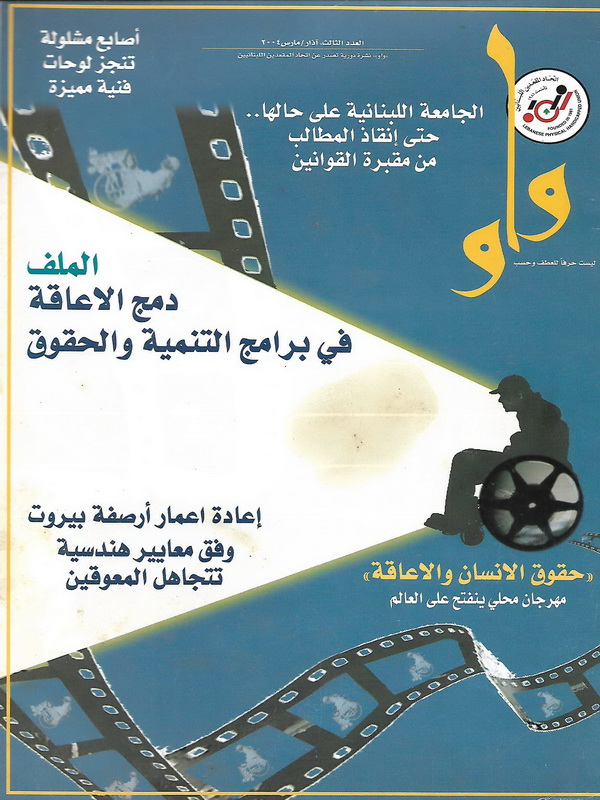
Issue 3
The third issue came out in March 2004. Its opening piece was titled “Towards an Awareness Campaign for a Culture of Rights and Law.” The main Dossier was dedicated to integrating disability into development and rights programs. The Institutions covered the “Private Freedoms” organization as an institution that protects human dignity. Among the Activities featured: LUPD’s participation in the Beirut Arab and International Book Fair, a look at two Bekaa schools adopting inclusion, and the regional conference on integrating blind children. The Festival section covered the “Human Rights and Disability” festival. The Investigation dealt with the challenges of protecting people with disabilities at different ages, with a focus on the rights of women with disabilities. In Cause section shed light on the Lebanese University and unfair taxes.
The issue also included regular sections like: Craft and Talent, Problems and Opinions, Sports, Internet, Entertainment, and ended with the Last Word.
Supervised by Hussein Ayoub. Editor-in-chief is Abir Jaber, preparation by Iman Khalifeh, caricatures by Dunia El-Hajj, photography by Hussam El-Danaf, and layout by Omar Harqous.
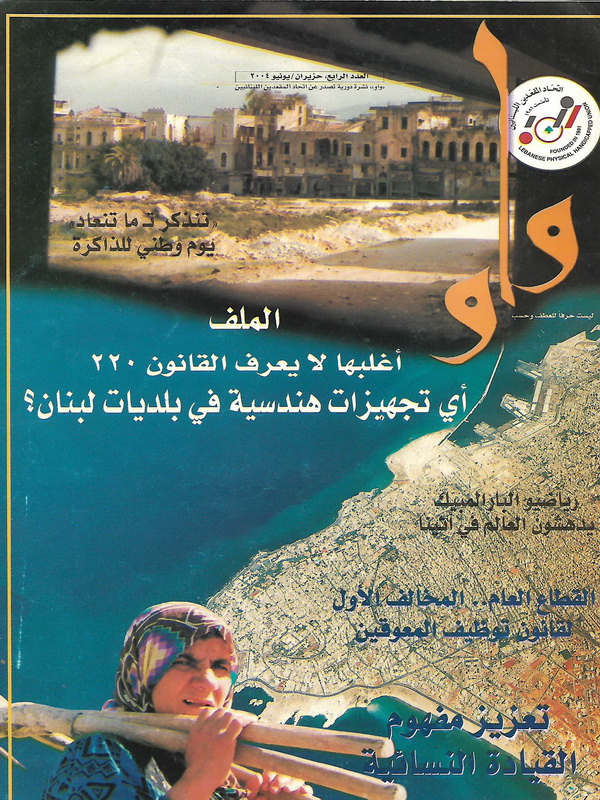
Issue 4
The fourth issue came out in June 2004. Its opening piece was titled “Our Weapon Is the Power of Rights,” stressing the need to apply Law 220/2000 and existing laws by issuing the necessary implementation decrees. The Institutions section covered promoting the concept of women’s leadership as a condition for development. The main Dossier was dedicated to municipalities, since it turned out that most Lebanese municipalities don’t know about Law 220/2000 or the rights of people with disabilities within the town or neighborhood. The Investigation dealt with how people with disabilities overcome challenges and obstacles, under two headings: the story of a disabled person looking for a job opportunity whose passion for sports made him overcome his crutches, and a portrait of Mohammad Bayram, “the mukhtar of the disabled.” Among the Activities covered: the solidarity stop points and signature campaigns launched by the LUPD to apply the law, the “Our Voice” project, and the solidarity sit-in held in support of detainees and the missing. The issue also shed light on several rights and development conferences, including: the Millennium Development Goals from a disability perspective, a consultative meeting to analyze the 2004 budget, a roundtable with the Tyre municipality, the Sharjah conference on rehabilitating and employing people with disabilities, and the “Never Again” campaign. The issue also covered the solid waste sorting issue in Lebanon, and the case of a person who became disabled in the civil war. The “Craft and Talent” section highlighted Hisham Salman, the inventor of the first Arabic CD for deaf people. The issue also included regular sections like: Problems and Opinions, Sports, Internet, Entertainment, and ended with the Last Word.
Supervised by Hussein Ayoub. Editor-in-chief is Abir Jaber, preparation by Darine El-Omari, caricatures by Dunia El-Hajj and Nancy Bash, photography by Hussam El-Danaf, and layout by Omar Harqous.
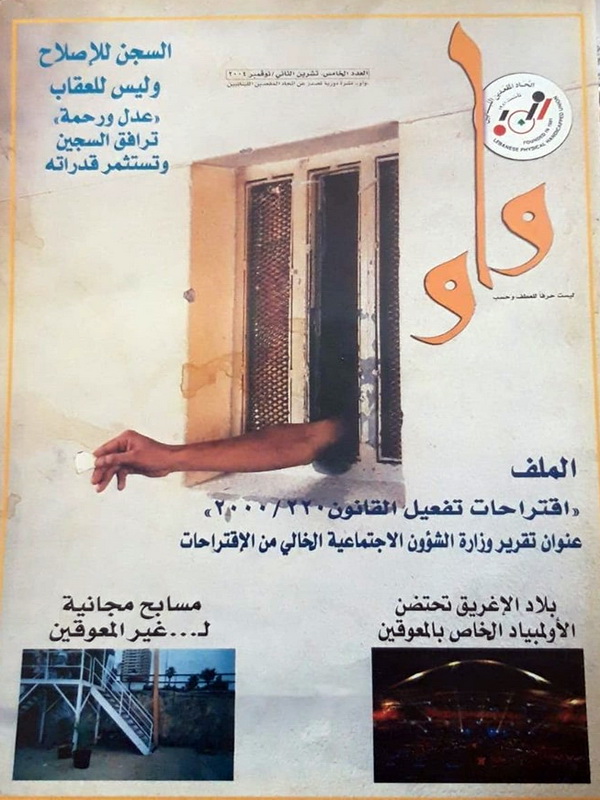
Issue 5
The fifth issue came out in November 2003. It included an opening piece by LUPD president Sylvana Lakkis titled “Will We Master the Art of the Possible?” The main Dossier was dedicated to suggestions for activating Law 220/2000, including a report from the Ministry of Social Affairs that lacked any suggestions. The Institutions section was dedicated to the “Justice and Mercy” association.
The Activities section included a training camp that brought together people with and without disabilities, while the Conferences section covered Lebanese criticism of the National Social Development Strategy. The Cause section presented the story of the child Nour El-Rifai, who suffers from discrimination and marginalization, and how she turned her disability into a bright life.
Supervised by Hussein Ayoub, editor-in-chief Abir Jaber, preparation and editing by Darine El-Omari, caricatures by Rana El-Baba.
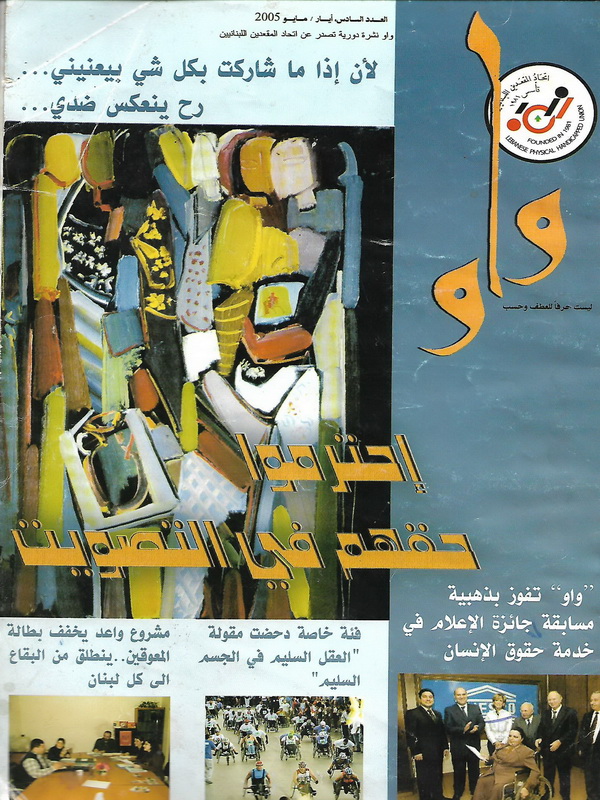
Issue 6
The sixth issue came out in May 2005. The opening piece by LUPD president Sylvana Lakkis dealt with the big hopes people with disabilities have for applying Law 220/2000, along with fears of being marginalized by the government, just like successive governments did since the law was issued. The main Dossier was dedicated to integration into society based on the active participation of people with disabilities in political life. The Project section talked about the project to open up job opportunities for people with disabilities in Lebanon as a promising project that reduces unemployment among this group. The investigation was dedicated to the Integration Network in Lebanon, which includes a number of advocacy organizations for people with disabilities, including LUPD, as an informal framework to achieve what the state hasn’t achieved until today. The Law section covered the tax exemptions set in Law 220/2000 and how different departments misinterpret them. The “Your Guide to Accessible Places” section covered engineering standards in hospitals that exclude blind people. The “Craft and Talent” section presented a portrait of disabled photographer Fayez Akkacheh. The issue also included regular sections like: Sports, Internet, Entertainment, and ended with the Last Word.
Supervised by Hussein Ayoub. Editor-in-chief is Abir Jaber, preparation by Darine El-Omari, caricatures by Dunia El-Hajj and Sahar Borhan, photography by Hussam El-Danaf, and layout by Ali El-Hajj Hassan. The cover art for this issue was by artist Paul Guiragossian.
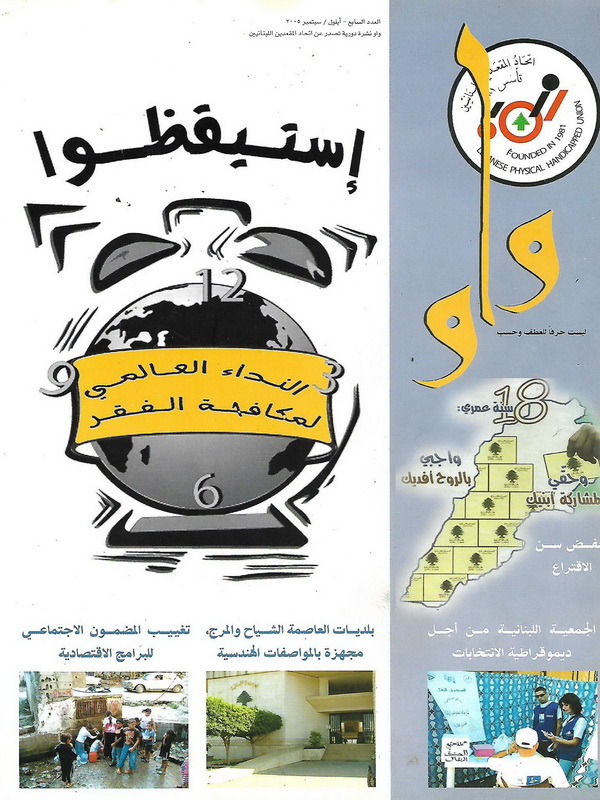
Issue 7
The seventh issue of came out in August 2005. The opening piece was titled “Wake Up,” by LUPD president Sylvana Lakkis, in which she called for alerting officials in charge of disability files and the relevant ministries to the need to speed up putting rights into effect. The main Dossier dealt with development policies in Lebanon between reality and vision. The Law section included an article titled “The National Council for the Disabled: Between Political Decision and Structural Flaw.” The issue included a special investigation on the Arab consultative meeting on the International Convention on the Rights of Persons with Disabilities, and an investigation on the “My Right” campaign, the national campaign to pass the political rights of people with disabilities in Lebanon, which turned the participation of people with disabilities in elections into a public issue. It also presented a portrait of the Lebanese Association for Democratic Elections, and the Public Issue section talked about lowering the voting age. The “Your Guide to Accessible Places” section covered the municipalities of the capital, Chiyah, and Marj, which are considered equipped with engineering standards. The issue also presented the local and foreign activities LUPD organized or took part in, and included regular sections like: Problems and Opinions, Sports, Technology, Internet, Publications, Entertainment, I Read for You, and ended with the Last Word.
Supervised by Hussein Ayoub. Magazine director is Fadi El-Sayegh, editor-in-chief is Abir Jaber, preparation by Ibrahim Charara, caricatures by Amal Kaawoush and Fika Paramonova, photography by Hussam El-Danaf and Dani Jneidi, and layout by Ali El-Hajj Hassan.
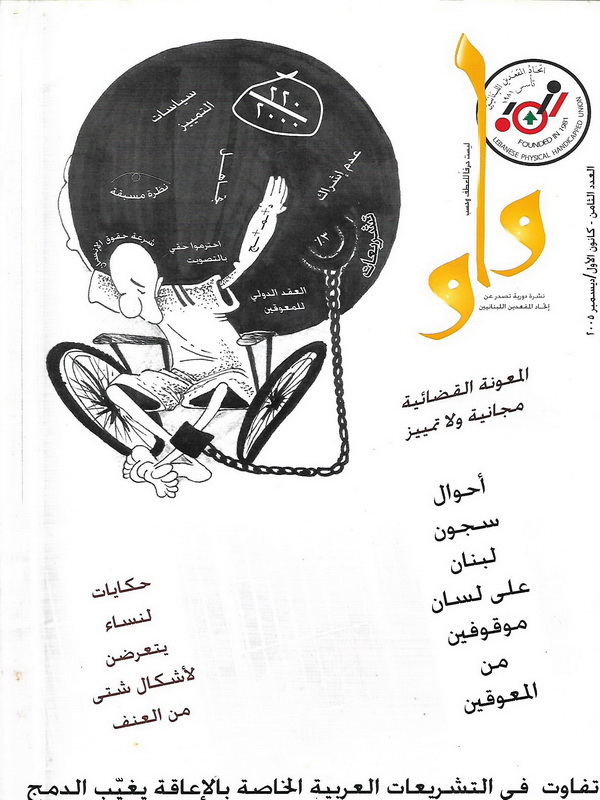
Issue 8
The eighth issue included an opening piece by LUPD president Sylvana Lakkis, dealing with the dangerous conditions marginalized groups in Lebanese society face, with a focus on people with disabilities and women, calling on the state to take responsibility toward these two groups. The main Dossier was dedicated to two main topics: first, the conditions of people with disabilities in Lebanese prisons and detention centers, through an investigation into prison conditions in the words of detained people with disabilities, and an interview with a representative of Amnesty International about the rights of this group, discussing the importance of the legal aid committee in defending detainees who can’t afford lawyers’ fees. The second topic dealt with violence against women through cases of abuse, and interviews with the “Kafa” and “Abaad” organizations. In the “Law” section, the issue covered legislation on the issues of people with disabilities in Arab countries. In the “Institutions” section, it presented a portrait of the Lebanese Association for Trisomy 21. The “Your Guide to Accessible Places” section was dedicated to talking about banks that meet engineering accessibility standards for people with disabilities. The issue also presented the local and foreign activities LUPD organized or took part in, and included regular sections like: Problems and Opinions, Sports, Technology, Internet, Publications, Entertainment, I Read for You, and ended with the Last Word.
Supervised by Hussein Ayoub. Magazine director is Fadi El-Sayegh, editor-in-chief is Abir Jaber, preparation and editing by Imad Eddine Raef, caricatures by Mohammad Sarhan (cover art), Amal Kaawoush, Marwan Hammam, and Fika Paramonova, photography by George El-Asmar and Hussam El-Danaf, and layout by Ali Sarhan.
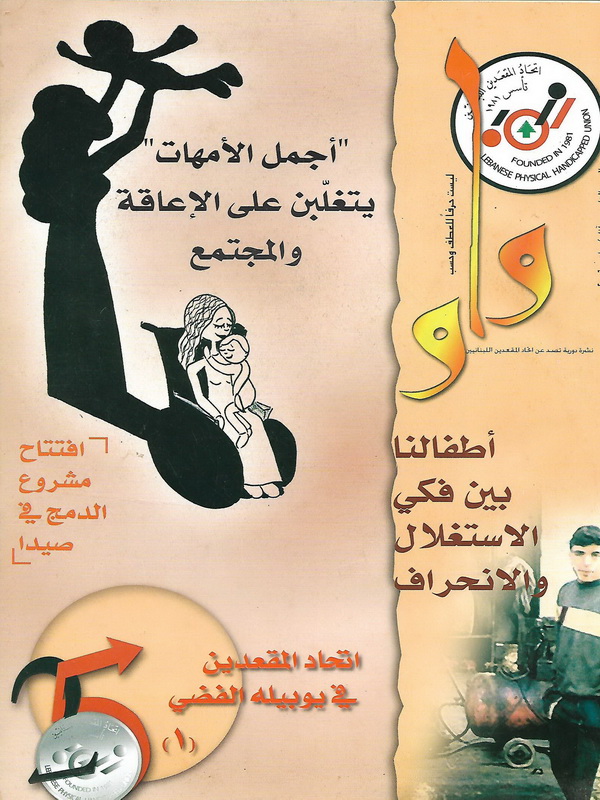
Issue 9
The ninth issue opened with a piece by LUPD president Sylvana Lakkis on how civil society can advance human rights in the Arab world and Lebanon.
The main dossier focused on motherhood and childhood. Dr. Ugarit Younan discussed the mother-child relationship in Arab society and the harm caused by a culture of violence and spoiling. A journalistic investigation highlighted successful mothers with disabilities who broke through both disability and patriarchal barriers, followed by an occupational therapy perspective debunking the idea that women with disabilities can’t be mothers. On the child topic, Dr. Elie Mikhael covered the Higher Council for Childhood, and an investigation exposed child labor on Beirut’s streets and its physical, psychological, and mental risks, including temporary and permanent disabilities.
The issue also covered the second Arab parliamentary symposium on disability legislation, noting the gap between legislators and civil society and the absence of people with disabilities from the legislative process. It highlighted inclusive projects like the talking library and an economic and social integration project in Sidon.
Regular sections included a “Human Cause” on Nazha Sbeiti, who spent 22 years bedridden; a Law section on the injustice of Lebanon’s nationality law against mothers; and “Craft and Talent” featuring poet Mariam Bajouk, who has polio and heads a mixed team at LibanPost. Marking LUPD’s 25th anniversary, the issue began a silver jubilee retrospective on the union’s founding years (1979–1989), alongside union activities, an accessibility guide, and other regular features.
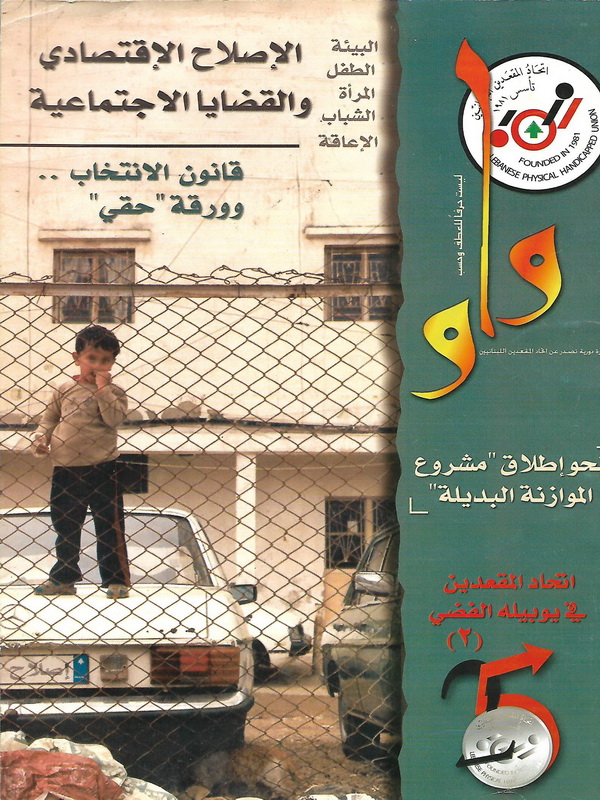
Issue 10
The tenth issue opened with a piece by LUPD president Sylvana Lakkis on inclusive development and the challenges of economic reform in Lebanon. It featured an interview with economic expert Adnan El-Hajj on the government’s reform direction, and Dr. Mahdi Mahfouz on the budget and civil society. Disability topics were covered by Mohammad Lutfi, while Linda Matar addressed reform and women’s rights. The issue also tackled youth and migration, the environment with expert Habib Maalouf, and childhood with Bassem Gedeon.
Two projects were presented: the “National Project on the Alternative Budget,” to push policymakers to consider civil society’s input on the budget, and the TV programs of the Arabic-language Sat Seven channel and their impact on integration and diversity.
Other coverage included a journalistic investigation on integration and the social model, a “Human Cause” on the marginalization caused by the non-application of Law 220/2000 through the story of Rabih, the new election law, a “Craft and Talent” piece on a fisherman with a disability, and a look at accessible places like the airport.
Marking LUPD’s silver jubilee, the issue highlighted the union’s media journey over 25 years under the theme “Towards Journalism Specialized in Disability.” It also covered kayaking for people with disabilities, the Forward Employment Exhibition at BIEL (including a survey showing few employers know the law and most don’t hire people with disabilities), and Lebanon’s first occupational therapy conference. Regular sections rounded out the issue, which closed with a word from Professor Abir Jaber on the alternative budget within a comprehensive national project.
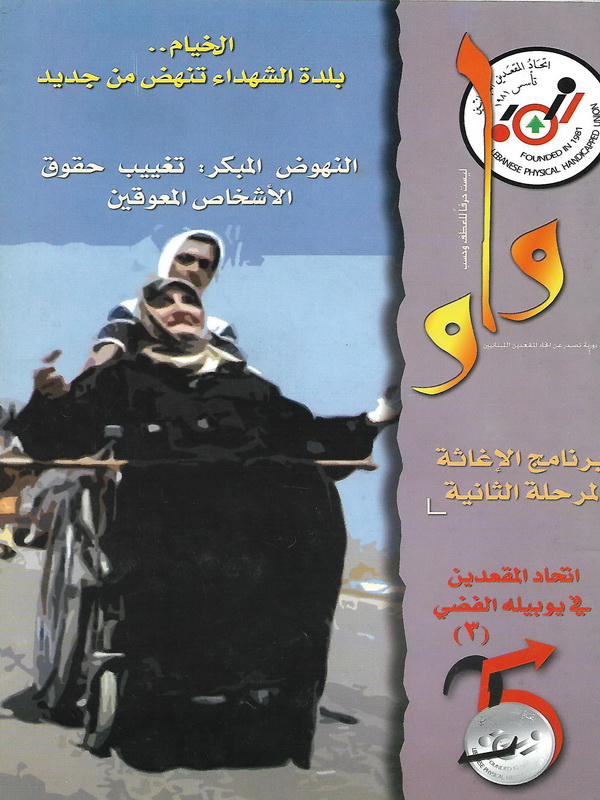
Issue 11
Waw’s eleventh issue, published by LUPD, came out in early November 2006, coinciding with the union’s 25th anniversary. It opened with a piece by president Sylvana Lakkis on diversity as a potential savior for Lebanon, criticizing the failure to fund rehabilitation or include accessibility standards in reconstruction after the July war, especially as disabilities grew due to war and cluster bombs.
The main dossier covered reconstruction in Lebanon, including the destroyed town of Khiam, international aid efforts, the Stockholm paper’s neglect of people with disabilities, and the doubled suffering of displaced people with additional needs in unequipped shelters. It stressed reconstruction must follow inclusive engineering standards per Law 220/2000.
Other coverage included LUPD’s relief program, war diaries from Beirut’s southern suburbs, the El-Dehaini family’s story, the Lebanese Popular Aid Association’s work, the Geneva Convention, and the UN’s draft convention on the rights of persons with disabilities. The silver jubilee section covered LUPD’s relief work during the civil war and the 1993 and 1996 wars.
Regular sections closed the issue, ending with Abir Jaber’s word on addressing the growing needs of people with disabilities in reconstruction.
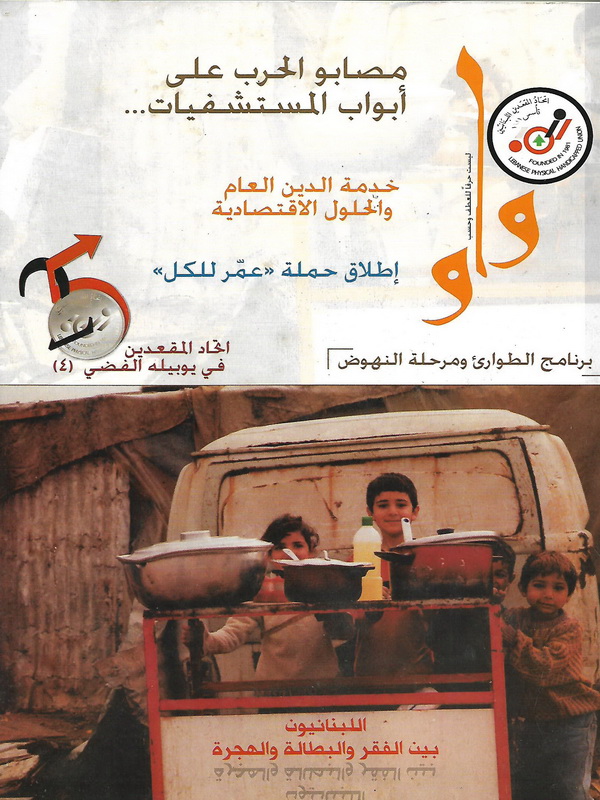
Issue 12
The Spring 2007 issue included an opening piece by Sylvana Lakkis titled “So We Can Cancel the Charity Equation,” in which she talked about the double standards officials show toward urgent social issues, and how they practice a politics of charity, so that the equation in effect becomes “benefactor and beneficiary,” with all the dependency, guardianship, humiliation, and clientelism this term carries. Practicing double standards in positions has become so widespread that it covers the official, political, and media levels. Lakkis asked: “Where are the loud voices from the platforms in Martyrs’ Square and Riad El-Solh Square? Where are they from people’s suffering? Where are they from the ABC of freedom, dignity, and independence?” Lakkis addressed people with disabilities, colleagues who bear the responsibility of not allowing the benefactor-beneficiary policy to continue, saying: “We must make the international convention an effective tool to enshrine our rights, to spread the integration policy, and to strengthen every opportunity that would establish an inclusive environment.. to move forward toward laying the foundations of a just society for everyone.”
The main Dossier dealt with a journalistic investigation on “Public Debt and Its Effects on the Living and Social Situation in Lebanon,” and interviews with economic experts on public debt servicing, reform, and disability issues. The law section talked about “The International Convention and Law 220/2000.” Then the issue’s investigation dealt with the case of those injured in the recent war and the halt in health and hospital care that the Ministry of Health promised, through many cases where continued hospitalization at the ministry’s expense was rejected in the Lebanese Bekaa. The “A Human Cause” section covered a family that applies educational integration in the harshest living conditions in southern Lebanon, and how this family overcame the many difficulties and obstacles it faced. The “Craft and Talent” section talked about women with disabilities and work through a portrait.
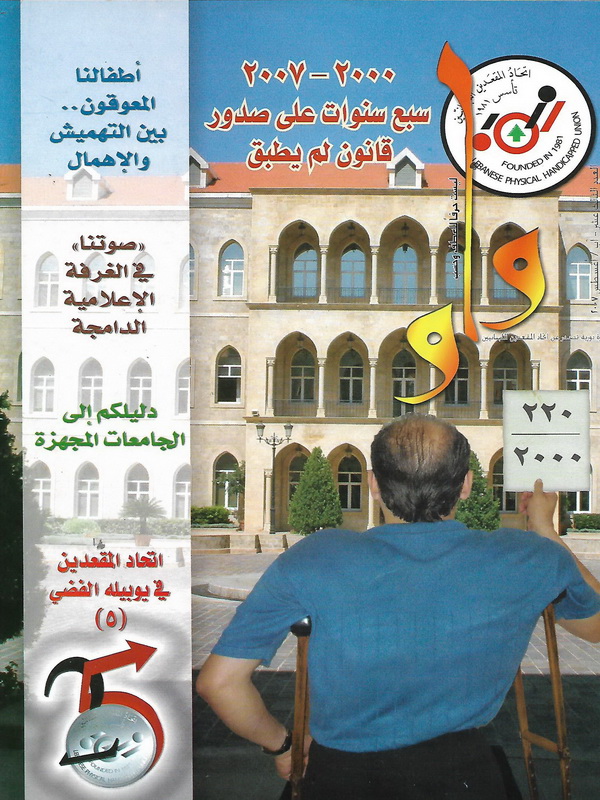
Issue 13
The Summer 2007 issue included an opening piece by Sylvana Lakkis titled “The Opportunity for Integration Is Available.. and Strongly,” in which she talked about Law 220/2000, which has completed its seventh year without those concerned taking practical steps to implement it, and how to shorten the distance toward applying this law. In it she said: “We simply ask: when will everyone decide to show diversity in culture, tools, and skills so we can rebuild inclusive and just programs and policies? True, recovery needs many things and time, but the opportunity is available and strongly present now, and everyone must get active. We suggest using the actors who have accumulated focused experience in approaching integration and rights to prepare the basic papers for a recovery plan toward applying full inclusion.”
The issue included a main Dossier on the health file of people with disabilities in Lebanon, in an investigation titled “A Card That’s Useless, and a Law That’s Not Applied.” Then the file moved to addressing the health file through interviews with Dr. Ismail Sukkarieh on applying the law and the work of the parliamentary committee concerned with health, labor, and social affairs; an interview with Dr. Sleiman Haroun, head of the Syndicate of Private Hospitals in Lebanon; an interview with Bassam Sanjar, member of the syndicate of prosthetic limb and assistive device manufacturers; with unionist Ali Muhieddine on social security and people with disabilities; and with Dr. Ibrahim Abdallah, member of the National Council for Disability Affairs.
In the “Cause” section, through an interview with the UN Special Rapporteur on Disability, Sheikha Hessa Al Thani, the issue covered the ongoing work on disability legislation in the Arab world. Then through a report in the “Project” section, it talked about the inclusive media room in the “Our Voice” project, which came out of the Integration Network. In “A Human Case,” it moved to touch on the reality of children with disabilities through an investigation dealing with their suffering in the South. In the “Craft and Talent” section, the issue covered, through a portrait, the experience of legal translator Hussam Rihan.
The fifth silver jubilee part covered LUPD’s camps and their role in the union’s ongoing advocacy campaign toward rights training and social integration. Then it summed up a fruitful chapter of the two projects: opening up job opportunities, and national integration. The issue also has other regular sections like Famous People with Disabilities, Culture, Different Pens, and the “Last Word” article by colleague Abir Jaber.
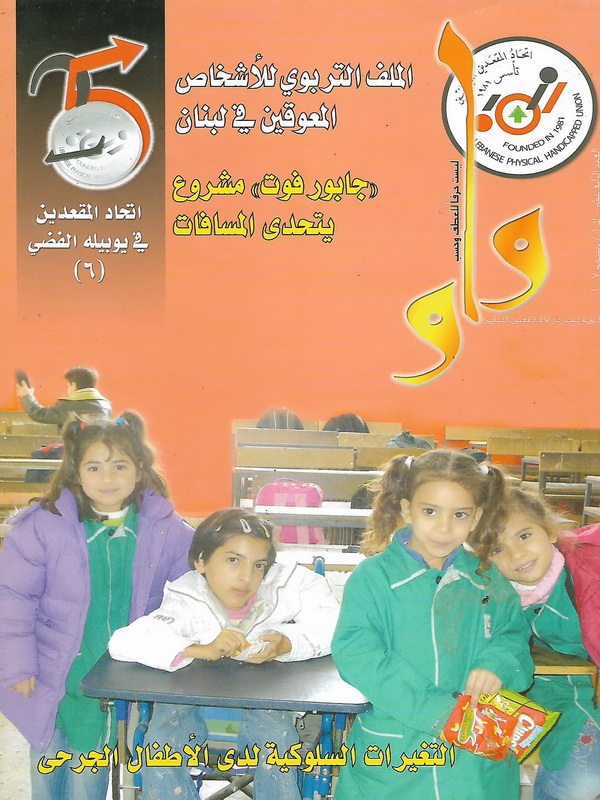
Issue 14
The fourteenth issue was concerned with disability issues according to the social model. LUPD president Sylvana Lakkis opened the issue with a word dedicated to the International Convention on the Rights and Dignity of Persons with Disabilities, presenting the importance of Arab countries joining this convention and ratifying it in their legislative councils, which gives these countries representation in the international monitoring committee. She also touched on “the years of missing rights 2000–2007” in Lebanon, given that Law 220/2000 on the rights of this group in society isn’t being applied. The last word, by Abir Jaber, talked about wishes for the country to come out of its coma and regain some serious advocacy activity to demand the missing rights of people with disabilities in Lebanon, titled “New Year.. New Hope.”
In this issue, the magazine reopened the educational file of people with disabilities in Lebanon, covering it through an extensive investigation and interviews with school principals who adopted integration policy, addressing the topic “between students, administrations, and parents,” under the title “Inclusive Experiences Inside School Walls.” Then it moved to interviews with those concerned with education, from the Educational Research and Development Center, the official body tasked with setting curricula and school books, to the Lebanese Association for Educational Sciences, to the Secondary Teachers’ Association, to the National Integration Project, putting before the reader the result of seven years of marginalization that affected students with disabilities, under the title “Experiences and Alternatives for the Relevant Ministries.” The law section also followed up on “the right of a person with a disability to education and learning.”
The “Project” section in this issue was dedicated to a report on the work of the “Jaipur Foot project in Lebanon,” as a pioneering experience in the field of manufacturing prosthetic limbs and medical alternatives. The “A Human Case” section covered the story of the child Hawraa, who regained her hearing, and the role of intervention with injured children. “Craft and Talent” talked, through a portrait, about young man Elie Mghabgheb, who has quadriplegia, and his excellence in “TV montage with digital techniques.” The issue also included an investigative report on children who newly acquired disabilities because of the recent July war, under the title “Our Injured Children.. A Psychological Reading of the War’s Results: Mass Failure and Dangerous Behavioral Changes.” With this issue, the magazine’s series on the union’s journey, on the occasion of its silver jubilee, comes to an end. In the sixth and final part, the stages of the ongoing advocacy campaign for people with disabilities in Lebanon were presented, titled “LUPD and the Fragmentation of Demands.”
With this issue, new regular sections were opened, including “Our Voice,” a space dedicated to advocacy where members of the inclusive media room in the “Our Voice” project, which came out of the Integration Network, appear. Its investigation was titled “Our Voice Asks People About Rights.” The issue also included regular sections like: Activities and Participation, Publications, Famous People with Disabilities, From the Web, and Different Pens.
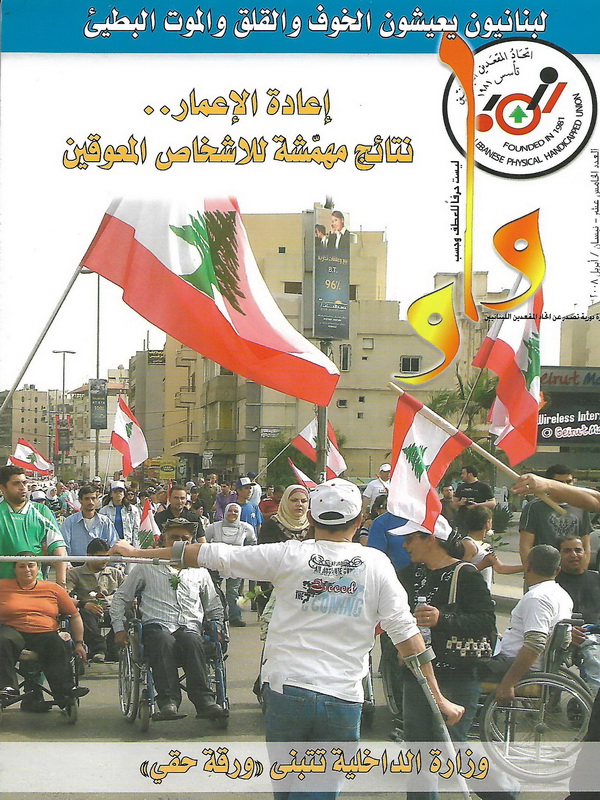
Issue 15
The fifteenth issue came out at the end of April 2008, containing approaches and coverage of urgent social issues amid an economic and living crisis that the Lebanese citizen is living under.
In the issue’s introduction, Sylvana Lakkis, president of LUPD, addressed social issues from a rights perspective, linking disability issues in Lebanon to the union’s persistent effort to put them among the priorities of the relevant ministries, in pursuit of applying Law 220/2000, eight years after it was issued.
The main Dossier dealt with the constitutional and economic-living crises Lebanon is going through, under the title “How Do We Build a Homeland?” Through an investigation monitoring citizens’ reality linked to the rights guaranteed by the constitution amid security instability. And interviews with politicians Wael Abou Faour and Abbas Hashem, and with Lebanese civil society organizations about the reality of social issues and how to build a homeland with some social justice, through interviews with Zoya Rouhana, director general of Kafa organization, on women’s issues; Sabah Badr El-Din, director general of the Social Movement, on active civil society; Arabi El-Ondari, executive director of the Lebanese Democratic Youth Union, on youth issues; Hala Aachour, director general of Green Line organization, on environmental issues; and on unions, Castro Abdallah, secretary-general of the Federation of Workers’ and Employees’ Unions in Lebanon. Then the file links to the core issue (the disability issue in Lebanon) through an analysis of reality and a look at the future.
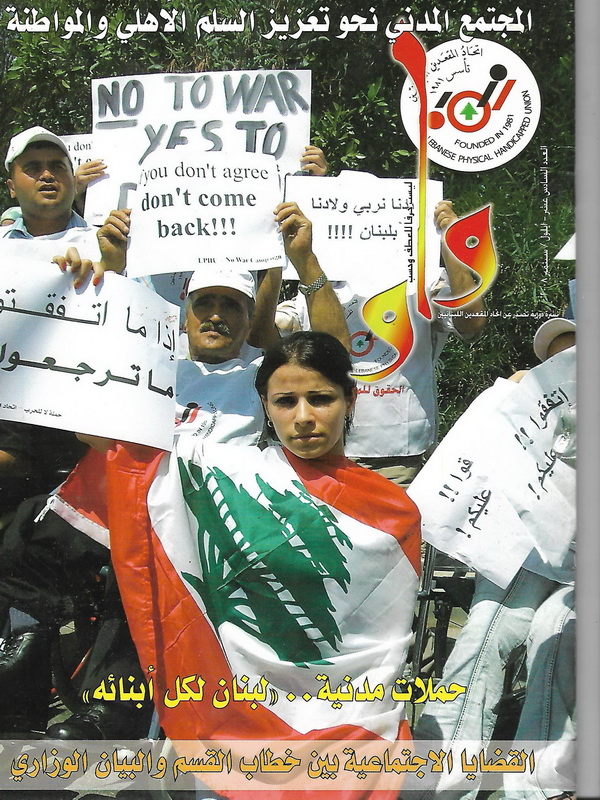
Issue 16
The early September 2008 issue was concerned with disability issues and social issues under the umbrella of human rights.
In the opening piece, Sylvana Lakkis, president of LUPD, talked about “the fateful role awaited from Lebanese civil society in strengthening civil peace and citizenship,” criticizing the ruling political class in Lebanon and the election law that takes the country sixty years back, according to a narrow sectarian, denominational, and regional vision. She focused on the role of Lebanese civil society and the possibility of activating its role through networking and non-sectarian coalitions to strengthen peace in Lebanon and reject infighting, as well as to promote the concept of citizenship among different social groups. The last word, by Abir Jaber, talked about media and disability, focusing on the media’s message and how much it affects viewers and readers, and how it benefits social issues (especially disability) if the issue is handled with inclusive terms and spirit.
The issue included a full file on Lebanese civil society. It shed light on the first participation of civil organizations in a parliamentary session as observers, during the session discussing the ministerial statement and the social issues it included. Then, through interviews with Father Gregoire Haddad and Ziad Abdel Samad, it addressed the role of civil society at this stage. The file then moved to non-sectarian civil campaigns and their role in the past three years, ending with a presentation of the results of the “No to War” campaign that LUPD launched.
In the issues section, the issue covered social issues in the oath speech, then covered youth’s vision of civil society in an investigation, and in another investigation presented a comparison between Lebanon and Scotland titled “Roads for Everyone.. A Dream of a Person with a Disability.” The “Craft and Talent” section in this issue covered the historic handmade pottery industry in Lebanon. It also presented projects LUPD is carrying out, including a field survey project to monitor architectural barriers at Beirut’s administrative polling stations, the inclusive development and self-advocacy project, and the economic and social integration project for people with disabilities in Lebanon.
The issue also presented the first part of a study on media and disability on the small screen, then the entry of the International Convention on the Rights and Dignity of Persons with Disabilities into force globally, while waiting for the Lebanese parliament to ratify it locally, and the agenda of the Arab coalitions of the Global Call to Action Against Poverty. The issue also included an investigation written by the “Our Voice – Inclusive Media Room” team, and a number of regular sections including: Culture, Famous People with Disabilities, Not Currently Showing, and “Different Pens”.
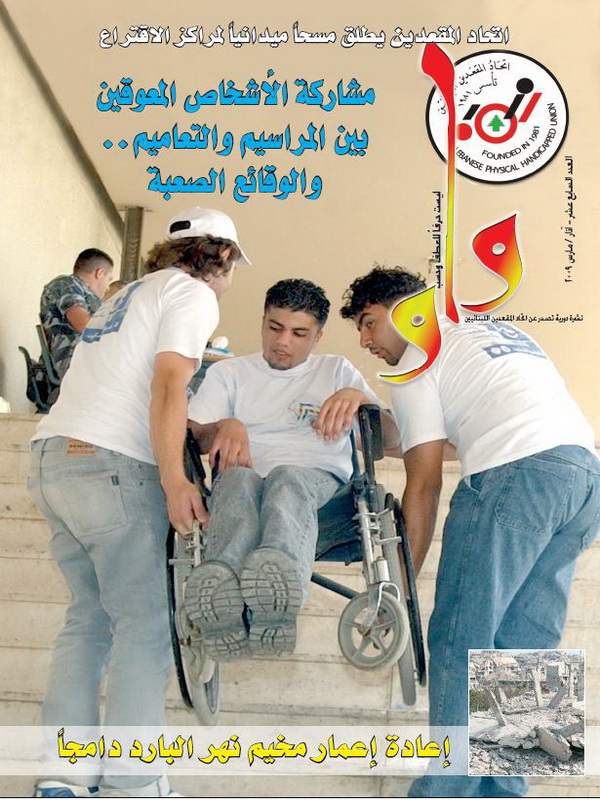
Issue 17
The mid-March 2009 issue was concerned with disability issues and social issues under the umbrella of human rights. In the opening piece, Sylvana Lakkis, director general of programs at LUPD, talked under the title “Pre-June Demands.. At Their Minimum” about Lebanese civil society adopting the modern concept of development in all its meanings, which puts those in power before their responsibilities, most importantly their responsibility toward people with disabilities, who make up 10 percent of Lebanese citizens. She summed up a number of demands that should see the light before the upcoming parliamentary elections, including: passing the general budget, reviving the Economic and Social Council, issuing the implementation decree related to architectural accessibility in application of Law 220/2000, adopting the Interior Ministry’s initiative before the other relevant ministries, applying the 3 percent quota in public jobs in application of the law; and reminding rulers that the people will judge them on how they handle the rights of this group, and that “history will judge between us.”
The last word, by Abir Jaber, under the title “The Participation of People with Disabilities in the 2009 Elections.. A New Step Towards Real Integration, Even If Still Incomplete,” talked about the importance of the upcoming elections for people with disabilities: “So this year’s elections remain an important step for people with disabilities — or at least some of them who will be able to reach polling centers easily — to say their opinion on the political decision in the country. And so they record for history that this group, which has been marginalized for years, exists and has every right to say what it wants.”
The issue included a full file on the political rights of people with disabilities, addressing the topic with a meeting with the Minister of Interior and Municipalities, His Excellency Mr. Ziad Baroud, an interview with social researcher Dr. Talal Atrissi, a presentation of the civil discussion with officials and those in power, and the recommendations and results, plus a detailed presentation of inclusive election standards for motor, hearing, and visual disabilities, and another presentation of the circulars issued by the Ministry of Interior and Municipalities on making it easier for people with disabilities to vote. The presentation also touched on the awaited implementation decree of Law 25/2008, which organizes the election process, in connection with Law 220/2000. The “Campaign” section in this issue continued its presentation on the “My Right” campaign, the civil campaign to pass the political rights of people with disabilities from 2005 until this year, while the “Law” section covered the election law under which the upcoming parliamentary elections will be held.
The issue included an investigation on rebuilding the “Nahr El-Bared” camp according to engineering standards that respect the needs of people with disabilities, based on LUPD’s experience. In the “Craft and Talent” section, it covered “the teacher with a disability” through a portrait. The issue also has the second part of a study on media and disability on the small screen, then a presentation of the International Convention on the Rights and Dignity of Persons with Disabilities entering into force globally while waiting for the Lebanese parliament to ratify it locally, and a report on the global food crisis and the economic crisis, plus a number of regular sections including: Culture, Famous People with Disabilities, Tourism, Sports, Arts, and “Different Pens”.
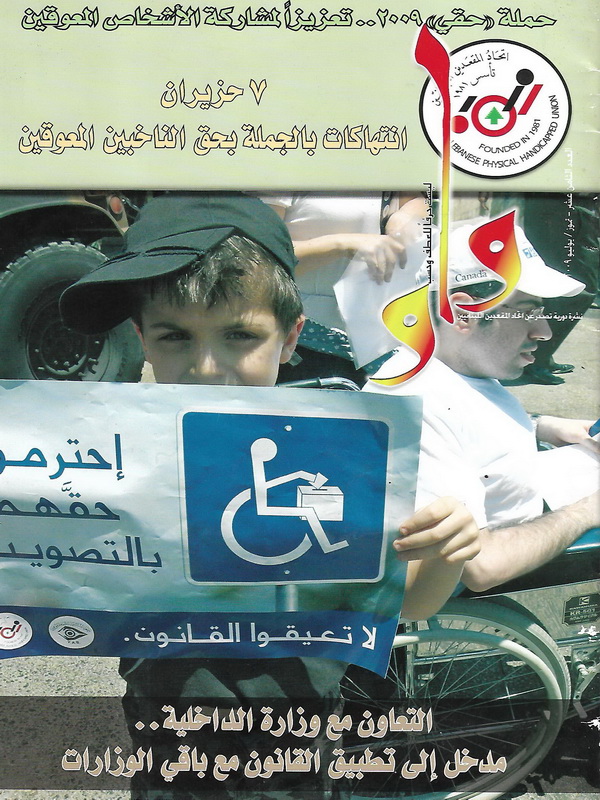
Issue 18
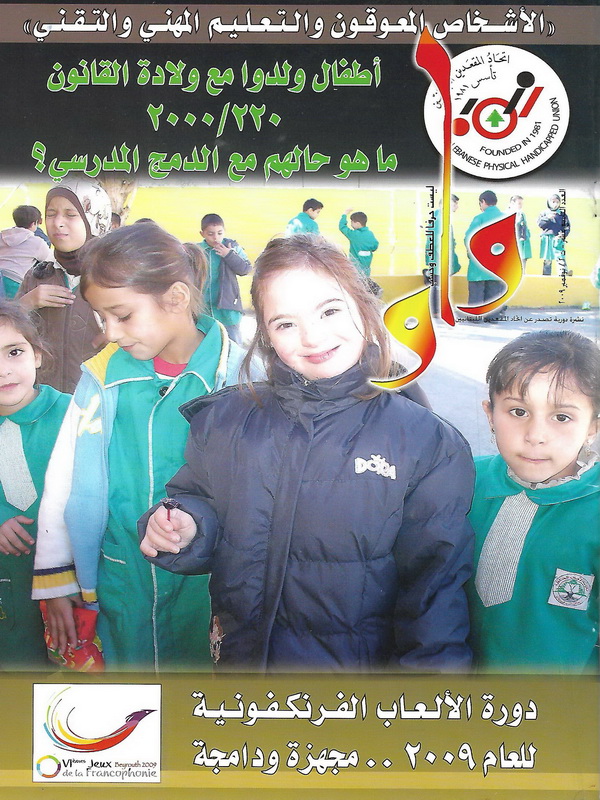
Issue 19
The mid-November 2009 issue was concerned with disability issues and social issues under the umbrella of human rights.
In the opening piece, under the title “Our Demands to the Government in Application of Its Ministerial Statement,” Sylvana Lakkis listed the demands of people with disabilities in the educational and health files that have become chronic, addressing the broad-based government, and calling for ratification of the International Convention on the Rights of this group and its annexed protocol. The main Dossier dealt with educational integration. In an investigation, it looked at children who were born with Law 220/2000. Then it covered the educational integration project in public schools as a civil experience that establishes a participatory relationship with the Ministry of Education. Then it moved to vocational and technical education in Lebanon and the need to impose integration there in application of the law. Then it stopped at the national program for school integration in Lebanon, an official program about to launch. The file also stopped at the cost of architectural accessibility in schools, based on a study LUPD prepared. In the law section, the issue covered equal opportunities in educational institutions ten years after Law 220/2000 was issued. In the “Report” section, it covered the world conference on inclusive education, held in Salamanca, Spain. The issue included an investigation on LUPD coordinating the process of equipping Francophone games venues in Lebanon as an experience in securing an inclusive environment. In the “Craft and Talent” section, colleague Mohammad Bayram told “a story of creativity about the gun maker and artist Abu El-Fadl.” In the “Camp” section, the issue covered LUPD’s seventeenth central summer camp in the town of Jezzine under the title “The Road Forward.” In the “Media and Disability” section, by Fadi El-Sayegh and Iman Khalifeh, it covered the TV series “Step of Love” as a step toward an inclusive society. The issue also included LUPD’s activities and its local and international participation, plus a number of regular sections including: Our Voice, Culture, Famous People with Disabilities, Publications, Not Currently Showing, Tourism, Sports, Arts, and “Different Pens.” The last word was by colleague Abir Jaber, titled “A New Year.. Achievements That Deserve Appreciation”.
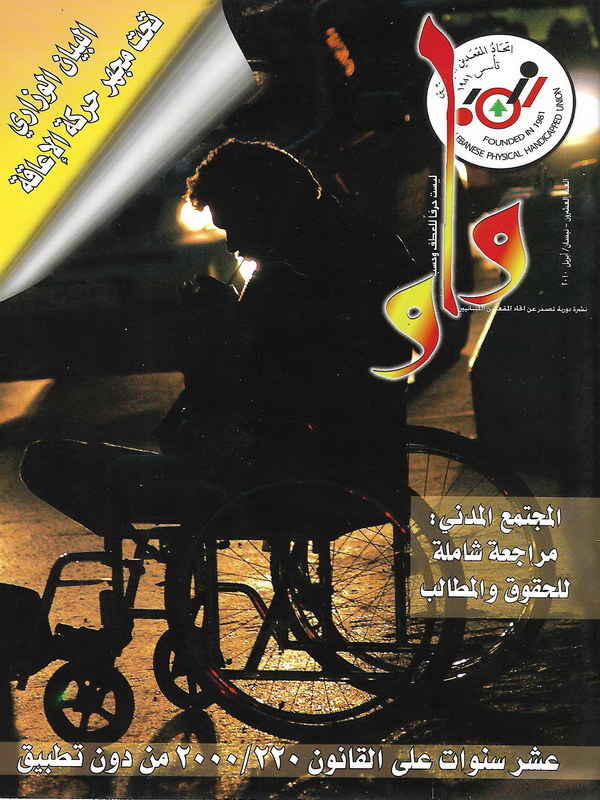
Issue 20
Opening: The opening was issued in the name of LUPD under the title “Let’s Work Together to Apply the Ministerial Statement.. The Opportunity Is Before Us.”
The main Dossier was dedicated to a comprehensive review of civil society in the face of marginalization and exclusion, under the title: “Ten Years Waiting for Law 220/2000 to Be Applied.”
Law section: It dealt with the ministerial statement and the demands of Lebanese civil society, including a statement by El-Mansouri in which he confirmed that “Lebanese governments are drowning in settlements.”
Investigation section: It came under the title “Mother’s Day Is a Renewed Opportunity for Their Persistence in Challenge.. Mothers with Disabilities Talk About Their Achievements.”
Cooperation section: It shed light on the signing of a memorandum of understanding on a sustainable inclusive environment between the United Nations Human Settlements Programme and LUPD.
Development section: It covered the inclusive development and self-advocacy project in its second phase.
Symposium section: It was held under the title “Education Is a Right for Everyone,” in a consultative meeting with the vocational education sector in Lebanon.
Last word: Written by Abir Jaber under the title “Ease of Access”.
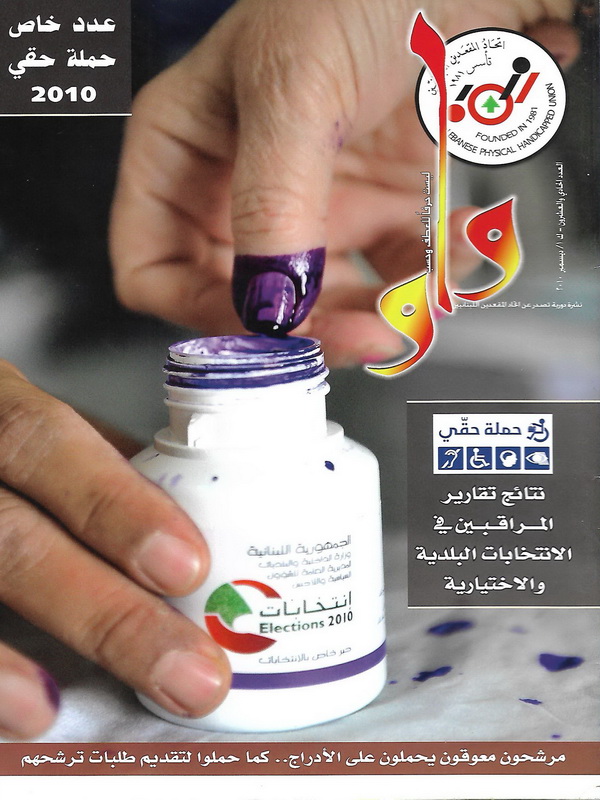
Issue 21
Opening: The opening was issued in the name of LUPD under the title “Towards Inclusive Parliamentary Elections in 2012.”
Investigation section: It came under the title “A 2010 Voter’s Journey,” and discussed how election obstacles in municipal elections remained the same as in parliamentary ones despite the Interior Ministry’s circulars, shedding light on voters with disabilities as they exercise their violated democratic right.
My Right 2010 section: It shed light on cooperation with the Interior Ministry, the Association for Democratic Elections, and the coalition, where the “My Right” campaign saw added momentum in its fourth phase. The campaign revealed a large rate of lack of accessibility, communication, and information, and weak handling, and monitored violations and irregularities in the 2010 municipal and optional elections, including reports from “My Right” observers in the Beirut governorate and the other governorates.
Last word: Written in the name of LUPD under the title “The Interior Ministry and the Coalition of Associations Towards Inclusive Elections.. My Right in the 2013 Election Law Draft.”
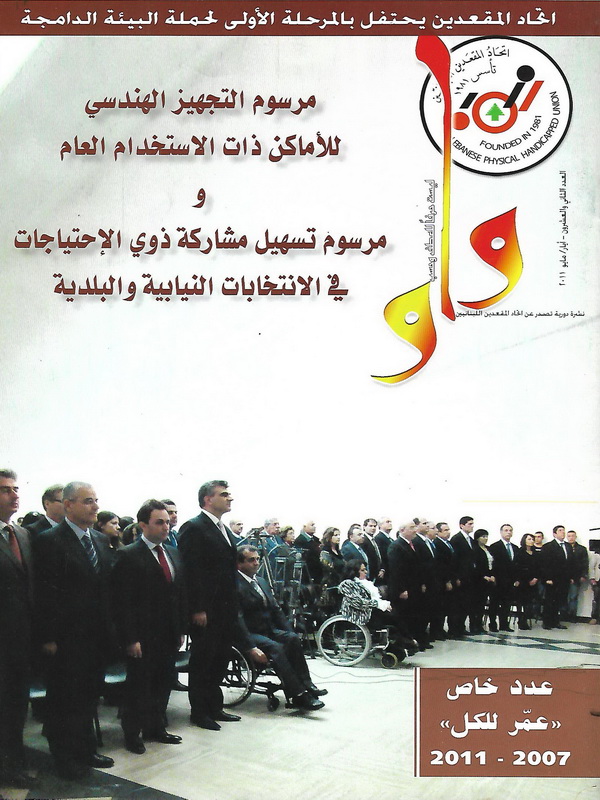
Issue 22
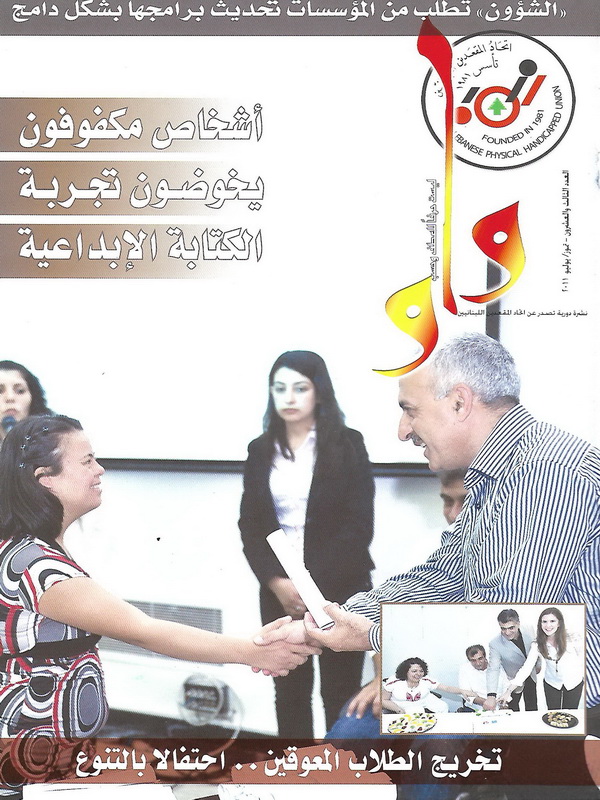
Issue 23
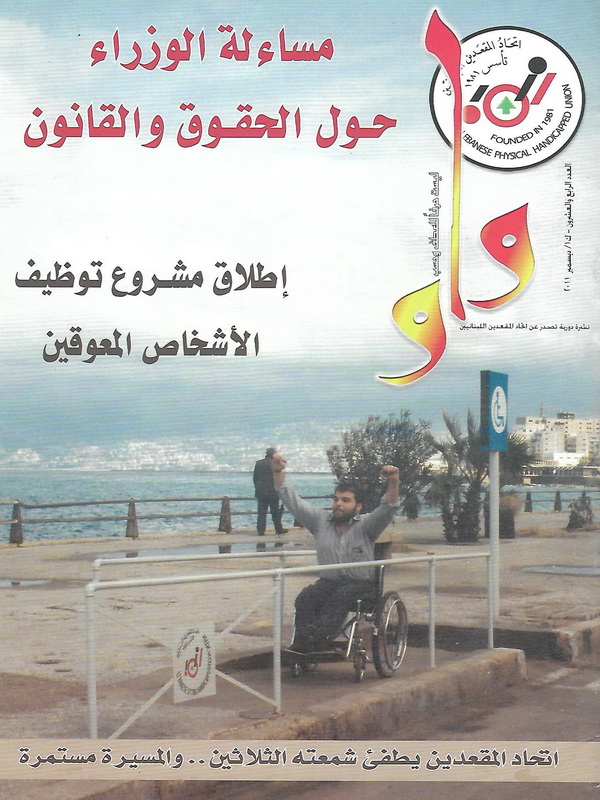
Issue 24
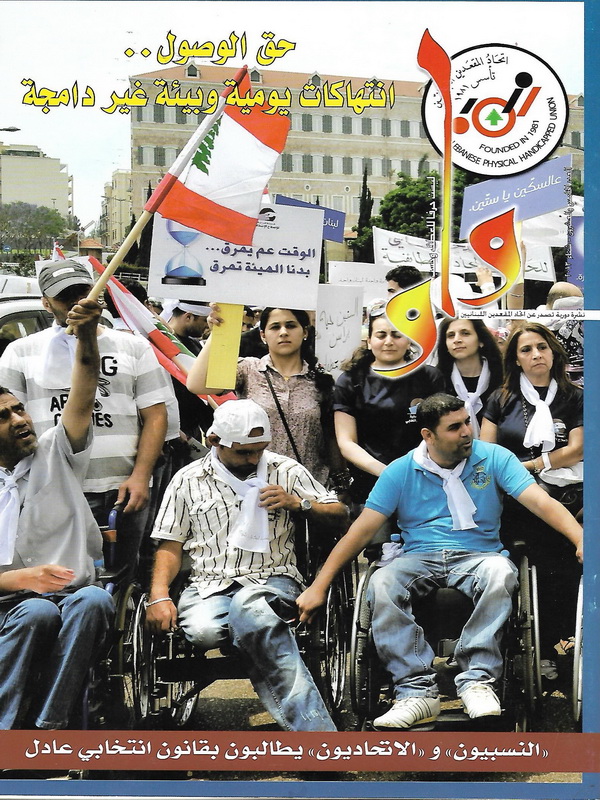
Issue 25
Issue 26
Published in February 2013, the twenty-sixth issue was concerned with disability issues and social issues under the umbrella of human rights. The opening piece dealt with the milestone LUPD achieved in the path of inclusive vocational and technical education, crowning three years of work in rehabilitating and employing people with disabilities and issuing related studies and research. The issue included an investigation on the observatory for the rights of people with disabilities in Lebanon and a presentation of the first report it issued monitoring violations according to the articles of Law 220/2000. In the “Initiative” section, it covered initiatives to reduce poverty and extreme poverty and the need to include disability on the development agenda in Lebanon. The main Dossier was dedicated to vocational and technical education, under the slogan “Integrated Initiatives Towards an Inclusive Society,” and included a presentation of the closing ceremony of the inclusive vocational and technical education and training project in Lebanon. The file also presented a study on education, training, and vocational work as a first step towards integration, and dedicated a report to diversity in vocational education institutions, stressing the benefits of education and its effects on learners with disabilities. In the “Displacement” section, the issue covered displaced Syrians with disabilities in the south as hostages in an environment with no accessibility. In the “Craft and Talent” section, it presented a portrait of young man with a disability Khaldoun Sinjab and his work in technology. In the “Project” section, it presented the project to strengthen the role of the disability movement in demanding rights. The issue also has a report on the comprehensive periodic review of rights – midterm. The issue also included LUPD’s activities and its local and international participation, plus a number of regular sections including: Famous People with Disabilities, Publications, Not Currently Showing. The last word was titled “Social Integration of People with Disabilities: Backwards.”
Issue 27-28
In Winter 2013, a combined issue was published containing issues twenty-seven and twenty-eight. It was concerned with disability issues and social issues under the umbrella of human rights. The opening piece dealt with the educational integration file and was titled “The Inclusive School Is the First Step Towards Job Integration.” This special issue presented a survey study LUPD issued titled “People with Disabilities and the Labor Market in Lebanon,” whose sample included 247 Lebanese and 245 Palestinians in the Bekaa and South regions and their Palestinian camps. The last word called for benefiting from civil expertise and employing people with disabilities..
Issue 29-30
In January 2015, a combined issue was published containing issues twenty-nine and thirty. It was concerned with disability issues and social issues under the umbrella of human rights. In the “Observatory” section, it presented the second monitoring report issued by the observatory for the rights of people with disabilities in Lebanon, including violations against people with disabilities according to the articles of Law 220/2000. The issue included an investigation titled “The Mobility of People with Disabilities in an Environment That Doesn’t Respect Their Needs: Anxieties and Obstacles,” by Rawan El-Amin. In the Media and Disability section, it covered a training workshop on the topic and preparing cadres to apply the International Convention on the Rights of Persons with Disabilities. In the “Case” section, the issue presented an investigation by Heba Dannash about siblings with disabilities Mariam, Ali, and Mohammad facing the racism of inherited folklore and society. The issue also presented a study by Dr. Mohammad Baroud and Mahran El-Tawil on the right to work for people with disabilities between Lebanon and Palestine. It included recommendations and a comparison of Lebanese and Palestinian legislation with the International Convention on the right to work and employment. The issue also shed light on the reality of Palestinian refugees in Lebanon, between reality and hope. The issue also included LUPD’s activities and its local and international participation, plus a number of regular sections including: Publications, Tourism, I Read for You, From the World, Technology, and Famous People with Disabilities. The last word was by colleague Abir Jaber, titled “All Rights for All People Without Exception.”
Issue 31-32
In Spring 2015, a combined issue was published, containing issues thirty-one and thirty-two. It was concerned with disability issues and social issues under the umbrella of human rights. The opening piece was titled “Good Intentions Added to Promises,” talking about ministerial statements and their repeated promises that were never applied. The issue included an investigation on preventing people with disabilities from entering official institutions to check their conditions, on the first national monitoring day in Lebanon. It presented the results of that day under the title “Violations by the Dozen.” The issue also presented a study by LUPD on the national institution for employing and rehabilitating people with disabilities, prepared by Dr. Mohammad Baroud. The issue also presented an international report on disability and access to information in Lebanon, prepared by Sylvana El-Lakkis, Georgia Nash, Nermine El-Sebai, and Edward Thomas. The issue also included LUPD’s activities and its local and international participation, plus a number of regular sections including: Tourism, Not Currently Showing, From the World, Technology, and Famous People with Disabilities. The last word was by colleague Abir Jaber, titled “Making an Inclusive Decision: Media as a Partner.”
Issue 33
In September 2015, the thirty-third issue came out. The opening piece was about the right of people with disabilities to access books and the written word. The issue included an investigation titled “Blind People Between Libraries and Publishing Houses,” by Rawan El-Amin. In the “Labor Day” section, the issue presented the advocacy cry of activists with disabilities about decent work and fighting unemployment among them, at the sit-in LUPD organized in front of the Grand Serail in Beirut. In the “Rights” section, Intisar El-Dannan talked about “six thousand Palestinian refugees with disabilities outside the calculations.” The “File” section covered IDEAS tools under the title “Nothing About Us Without Us.” The issue also presented the periodic review on Lebanon’s compliance with obligations related to the rights of people with disabilities in Lebanon. Heba Dannash, in the “Portrait” section, talked about paramedic with a disability Hassan Jbeily. The “Case” section presented a sit-in LUPD organized in front of the ESCWA building in Beirut under the title “Development Without Disability Is Failure.” The issue also presented the launch ceremony of the disability and access to information report. In the “Conference” section, it talked about the inclusive decisions workshops organized in Kyiv on mainstreaming the concept of diversity. The issue also included LUPD’s activities and its local and international participation, plus a number of regular sections including: Tourism, Not Currently Showing. The last word was by El-Hariri, titled “77 Percent of People with Disabilities Without Cards.”