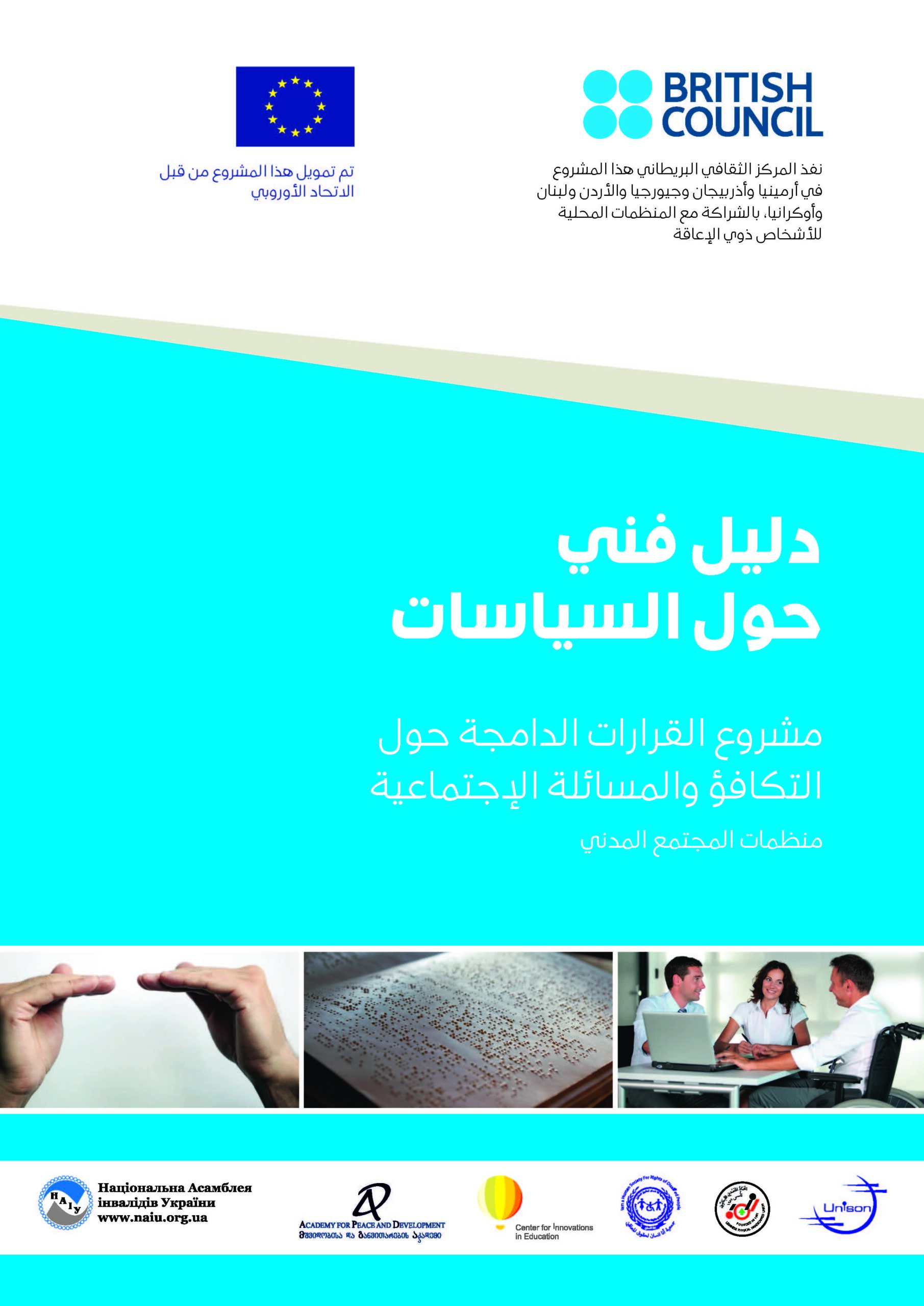
A Technical Guide on Policies: Inclusive Resolutions on Equity and Social Accountability

These tools are designed to advocate for the ratification and implementation of the International Convention on the Rights of Persons with Disabilities (CRPD). The toolkit is based on case studies from the seven participating countries; Lebanon, Jordan, Ukraine, Azerbaijan, Georgia, Armenia and the United Kingdom. The toolkit was developed by disability professionals from the UK who have a long history of advocating for the rights of people with disabilities.

The guide’s ease of use and case studies from different countries will help facilitators better understand the CRPD. The guide explains how authorities (i.e. governments) can become an effective partner for civil society to help decision-makers pass inclusive laws. The guide also focuses on the media and how it can be a key ally in the disability advocacy process, including awareness-raising for the general public.
  • A Technical Guide on Policies: Inclusive Resolutions on Equity and Social Accountability

    A Technical Guide on Policies: Media

  • A Technical Guide on Policies: Inclusive Resolutions on Equity and Social Accountability

    A Technical Guide on Policies: Decision Making

    The toolkit aims to help policymakers engage in inclusion decision-making. It is a decision that involves people with Disability, according to their own principle of “nothing about us without us”. Whether you’re a policymaker, a journalist, or a member of a community organization, involving people with disabilities will improve the efficiency of what you do. […]

  • A Technical Guide on Policies: Inclusive Resolutions on Equity and Social Accountability

    A Technical Guide on Policies: Civil Society Organizations

    In the era of the International Convention on the Rights of Persons with Disabilities, we are moving toward inclusion when we implement the idea of ​​amending the current status quo in our society, where isolation is widespread against persons with disabilities, on the one hand, and where discrimination is practiced against them, primarily due to […]