
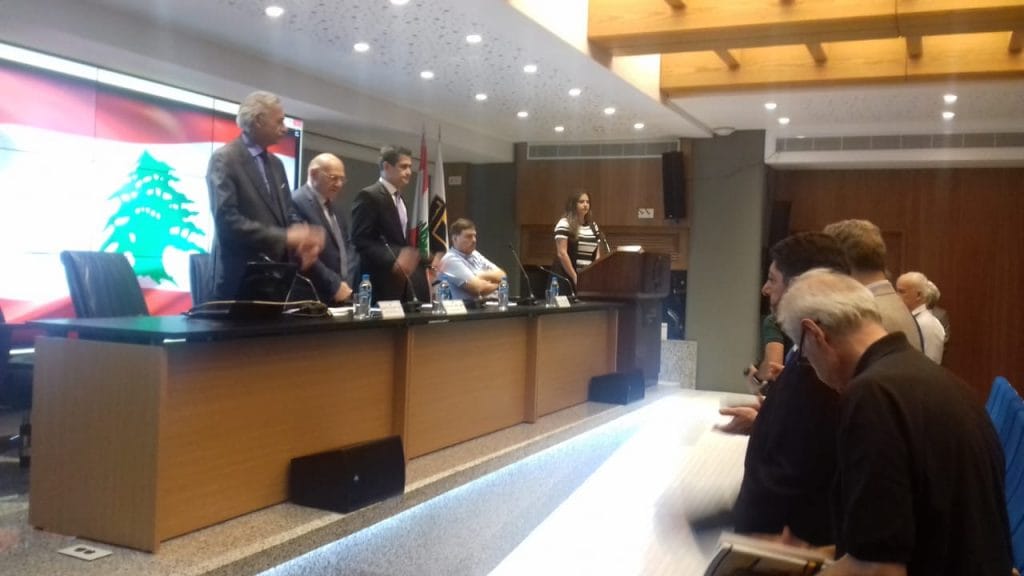
The President of the Lebanese Union for Persons with Motor Disabilities, Silvana Al-Laqis, emphasized “the necessity of creating decisions for an inclusive environment because it is a human right and its non-implementation violates a convention and weakens social cohesion,” and wished everyone to adopt “facilitating movement to promote inclusive life for people with disabilities in the city,” starting with the Engineers Syndicate, which “we hope to open special courses to explain this guide and how to apply it to all segments.” She explained the obstacles in dealing with diversity.
Al-Laqqis’ remarks came during the launch of the Beirut Engineers Syndicate’s “Facilitating Movement to Promote Inclusive Living with the participation of Minister of Social Affairs Richard Qayoumjian, Minister of Public Works and Transportation Youssef Fenianos, Director General of Land Transport Qayoumjian, Minister of Public Works and Transportation Youssef Fenianos, Director General of Land and Maritime Transportation Abdelhafiz Al-Qaisi, President of the Union of Lebanese Engineers, Captain Jad Tabet Director General of the Standards and Metrology Organization Lana Dergham and a crowd of engineers and interested parties.
After the national anthem and introductions, architect Maria El Helou delivered a speech by the head of the Rashid Sarkis, Chairman of the Disabled Persons Care Committee, said: “The most beautiful thing in this “The most beautiful thing about this stand is the human being, and the sweetest thing is the human being. My words are digging in a different form, as engineering is at the forefront of The demonstration of human values, and the warm feeling for the good of society. If only everyone would listen to what he says science in every matter, we would have eliminated many obstacles, hindrances, and impediments that no one can escape recognizing their existence. No one can escape recognizing their existence and their negative effects on the country from every side.” She thanked Captains Bilal Al-Alaili, Khaled Shihab and Jad Tabet, who “contributed and put contributions and touches to the guide.” He also praised the General Organization for Metrology for “helping to reach the threshold of developing Lebanese standards, some of which have matured related to elevators.”
For his part, Tabet emphasized that “the issue of mobility in the city is central to its structure and the most important thing is to facilitate the movement of the most vulnerable groups: Children, the elderly and people with disabilities. Mobility and free movement in the city, in residential buildings, workplaces and public spaces are fundamental rights for all citizens.”
Speech by Captain Jad Tabet, President of the Union of Lebanese Engineers
As engineers, designers and implementers, it is our primary duty to work to improve the urban environment and ensure the adoption of principles that promote inclusive living for people with disabilities during all stages of engineering work, from designing public spaces that ensure freedom of movement and full participation in social life, to studying residential buildings and workplaces so that people with disabilities can move around without facing barriers and obstacles that prevent them from living independently and using all services without any discrimination, to striving to monitor implementation to ensure that the urban space is actually transformed into a space
The Syndicate of Engineers launched the first guide to facilitate the movement of people with disabilities in the city in 2012, a year after the issuance of Decree 7194. The guide was published in French with the help of APAVE Lebanon, the Lebanese Metrology Organization LIBNOR, the Majal Observatory at the Faculty of Elba – University of Balamand, and the Lebanese Union for Persons with Disabilities. The publication of this guide was particularly important as it allowed for the first time in Lebanon to shed light on the practical measures that engineers should follow in the design of buildings and public spaces in order to ensure an inclusive space for all. After assuming my duties as Captain of Engineers, I insisted on the need to start from this first step to issue a new, revised version in French that includes some additional details and to work on a full version in Arabic that will become an effective tool for all engineers, so that we have a professional and technical reference that allows us to design an inclusive built environment. Indeed, this guide has come to life thanks to the efforts of a team of volunteers, whose work I must express my thanks and appreciation.
The Engineers Syndicate proudly presents this new guide, which constitutes an advanced step towards securing the rights of persons with disabilities in the city, and affirms its keenness to continue working towards transforming our urban space into an inclusive space.” He emphasized “the importance of adopting effective measures that allow for the full implementation of Decree 7194, and preventing any attempt to evade the implementation of this decree, whether due to flimsy pretexts or due to negligence and irresponsibility.
While the Engineers Syndicate affirms its full readiness to assume all its responsibilities, it also emphasizes the need for civil organization departments, municipalities and public institutions to fulfill their duties to monitor respect for the measures stipulated by the laws so that Lebanon does not remain at the back of the countries in terms of implementing the United Nations Convention on the Rights of Persons with Disabilities, which was adopted in 2007.
I want to thank His Excellency the Minister of Public Works and the Minister of Social Affairs, as well as the NGOs, the Lebanese Union for Persons with Disabilities, the Forum for the Rights of Persons with Disabilities, the Union of Lebanese Disability Associations, and colleagues Bashar Abdel Samad, Serge Yazigi, and Nassib Nasr for joining us for this meeting.
For his part, Al-Qaisi conveyed the Minister of Works’ greetings and apologized for not participating in the ceremony for reasons beyond his control
It is an honor for me to represent the Minister of Public Works and Transport on this occasion and to deliver his speech on his behalf.” “We always come to our home, the Engineer’s House, to express our opinions in this edifice full of civilization, science and quality culture, and to consult on all aspects of urban life and develop practical steps to implement them. The finest thing we do today in this edifice is to approach human rights for all segments of the population and give them the necessary amount of care and attention, which we consider it a duty of the state through the concerted efforts of all public administrations to achieve the steps of its implementation.” He continued: “People with disabilities are an essential segment of our society, and we cannot be effective in our society unless the work between all segments of it is integrated and each segment plays its role and its place in the national economy. The development of societies cannot be achieved unless all segments of society enjoy their full rights, otherwise we are on the path to social and economic collapse. We at the Ministry of Public Works and Transportation work hard when preparing projects to ensure that they take into account the service of all citizens, especially our loved ones with disabilities, to whom we pay extra attention to ensure their service and mobility requirements. This matter is at the core of our concerns, and we gave it the necessary attention when preparing the comprehensive national study to secure transportation service for all Lebanese regions through an integrated network of public passenger transportation and determine their service requirements.
Minister of Social Affairs Richard Kouyoumjian’s speech
I am pleased that I am present in the syndicate that made an effort to print a guide, to facilitate the affairs of people with special needs or those with hard needs as you want to call them, we need a lot of work. I would like to congratulate the captain and the Engineers Syndicate and all those who worked on this guide from writers, researchers and publishers to issue this guide and be accessible to engineers and everyone who needs it, especially in the process of constructing houses, public places, streets, roads and everything that concerns the movement of people with special needs, and more than that not only for people with special needs but for the elderly, deaf and blind who need buildings to be equipped so that there is a development for the blind in civilized countries through certain walking signs followed by touch. There is also a special alphabet for the deaf that they can read, as well as special means of communication and telephones, as these have become axioms in civilized countries that we must strive to achieve in this country.
We have become in advanced positions in terms of equipment for people with special needs after we considered a wheelchair passageway to be an achievement, and here we thank the syndicate and the Ministry of Works for their active role in reaching a model situation to facilitate movement not only for people with special needs, but for everyone who needs it. We must cooperate between all concerned ministries to develop a participatory strategy to facilitate the lives of people who need such equipment.
He praised the Engineers Syndicate, which “does not issue a building license unless all the technical specifications required for people with special needs are noted in it, but the license is not enough, but there is a need here for serious follow-up and effective monitoring of the application of the required conditions. There must also be a contribution of municipalities in the follow-up and monitoring process.”
Then a discussion session began, where the moderator, architect Bashar Abdel Samad about the content of the book, and the discussions dealt with practical measures to secure the rights of Silvana Al-Laqis, Nawaf Kabbara, architect Serge Yazigi, Dr. Moussa Sharafeddine, and engineer Nasser. Architect Serge Yazigi, Dr. Moussa Charafeddine and Engineer Nassib Nasr.
Kabbara addressed the International Convention on the Rights of Persons with Disabilities, which was approved in 2006 and signed by Lebanon, but was not ratified by the parliament as a result of the government 2006 and signed by Lebanon but not ratified by the parliament as a result of the government that was called Tartar in 2007, and the political conflict that took place. in 2007, and the political conflict that ensued, resulting in the freezing of 66 draft laws, including The ratification of this international treaty.
Sharafeddine discussed the reasons why some people with special needs are not able to leave their homes for long periods of time. from their homes for long periods of time due to “the lack of the necessary equipment in most of the places they want to go to, which is a right to the life cycle The need to recognize social diversity to set standards for specific people and the need to recognize social diversity to set standards for specific people. And the need to recognize social diversity to set standards and criteria for specific people with the need to take into account their diversity and facilitate their movement. take into account their diversity and facilitate their movement.”
Yazigi touched on the issue of the “Domain Observatory,” which bridges applied research and professional expertise in buildings and creating bridges, and the goal of this observatory is to communicate with civil bodies to crystallize this policy and try to implement it,” he said, noting that “The guide is characterized by technical specifications that exist and differ from international guides.”
Engineer Nassib Nasr discussed the process of issuing the manual and printing it in copies with Majal and engineer Rashid Sarkis, who was the “liaison with the syndicate” and the technical factors it contains that can be applied in construction, stressing that “the manual has two faces: A technical face that contains information directed to the engineer, technician and everyone who deals with this subject, and the second face is citizenship. What it lacks is legislation and application.”