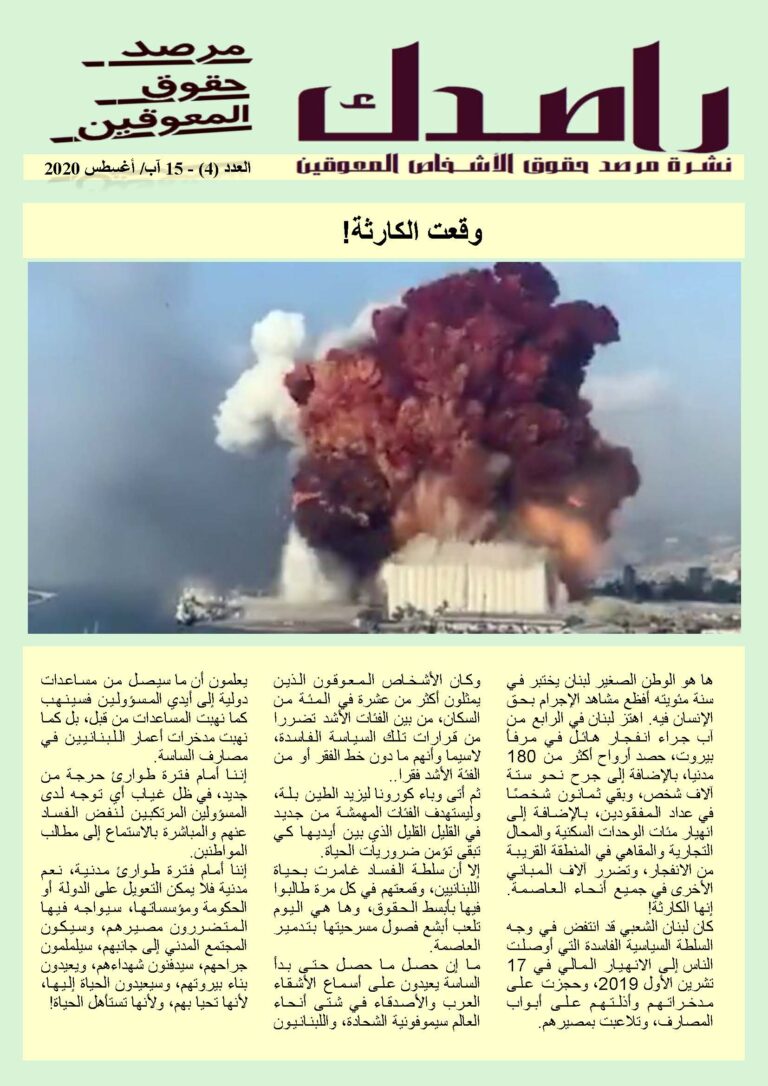
The explosion was the worst thing that could happen to an entire people, and even now it seems futile to write these words in the face of a reality that we have not been able to internalize, perhaps because it is too much for us to bear.
We were in Beirut, and the last one exploded. After the explosion, all of us carried injuries that will accompany us for a lifetime, most notably the psychological trauma that makes us hide whenever we hear a strong sound that we don’t know the source of. There are also those who will grieve forever for their loved ones who were killed, and there are those who are still carrying the physical effects of the explosion after they suffered motor and sensory disabilities that changed all their lives, especially in a country as ill-equipped as Lebanon.
We at the Lebanese Federation for Persons with Motor Disabilities tried to convey the stories of those injured in the explosion who were left with motor disabilities so that the public can realize the enormity of what happened.
Interview with Abdulrahman Bishnati
The first interview with Abdel Rahman Bishnati was in his small rented house in the Burj al-Barajneh camp. He was very sad and depressed, especially since he had lost his mobility and thus his productivity. Abdel sat near the corner, we drank coffee and he told me his whole story. At the end of the interview, I took his picture, in which he didn’t smile right away, but he put it back and tried to smile. A few months after the interview, Abdul lost his life due to complications from his injuries from the harbor explosion, leaving behind his three daughters.
And so we begin with his story:
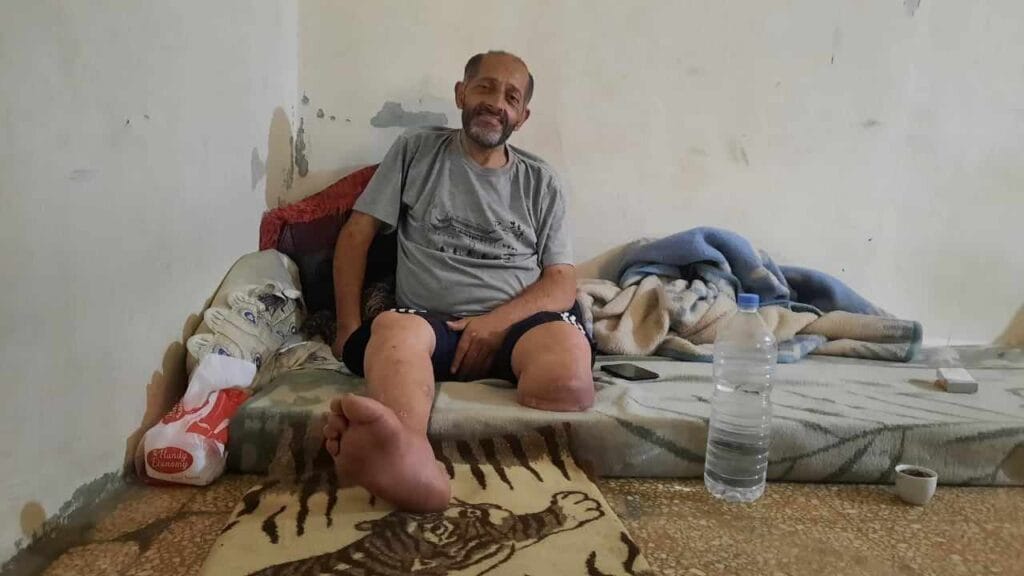
I worked as a coffee peddler in the Bashoura area and volunteered in the Lebanese Civil Defense for many years before the Beirut port explosion.
On August 4, when we got the news of the fire, I got ready to leave with my colleagues, but I didn’t make it to my destination. I remember standing close to the window and the wooden cabinet, and I remember how they pulled me out of the wreckage where my left leg was stuck. A few days later, my leg turned blue and turned gangrenous, and to save my life I had to undergo an amputation.
While the state failed to provide for my needs or even compensate me, my leg was amputated, and I became unemployed and dependent on monthly aid. I became socially isolated because I could not move independently in Beirut or even within my rented house in Burj al-Barajneh camp, and my health condition worsened to the point where I need to undergo open heart surgery, the date of which has not been set because the cost exceeds 40 million Lebanese pounds.
Despite everything that has happened, my biggest loss is that my life used to be full of movement and activity, and now my days are reduced to a small corner filled with a routine that is only broken when my three daughters from the orphanage come to visit me every week.
The Lebanese Federation for Persons with Motor Disabilities launched a relief program to help people affected by the Beirut port explosion, which provided various forms of support to people with disabilities affected by the Beirut port explosion as well as to people who became disabled due to the explosion.
Interview with Mazen Harb
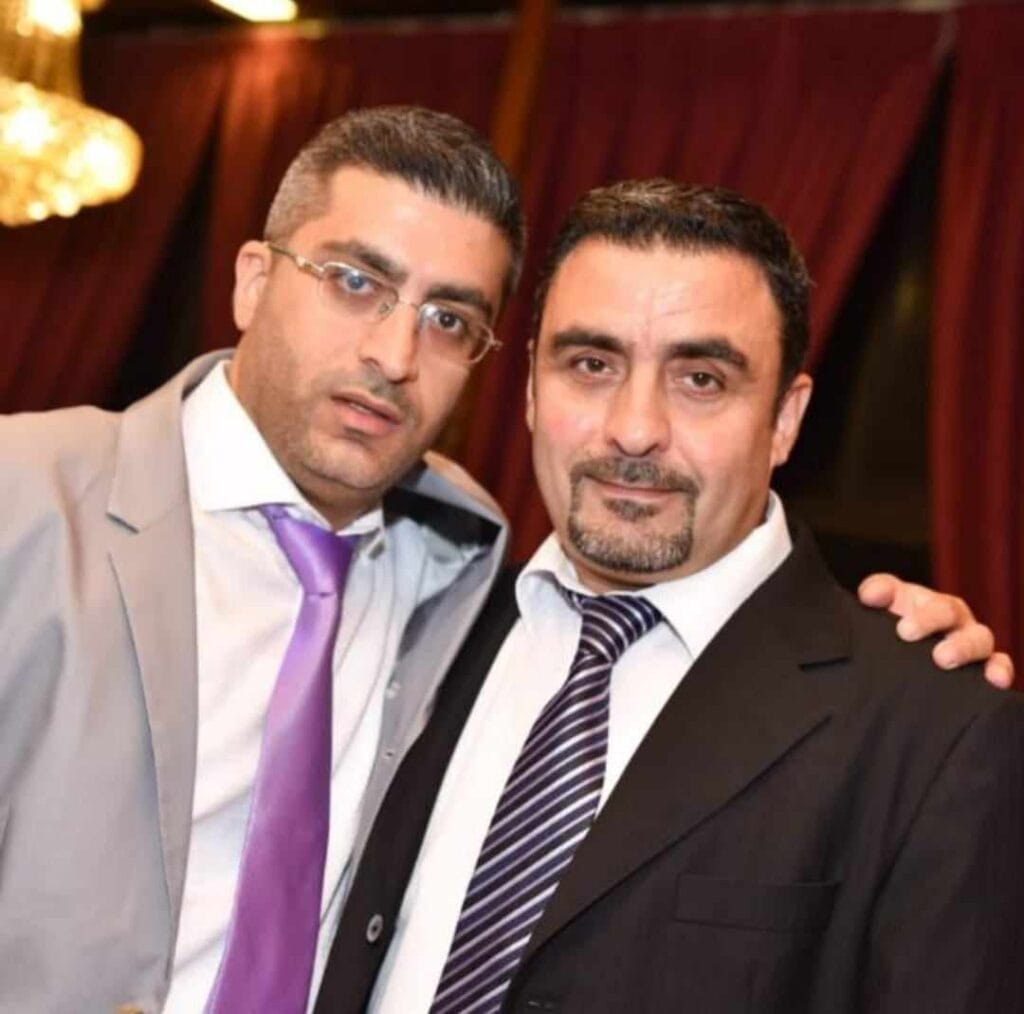
I called him and he didn’t answer. After several attempts, his colleague’s voice came to let me know that he was injured. I rushed to his office in the city center and found him on the floor with his hand moving. Ibrahim is my brother, 14 years younger than me, and I raised him while our father worked abroad to support us.
I immediately took Ibrahim from the office to the hospital, where he underwent the first operation after he was found to have a brain hemorrhage. A week later, the doctors discovered that all the bones in his face were broken, so they performed a reconstruction. I went into the room after the operation to check on him, but I couldn’t find him, so I asked the nurse: “Where is Ibrahim? He’s not here?” Her answer came: “This is Ibrahim.” I didn’t recognize him because of the tumor on his face and head.
During this time, Ibrahim was unconscious, his throat was pierced to breathe, and a tube was inserted from his stomach to feed his body with fluids. After three months, Ibrahim’s body regained consciousness, but his body was unable to meet his needs and he lost his ability to communicate with the outside world.
We moved Ibrahim to a specialized rehabilitation center for a year, where he regained movement in his hands and was sometimes able to say certain words. He regained some of his cognition and was able to breathe on his own despite being infected with the coronavirus. During that year, we discovered that in addition to his injury, he had a hole in the roof of his throat from the explosion, and he was operated on. Since then, he has been able to eat certain types of food.
Ibrahim was scheduled to celebrate his wedding in September 2020. On September 25, 2021, we took Ibrahim out of the center and brought him back to the family home in the Bishara al-Khoury area. Ibrahim lives on the fifth floor, and my family and I live on the sixth floor. As I did before the explosion, I visit him every day to check on him and watch him while he sits among us.
On the morning of September 28, we noticed he had a high fever, and because of the coronavirus pandemic, we couldn’t get a car to take him to the hospital. Around 7 p.m., when the power came back on in the building, I took him down from the apartment and took care of his transportation myself. As soon as we arrived at the emergency room, Ibrahim lost consciousness, we tried to revive him, but we lost him. Ibrahim didn’t actually die on September 28, 2021, we lost him from the moment the explosion happened. That day, when I found him, I asked myself: “What am I going to tell our mother?” We lost his person, his body, his memories and his future. Until now, I can’t find anything to say or console us.
The relief program includes meeting the medical needs of people with various disabilities resulting from the explosion. In addition to required surgeries, food supplies, hygiene supplies, personal care, and material assistance
Interview with Maryam Hijazi
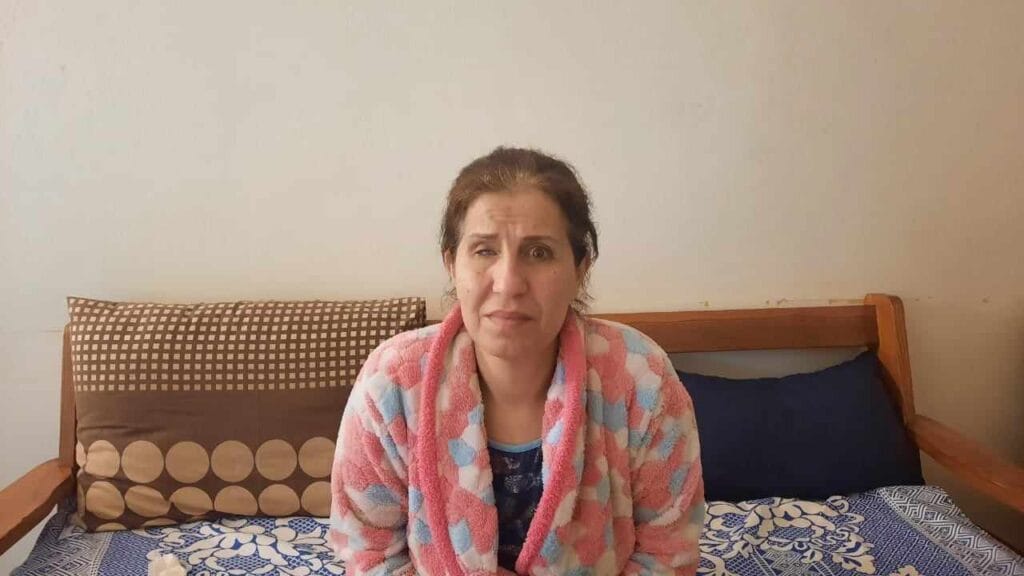
I was 10 years old when my father took me to the Hamra district of Beirut to check on his friend’s house and make sure there was no damage from the ongoing civil war. While we were there, a battle broke out in the street and a shell landed inside the house. I was hospitalized, and shortly after I was injured, I was in a coma for three months. When I woke up, the doctors discovered that I had diabetes.
Forty-two years later, my instincts pushed me out onto the balcony of my sister’s house in the Deep Trench area to watch the smoke from the Beirut harbor. Minutes later, my body flew into the house. On that day, August 4, I lost my right eye completely, and my left eye was damaged.
Today, I’m a 54-year-old divorced woman and mother of four girls. I can’t be productive because all the scenes I see in front of me aren’t clear, and the nerves in my right hand are damaged and I need surgery to repair them. I can’t see people’s faces, I can’t read letters and numbers like I used to, and when the electricity goes out, I can’t move around the house without the help of my daughters. Going out on the street after sunset is impossible, because the darkness completely hinders my movement.
I received psychological and financial assistance from several organizations, and the ministry paid for my surgery and the installation of an artificial eye for me to wear when I go out. But these details are not enough. I need financial compensation from the state to ensure that I can raise my daughters with dignity, especially since the burden falls on my eldest daughter.
My main crisis right now is the rented house I’m living in. Look at it, look at how the water is leaking from the roof to the floor. Some time ago, the landlord informed us that we had to vacate it. Today, with the economic collapse, the high cost of living, and my health condition, I am looking for a habitable apartment to move into with my daughters.
The Union’s relief program supported people with disabilities through psychological support sessions and in-kind grants that helped develop their productive projects and ensure their financial independence.
Hanan Bazaza Interview
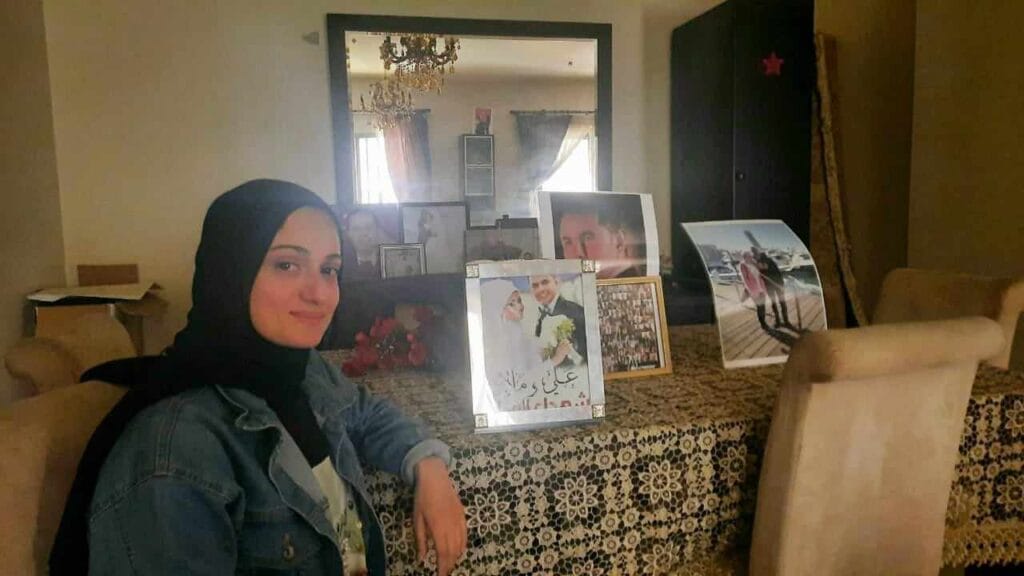
I finished taking my university exams and then headed to a restaurant in Gemmayzeh, where I sat next to my sister Malak, her husband Ali, and my mother, and before the waiter brought out the dessert plates, we took our last picture.
I heard the sound, closed my eyes and found myself lying on the floor unable to get up. In the strange woman’s car that took us to the nearest ambulance, I saw an angel with half-open eyes and a bloody body.
When I arrived at the hospital, I thought she was with me. They didn’t tell me the truth because of my medical condition and the urgency of my surgery. We lost Malak and didn’t know which hospital she was taken to until my brother recognized her body the next day. As for Ali, he stayed on the floor of the restaurant until his brothers came and took him to the nearest hospital where he died. I learned later that when we were in the car, Malak’s body had no pulse, so they didn’t put her in the ambulance because the priority was for the wounded.
The first surgery was performed and the iron skewers were implanted in my thigh, but the operation turned out to be a failure and the doctors had to re-fracture the femur and repair it properly. The second surgery cost me a lot, as I was unable to walk for a month and the physical pain was still present. For those who haven’t experienced the feeling, I can tell you that life is difficult in every way when you lose your ability to move. For me, the choice to use a walker was not an easy one, as I know how society stigmatizes people with mobility impairments.
On August 4, I lost my sister Malak and her husband Ali Ayoub, and what remains are our memories of them, their photos on the table, their 5-year-old son Mohammad and their 3-year-old daughter Lynn. I know that one day I will regain part of my life and recover psychologically, although the journey will be long, because the trauma has overshadowed everything else, so much so that even now I ask myself the question: How did you survive?