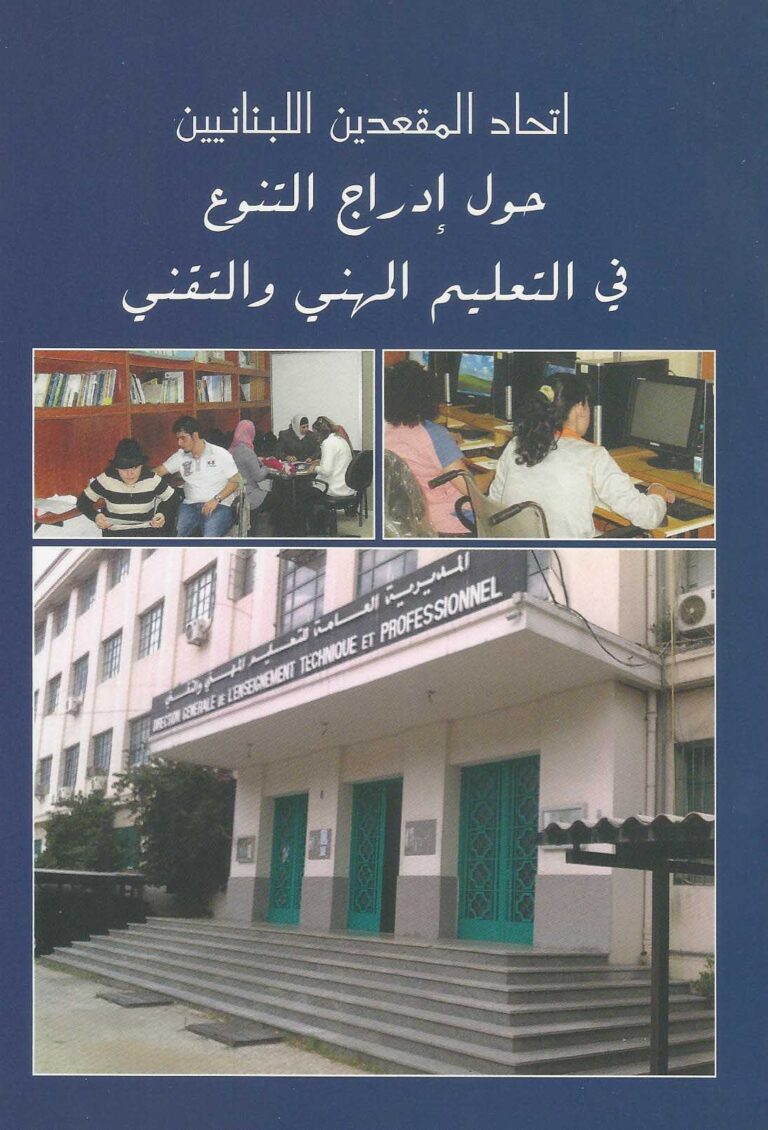
The Inclusive Education Program of the Lebanese Union for People with Physical Disabilities (LUPD) is a comprehensive rights-based initiative aimed at guaranteeing the right of children and youth with disabilities to access quality learning within mainstream schools and institutes.
It operates in line with Lebanon’s Law 220/2000 and the UN Convention on the Rights of Persons with Disabilities. The program goes beyond individual integration, seeking to transform the education system and society at large into fully inclusive environments through advocacy, pressure, and direct implementation.
Core Objectives
- Ensuring the right to education for all: Combating illiteracy and dropout rates, and ensuring equal opportunities in academic and vocational education. A key goal is to raise the very low rate of university attendance among persons with disabilities.
- Accessible learning environments: Ensuring that all educational buildings (schools, technical institutes, and universities) are physically accessible through ramps, elevators, accessible restrooms, and classrooms that enable mobility and independence for students with physical disabilities.
- Capacity building: Training educational and administrative staff on inclusive teaching methodologies, curriculum adaptation, and tailoring educational tools to individual needs. Special attention is given to technical and vocational educational staff.
- From care to empowerment: Supporting the gradual transformation of disability-focused institutions from residential care centers into empowerment hubs that rehabilitate individuals for rapid integration into schools and society, rather than isolating them for long periods.
Implementation Strategies
- Field leadership and pilot models: Implementing practical inclusion models to guide official authorities. A notable example was integrating a group of students with disabilities into a school in Arsal (before 2005), which involved logistical retrofitting, educational planning, and rehabilitation. The program also provides accompanying services such as physical and speech therapy to help students remain in their educational environments.
- Legislative advocacy and policy: Actively engaging in policy advocacy, producing policy papers to activate and advance inclusive education in Lebanon. The program urges the Ministry of Education to allocate annual budgets to cover costs of accessibility and school retrofitting. The LUPD also demands that job descriptions for specialists be adapted in a way to ensure that human resources in public schools and institutes are qualified to serve in an inclusive educational environment.
- Technical partnerships and networking: Collaborating with technical partners to develop a specialized engineering unit for assessing and retrofitting schools and technical institutes according to accessibility standards. Joint monitoring mechanisms with associations of persons with disabilities track progress in inclusion and provide recommendations to the Ministry of Education.
The Inclusive Education Program is integral to LUPD’s broader vision of empowering persons with disabilities and achieving full citizenship. It represents a sustained effort to overcome the economic and cultural challenges that hinder a fundamental human right.
Related Content

Vocational Training
We aim to equip persons with disabilities with the technical and practical skills required by the contemporary labour market, while ensuring the removal of all barriers that may prevent their access to production and work centers.
Architectural Consultation
Toward accessible buildings that open their doors to everyone. Do you find it difficult to use a place because of too many barriers? Does an entrance, a staircase, a narrow corridor, an unclear sign, or an unsuitable design prevent you from moving, getting around, understanding, hearing, or communicating easily? We can help. The problem is […]
Energy and Inclusion for Sustainable and Accessible Education
This project aims to support school-aged children in Lebanon by improving access to the official school system, especially for the most vulnerable children, and enhancing protection services.
Announcing the readiness of the Saida Technical Institute
14 / 10 / 2016Within the framework of the inclusive vocational education project, the Lebanese Wheelchair Union organized on Friday, October 14, 2016, an activity to announce and promote the readiness of the Saida Technical Institute to receive students with disabilities, where the team toured the offices of the mukhtars and distributed leaflets in this regard, and the teams […]
Kafr Zabad: Monitoring the municipality, clinic and public school
08 / 10 / 2016On Saturday, October 8, 2016, the Lebanese Wheelchair Union, in partnership with the UNESCO Mediterranean Youth Networks Project “Empowering Youth and Communities to Lead in Defending the Rights of Persons with Special Needs in Lebanon”, carried out a field audit tour to verify the validity of the monitoring information carried out by the “Cultural Club […]