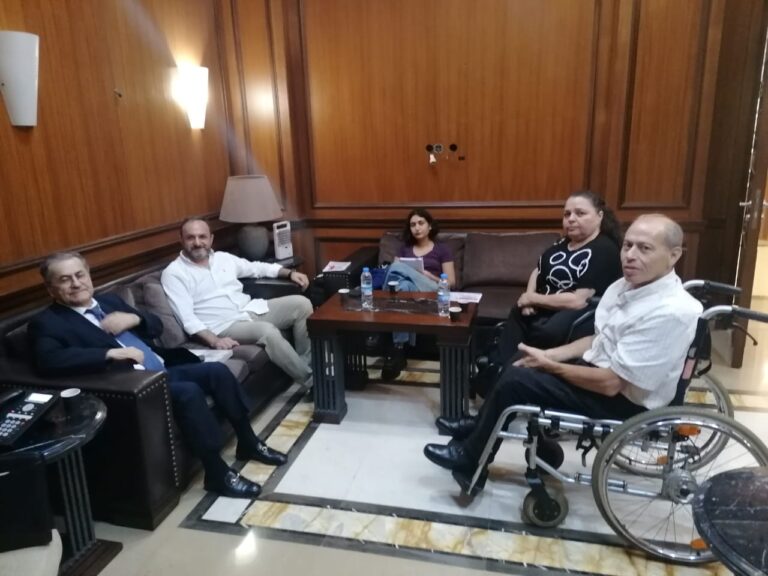
The Legal Agenda publishes a report prepared by Nizar Saghieh and Ghida Frangieh in cooperation with the Lebanese Wheelchair Union and the Diakonia Society, titled: “When the State is Chronically Ill: The movement around Law 220/2000, from diagnosis to intensive care.”
This report does not aim to monitor the rights enshrined in the said law that have not yet been implemented, or the violations committed here and there, but primarily seeks to chart the political and social movement under such a law, especially in light of the breach of its implementation.
How do public administrations react to accusations that they are failing to implement a law that would guarantee the right to citizenship to a large segment of the population? What arguments and pretexts do they use to avoid any attack on their legitimacy?
How does the social group concerned approach this law and the flaws in its implementation? Do they consider it a program of action to be implemented jointly with public administrations, or do they see it as a set of rights that have been violated and about which they confront these administrations with some degree of antagonism? This approach remains largely governed by how these forces interact with the public administration and its flexibility, specifically the extent to which the former is convinced of the credibility of the public administration or the feasibility of positive interaction with it.
Then, what are the symbolic implications of the law, namely, that the rights of the disabled are legitimate and that their isolation and marginalization must stop, both for the disabled and the associations that represent them, and for others and their willingness to recognize them independently of any interference or imposition by the authorities?