
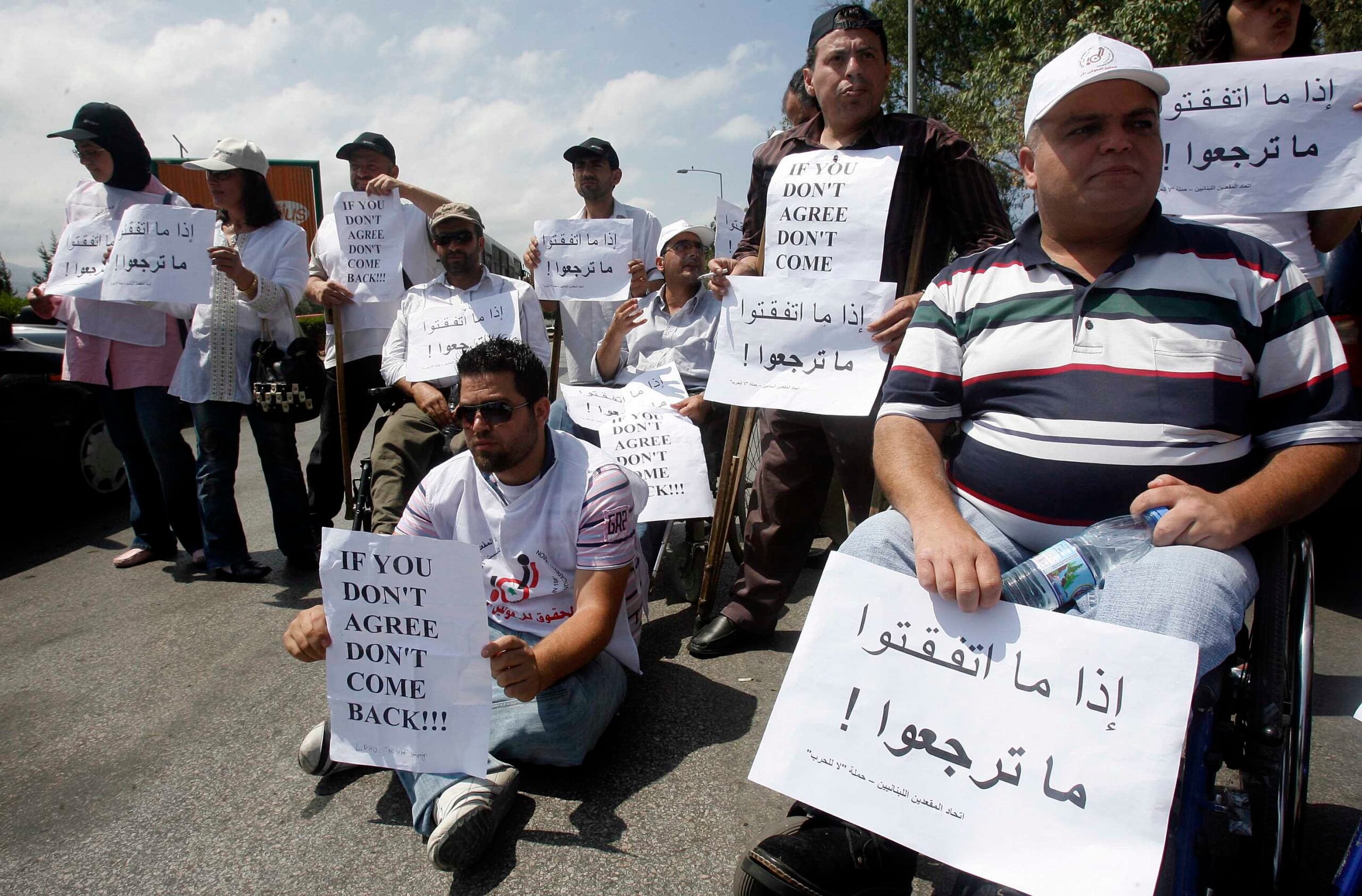
The No to War campaign, which was the result of the immediate action of Lebanese civil society, led by the Lebanese Union for People with Disabilities, in May 2008, under the slogan “If you don’t agree, don’t come back!”, is a highly effective positive shock following the internal strife that Lebanon witnessed as a result of political clashes. The message, and the three goals behind it; rejecting violence and fighting, rejecting political incitement, and rejecting media incitement; were very simple and efficient. This message reached all Lebanese, as well as the Arab and international communities. The slogan and message were passed around by citizens, politicians, and media professionals, and even became the title of an article by Dr. Salim El-Hoss. They culminated in the final announcement of the Doha Agreement by the Emir of Qatar, whose capital hosted the warring leaders. However, the campaign’s success lies not only in its widespread reach, but also in achieving its stated goal in the slogan and its three objectives through the Doha Agreement. It is rare for a spontaneous campaign launched by civil society to achieve such success.
Generally speaking, the campaign was quickly organized after brainstorming ideas at the May 15 meeting, followed by intensive communications from the LUPD management. The May 16 movement, which evolved into a symbolic sit-in, was followed by extensive media coverage. This was followed by LUPD meetings to monitor and prepare for subsequent actions. A memorial sit-in was held on May 20, followed by preparations and follow-up, including press releases and a press conference. Special preparations were also made for the May 25 movement, which was not implemented due to security concerns surrounding the presidential election session.
The campaign achieved another kind of success, as it was the first of many actions by Lebanese civil society following the blow it suffered as a result of the fighting. The campaign demonstrated that civil society can rise above its wounds, pick itself up, and relaunch a comprehensive awareness-raising and sustainable development movement in Lebanon.
Preparations
After the period of fighting that followed the General Labor Union strike on May 7 and continued with “civil disobedience” until after the arrival of the Arab committee, stemming from the meeting of Arab foreign ministers at the Arab League, working to resolve the crisis between the conflicting leaders and factions in Lebanon, the LUPD held its first meeting on May 15 at its main office located in Watta Moussaitbeh, where the members met after a forced absence from their headquarters that lasted for eight days.
The initial all-day open-ended meeting was a brainstorming session on the state of militia infighting in Lebanon, the effectiveness of any nonviolent, peaceful action on the ground by the federation, and the feasibility of action. The long discussions revolved around two main points: what is the role of the LUPD if the armed conflict continues, and can armed violence be combated by action from the LUPD? Although there were many opinions and suggestions for forms of action on the ground, they all came down to three points: an attack on the conflicting parties’ understanding of the concept of a state, a curbing of the incendiary media frenzy, and a call for genuine national reconciliation.
Campaign Charter
The campaign charter, signed by colleague Sylvana Lakkis and released on May 16, formed the general framework for the upcoming actions within the “No to War” campaign. It stated the following:
Our beloved country, Lebanon, is going through a dark crisis of uncertain outcome and direction, in which rival forces are leading it into sectarian, regional, factional and sectarian fighting; and opening new doors for conflict between brothers, accompanied by frenzied media incitement, away from all charters, laws, and the mission of the profession. Each of the warring parties calls the other to its concept of a state, monopolizing the right to interpret this concept, while the correct concept of a state is somewhere else that seems beyond the reach of both parties who are fighting for immediate gains according to narrow interests that ignore the urgent socio-economic crisis and the needs of marginalized groups of Lebanese citizens along the map of the country.
The Union’s “No to War” campaign holds all combatants and disputants and the political forces behind the armed and media incitement that disregards people’s lives and livelihoods, fully responsible for the betrayal of the Lebanese people represented by the irresponsible and reckless behavior adopted by the authority and opposition forces in Lebanon since February 14, 2005 until today; accordingly, we consider the following:
First: it is impossible to justify the use of armed violence, the stockpiling of weapons and their distribution to citizens by any of the warring parties in the streets, alleys and among the peaceful people, whatever the circumstances and whatever the intensity of the political conflict between the conflicting parties. The deliberate killing of each other and the violation of the sanctity of innocent people and their livelihoods cannot be justified in any way, shape or form by any of the humanitarian standards that have been adopted by all the conflicting parties.
Secondly: the fact that the conflicting parties indulged in violating human and democratic values to the extreme, especially with each party playing the role of the victim, while at the same time charging its supporters with sectarianism and factionalism, which threatened the foundations of coexistence and made us far from civil peace, and the use of children supporters to kill each other, creates subsequent generations that store hatred towards the other, which leads our children to subsequent violence.
Third: the fact that politicians from all conflicting parties have shown disregard for the lives of the people, and behind them is a huge group of journalists and reporters promoting one side or the other, unaware that their words on screens or on the airwaves constitute one of the most important weapons of politicians, thus preparing the ground for any fighting between citizens, charging people with large doses of hatred and malice, and facilitating the way to violate the sanctities of the people.
Accordingly, the “No to War” campaign calls on all Lebanese citizens to refrain from using weapons for any reason whatsoever, and to reestablish trust in the security forces, especially the Lebanese Army, which represents the rightful refuge for any citizen with a grievance to redress their grievances.
We call on politicians who do not provide an opportunity to broadcast their hatred against the other to consider what their hands have done in terms of killing and violating all human values, and to disengage from the poisonous inflammatory rhetoric that works to incite violence and return to the discourse of reason and appeasement.
We call on media professionals, journalists, news reporters, and talk show hosts to return to the mission of the profession and to stop the systematic sectarian and factional incitement that has become their habit since they left their mission and joined the ranks of politicians who gamble with the lives of all of us according to their narrow short-term interests.
We believe that our country deserves a united stand against violence and incitement of all kinds, just as we believe that our dear people deserve a decent life. Let us work together to build a country from which our children will not flee.
May 16 Sit-in
On Thursday night, with the news of a preliminary agreement between the warring parties on a number of points, in what was known as the “Venice Agreement” paper, and the travel of politicians to Doha to hold a conference for “national” dialogue, the LUPD administration accelerated the pace of work on a field movement to accompany the departing leaders, so the idea of the May 16 movement came as a result of contacts made by the LUPD President with a large number of members, supporters and friends, and ideas developed at night with colleague Sylvana Lakkis, producing a peaceful symbolic sit-in under the slogan “If you don’t agree, don’t come back!” as part of the No to War campaign, on the western side of the airport road, from 9 a.m. until the departure of officials to Doha, as none of those contacted had any certainty about the time of departure.
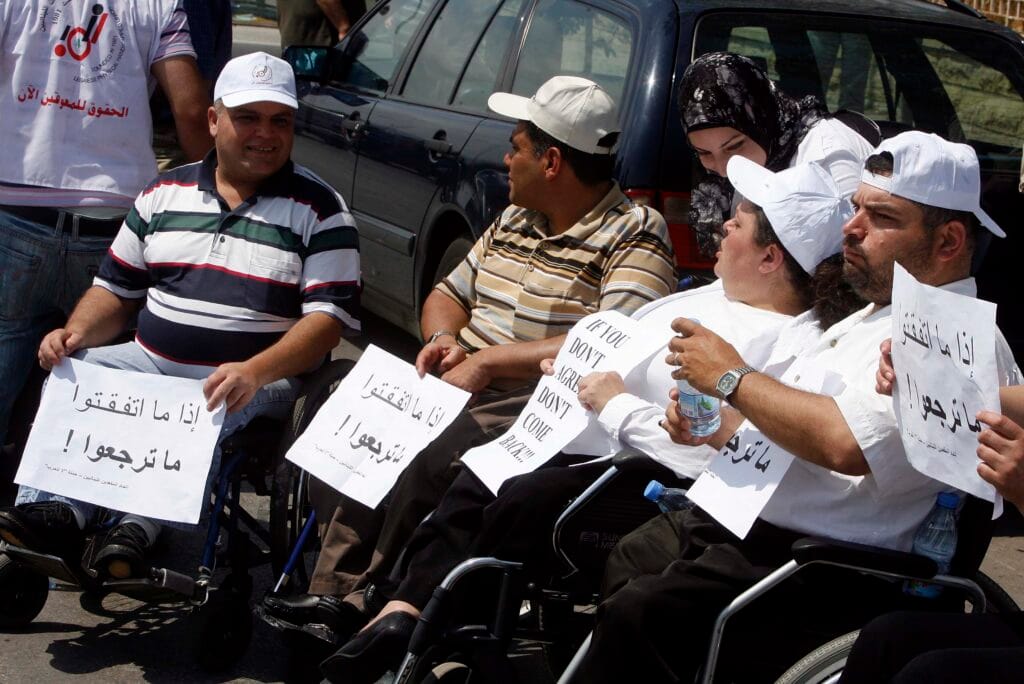
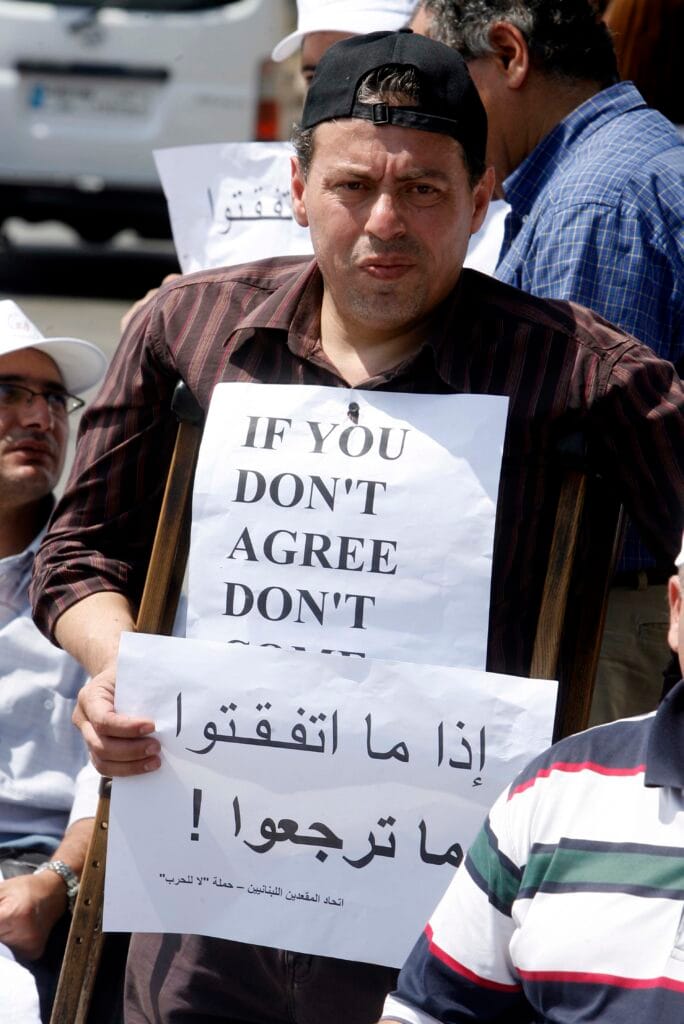
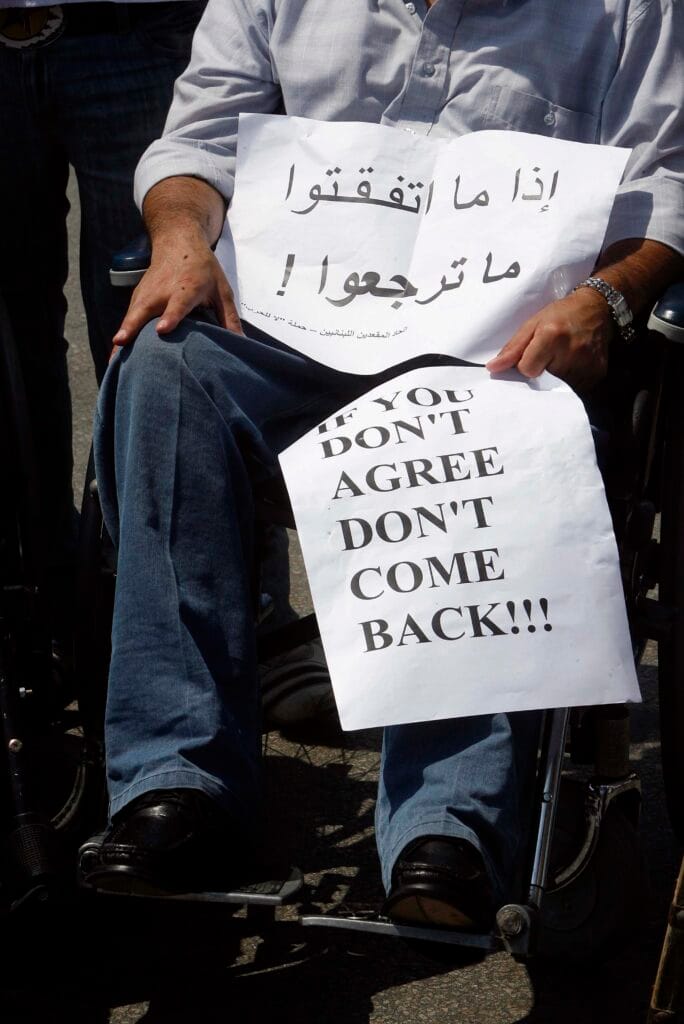
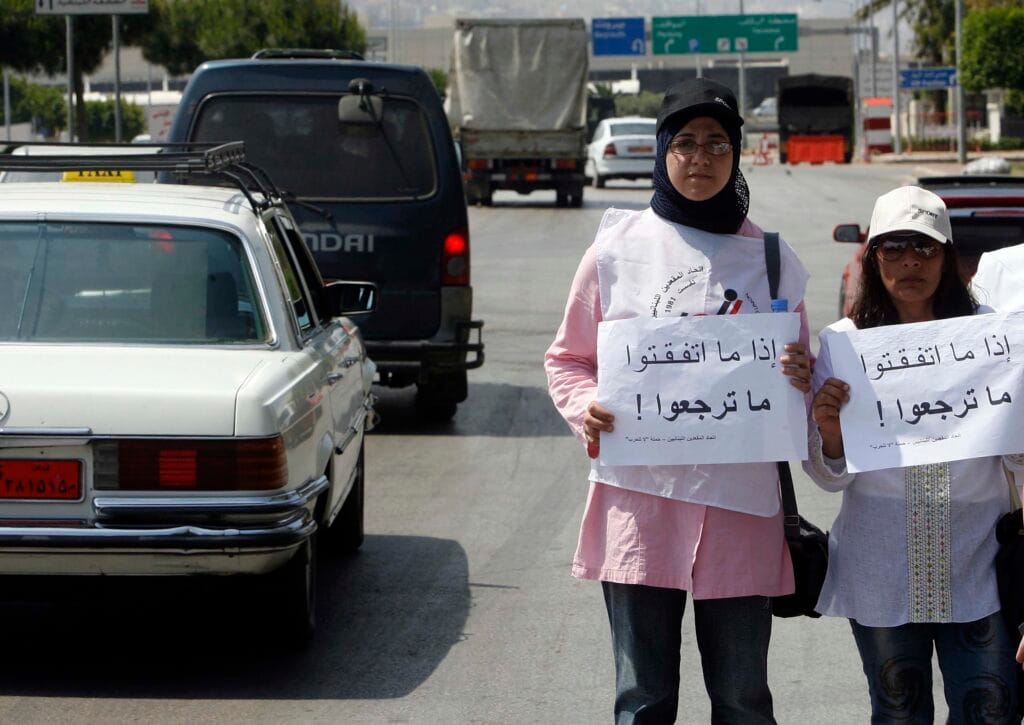
LUPD members and supporters of the campaign gathered from many Lebanese regions and set off on their long day, carrying the campaign’s slogan and chanting the Lebanese national anthem and political songs. They were joined in the afternoon by a number of young people affiliated with the “Khalas” campaign. The sit-in received ample media coverage, especially as the officials’ departure time approached, and lasted until 5:00 p.m.
May 18 Meeting
The LUPD members held a meeting at the Arous Al Bahr Café in Raouche, which included members of the administrative body and activists following the campaign, and the meeting followed up on the issue of upcoming movements within a comprehensive double-pronged strategy; the first being the continuous call for strengthening civil peace, rejecting violence and fighting, and preventing the use of weapons in the street under any pretext in the future, and the second being work towards finding an electoral law that adopts the eight points of reform that resulted from the efforts of the Fouad Boutros Committee. As for the approach that the meeting saw as the top priority at this stage, it was to turn to union bases to increase internal cohesion at this stage.
May 19 Statement
On the evening of May 19, the LUPD members convened a press conference called by the LUPD media unit at 6:30 p.m. for all visual, audio and written media, following news from Doha about the failure of the national dialogue between the conflicting parties. The statement was read by colleague Sylvana Lakkis, and included a harshly worded letter from Lebanese civil society to the leaders. The statement was signed by the campaign and stated:
Our leaders gathered in Doha… even though we did not choose you, the fact is you are our leaders. You went to Doha carrying our dreams, hopes, worries, and wounds pulsing in the alleys, wounds that have not yet stopped bleeding. You went to your dialog, and you passed by us and our slogans and our throats screaming, “If you don’t agree, don’t come back!”
Many of you reiterated this slogan in your statements that paved the way for your disagreement; or rather paved the way for a new unannounced agreement between you against us, over our present, our future and our dreams, over the tears of the bereaved and orphans thanks to what you have done, as well as all the awareness-raising and developmental efforts that civil society has been able to accumulate since the Taif Agreement until today. That agreement was written by your hands and you worked hard not to implement it. Here you are again agreeing against us, against the Lebanese whom you have impoverished, displaced, and robbed of their best assets, robbing them of their sense of security and belonging to their homeland. You agree not to agree, slaughtering us again, those of us who gave everything we have on the altar of your whims and narrow, stinking interests.
Here you are betting on our lives again, flouting all human and national values to return to the tools of sectarian, regional and factional incitement, to turn many of us who remain into martyrs, wounded, disabled, and destitute people who beg for their rights from you; to turn us once again into mere numbers in your narrow interests, which will lead us to another street war in which you are keen with all your efforts to mobilize sectarian strife.
Our leaders… you who claim that you are concerned about Lebanon, its unity, sovereignty and independence, and you have already proven that you are concerned about your personal interests and those of your entourage. Today we say to you: we in the Lebanese civil society, the invisible third line, are not a minority in Lebanon, and we have never been a minority, but our silent majority has never turned to violence, and it is not true what you promote at every opportunity that all Lebanese homes are not without weapons. Today, we warn you in no uncertain terms, do not return to violating sanctities by using the street, mobilizing fanaticism and taking lives, because your recent actions have violated all human and national values and norms, and there is no difference in this between all of you; we tested you all and you failed the test on the ground, and now we warn you from returning from Doha without agreement in the dialogue test, so what are you going to do?
We promise you that we will wait for you at every junction, at every movement, at every meeting in the official institutions that you deliberately disrupted throughout the previous period, and we will not fail in our non-violent, peaceful movements, and we promise you that you will not be safe from our throats and voices, and our continuous demands that you stop killing us daily… You who are gathered in Doha, we are here waiting for you in Lebanon.
This conference, along with news from Doha about the mood of journalists and the Lebanese community there, set the stage for an ongoing push for a broader reminder to pressure the meeting to come up with a consensual version of the agreement.
May 20 Sit-in
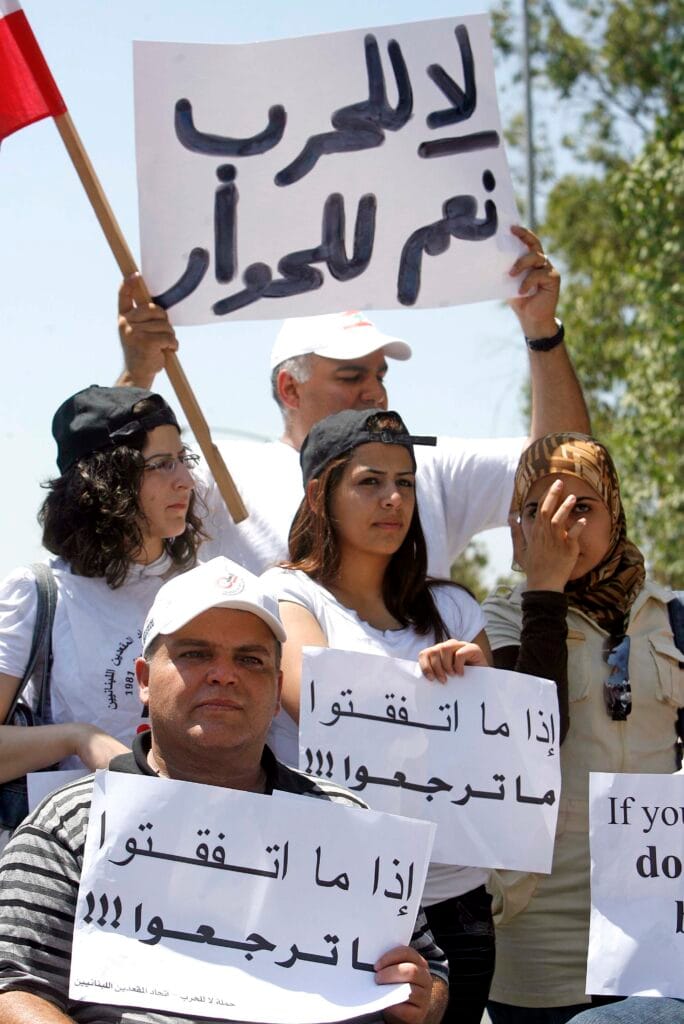
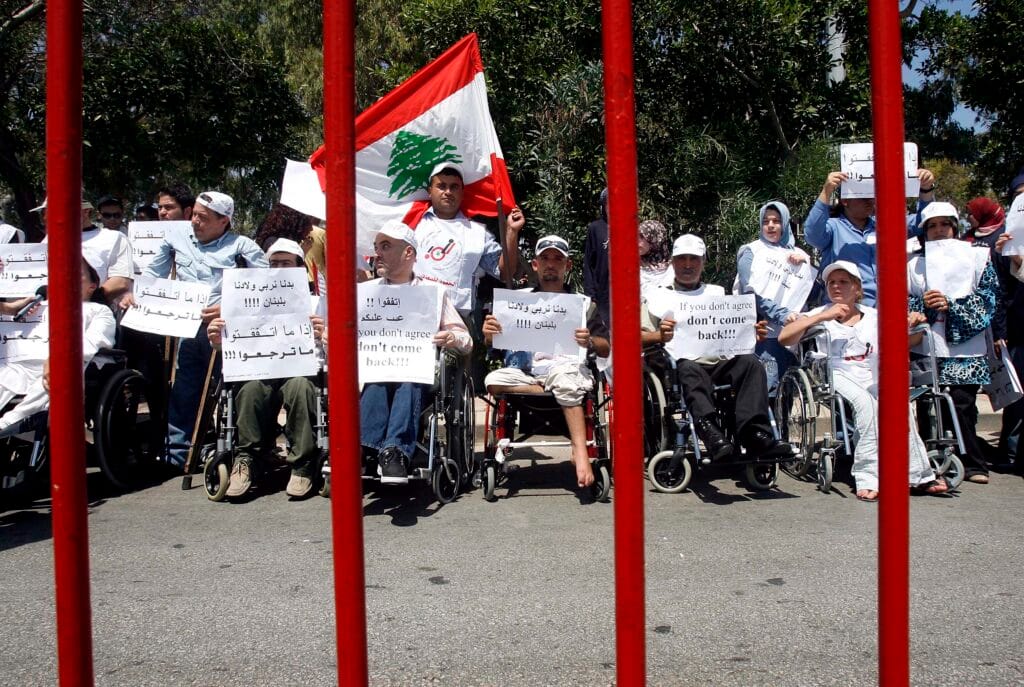
The LUPD’s cry resonated strongly with Lebanese civil society organizations, which joined the Federation in a reminder sit-in on Airport Road on Tuesday morning, May 20, from 10:00 a.m. to 12:30 p.m. More than 250 people gathered from all union base centers in Beirut, Byblos, Sidon, Nabatieh, Tyre, Bar Elias, Baalbek, and Mashghara. In addition to a number of volunteers from the “Khalas” and “Our Unity is Our Salvation” campaigns. The protesters emphasized their slogans and goals, which people responded to from their cars and a number of them joined them. The sit-in provided important media material for a large number of media outlets in light of the uncertainty around the dialog in Doha.
May 22 Statement
In light of the news coming from Doha about the agreement between the warring parties, the LUPD members thought it was necessary to issue a statement urging the local civil and political community to follow up on the implementation of what was agreed upon:
This is a statement to the Lebanese citizens who have endured so much from their leaders. You who stood in solidarity with us in our campaign, and raised with us our slogan “If you don’t agree, don’t come back” in the face of the politicians who went to Doha to return with the Doha Agreement, which we hope will establish civil peace in Lebanon. You proudly proved that you are up to the responsibility in your free solidarity stand to address one word to those responsible for all the tragedies and misfortunes that our country has gone through since 2005 until today, and we appreciate your great efforts, especially the efforts of the “Khalas” and “Our Unity is Our Salvation” campaigns, and to the Lebanese civil society in general, organizations and civil associations for their bold stand in solidarity and participation in the campaign, which proudly proved that free will can influence the decision and can be relied upon in crises, and you have also proved that you are able to open a focal point through which the ray of civilization passes and shines on the body of hateful sectarianism.
We also extend our appreciation to the Lebanese Army leadership and personnel for committing to their duty in facilitating the work of the campaign in its first spontaneous activities on the 16th and 18th of this month.
We turn to the politicians who drove past us on the airport road and peered at us from behind the windows of their armored cars, and none of them bothered to get out of their armored vehicles to take a historic stand in solidarity with the people, we say to you: we did not expect more from you.
Now that you have returned, and despite the fact that the points you agreed upon are not sufficient to lay the foundations of a democratic and civilized nation, and despite your sectarian and regional divisions of voters in your proposed electoral laws, we hope that your agreement, which was made under the commendable Arab auspices, especially with the guarantee of the Qatari Emir who enjoys all our respect and appreciation, will constitute the beginning of the foundation for a nation in which all its citizens enjoy civil and political rights, while eliminating any form of discrimination of any kind. We hope that you will commit yourselves to what you have committed to all of us, especially the following points:
First: Banning the use of weapons under any circumstance and in any form at home.
Second: Confining security and military authority to the state, whose security apparatus, led by the Lebanese Army, maintains security so that Lebanese citizens can regain their sense of security in their homes, workplaces, cities, and countries, and so that many can regain their sense of belonging to their homeland.
Third: Obliging your media organizations to stop all forms of incitement, and your serious endeavor to prevent the use of the language of intimidation at any level.
We also inform you that we in the No to War campaign, in solidarity and coordination with Lebanese civil society organizations, will monitor, observe and keep up with your commitment to the so-called Doha Agreement. We reiterate that we will wait for you at every junction, at every movement, at every meeting in the official institutions that you deliberately disrupted throughout the previous period, and we promise you that you will not be safe from our voices and our constant demands that you rise to the ranks of democratic countries that take their decisions from society and the people and not according to the personal interests of the political class.”
This statement was sent to all newspapers and audio-visual media outlets.
May 25th Rally
The LUPD members resolved to take action in the street through a mass sit-in in front of the Lebanese Parliament building during the electoral general assembly, which was scheduled for May 25 at 5 pm to elect a president, and preparatory meetings for the wide movement began on May 23, where groups and committees were divided between media, organizational, logistical, and others. T-shirts were to be printed with the name of the campaign and hats with the logo of the campaign and the LUPD. A notification was sent to the Beirut Governorate and the Interior Ministry, but this action was not implemented due to the tight security measures that made Nejmeh Square in Beirut a security zone where all forms of peaceful civilian action were prohibited.
May 25th Message
With the conclusion of this phase of the No to War campaign, with the election of the President of the Lebanese Republic, and in light of the implementation of what was agreed upon in Doha, the LUPD administration, represented by colleague Sylvana Lakkis, sent a message of thanks and appreciation to all participants, supporters and sympathizers of the campaign in Lebanon and the Arab world, stating the following:
On this happy day, when Lebanon is wearing its wedding dress, where joy dwells in the hearts and smiles radiate from the faces. On this day, voices from around the country came to greet you and thank each and every one of you. You are the ones who moved the Lebanese street and awakened the spirits.
Here, we must congratulate everyone on this great achievement. We salute you for these tremendous efforts. Special mention goes to those who overcame aches and hardships, and those who tried to overlook fatigue. Those who faced a lot in order to participate and move to the sit-in in Beirut.
Congratulations to all of you! Congratulations to Lebanon! Look at the joy on the faces. Look at how people are happily talking to each other!
All of this, you had a major contribution to, as you became the interest of people, platforms and the media, everyone trying to understand who you are, and more importantly, how you can be so independent and at the same time work for everyone. You, who came from the depths of our villages and cities, made the world get to know the actual and real citizen who belongs directly to the homeland and to human and civilized values, away from factionalism and sectarianism.
Greetings to you, the most beautiful people. You have my utmost respect and appreciation.
Congratulations on your reconciliation, and congratulations on your wonderful spirit. Keep going, we are counting on your awareness and your absolute bias for justice and equality. We are proud of you and hope to continue working together to bring glory to Lebanon, to enshrine civil peace, and to support and build a homeland for all.
Your colleague, President of the Lebanese Physical Handicapped Union.
No to War Campaign Results
- The ability of civil society to take the initiative and insist on the civil rights of Lebanese in all circumstances, and to challenge all difficulties to deliver its message.
- The great capacity of civil society to mobilize members and supporters for any nonviolent, peaceful call, no matter the circumstances.
- The ability of civil society to make its voice heard through its field movements, which represents a significant improvement in performance, even if it is spontaneous.
- The emergence of the Union as a natural representative of Lebanese civil society, despite the simplicity of the field action.
- Positive influence with civil society, which has rallied around the federal movement.
- Positive feedback from the Arab world and foreign non-governmental organizations.
- The campaign achieves all of its stated goals.
- The campaign is at the center of the final consensus speech in Doha.
- The campaign was mentioned by various politicians meeting in Doha, those waiting in Lebanon, and journalists on their talk shows.
- The great positive resonance among Lebanese citizens in Lebanon and the diaspora.
- Adoption of the rights of persons with disabilities in the oath of office speech of the newly elected Lebanese president on May 25, 2008.
The campaign existed in the natural context of the LUPD’s work towards reaching legitimate rights through continuous work on pressing social issues. Also, there was great fear of returning to a new phase of the civil war that haunts Lebanon since 2005. The LUPD found itself at the forefront to work to stop the sound of violence, bullets and the continuous collapse of state institutions. The LUPD demand work is normally based on demands from the state and its institutions and holding them accountable. However, in a state of war is not the time for demands and rights, and the LUPD experienced the civil war phase in Lebanon and it was their duty to act, and their action was fruitful on all levels.