
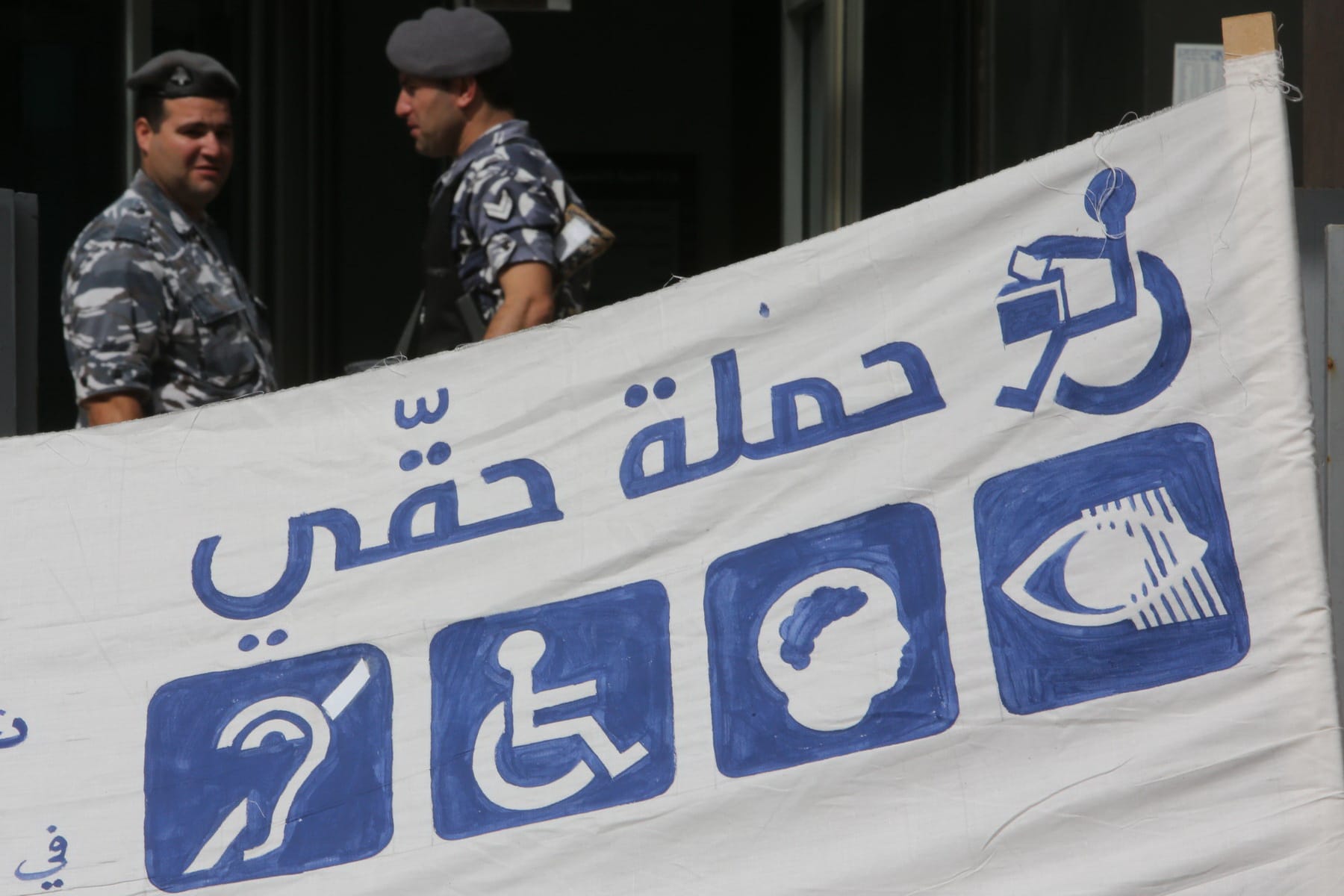
The Disability Rights Demanding Movement in Lebanon received promises and pledges from those directly involved in the electoral process about facilitating the process of voting for disabled voters in the general elections in application of Decree No. 2214/2009, and doing everything necessary to equip polling centers in Lebanon as stipulated in Section IV of Law 220/2000.
This is in accordance with Electoral Law No. 25/2008, as amended by Law 52/2009, Article 91, which reads: “The Ministry shall take into account the needs of persons with disabilities when organizing electoral processes and shall facilitate procedures that allow them to exercise their right to vote without obstacles. The Ministry shall establish the specifics of the application of this article after consulting the opinion of associations of persons with disabilities and service associations stipulated in Law No. 220 of 29/5/2000 on the Rights of Persons with Disabilities.”
According to Electoral Law No. 47/2017, Article 96, which reads: “…the Ministry shall take into account the needs of persons with disabilities when organizing electoral processes and shall facilitate procedures that allow them to exercise their right to vote without obstacles. The ministry shall set minutes for the implementation of this article after consulting the opinion of associations of persons with disabilities.”
And from the promises and pledges she received:
On May 6, 2018, Prime Minister Saad Hariri pledged to approve an item in the general budget to equip electoral centers in Lebanon (Wataniya, visual media). In response to a statement by the field coordinator of the “My Right Campaign – National Campaign for the Political Rights of People with Disabilities in Lebanon” colleague Silvana Al-Laqis that “these elections are not democratic and not fair (by carrying disabled voters on stairs) and that Minister Nohad Machnouk should be held accountable for his previous promises; Hariri said: “You are right. This is something I will take care of personally. My commitment will be in the things that people with disabilities need to vote with dignity.” He pledged to approve the equipment item in the general budget.
Statement by Minister of Interior and Municipalities Raya El Hassan at the start of the electoral process on the morning of April 14, 2019 (Wataniya, visual media). She was asked about the preparations to facilitate the voting process for disabled voters. She replied: “What we should have done was to have a civil defense to help people with special needs, especially if there is a high altitude. Unfortunately, we couldn’t do more than that. But God willing… In the next electoral process, we will take measures to take into account that there are people who can’t get to the high floors.”
On April 14, 2019, colleague Al-Laqis reminded President Najib Mikati of his previous pledges (2013), his announcement from the Government Serail of the Year of the Rights of Persons with Disabilities 2013, and his adoption of the studies on equipping public schools in Lebanon, presented to him by the President of the Lebanese Wheelchair Union, Hassan Marwah (“Progress towards an Inclusive Environment”), implemented by the Research and Consulting Foundation, based on an approach based on architecture and budgeting. The study found that 2,799 schools (1,405 public and 1,394 private) could all be equipped with elevators, wheelchair lifts, ramps, and toilets by cutting only 0.8 percent of the Ministry of Education’s total expenditures over six years.) Mikati pledged again, saying, “By the life of your eye, you will only hear that the issue in schools in general has been solved.” (My Right to Education Campaign Documentation, 2019).
In the end.
After reviewing the public budgets and expenditure sections between 2013 and 2022.
- As a result of a field audit conducted on October 15, 2015 by the teams of the My Right Campaign and the Observatory for the Rights of Persons with Disabilities in Lebanon (Media Unit of the Lebanese Wheelchair Union, 2015, printed brochure), polling stations in Beirut to determine their condition with engineering equipment, six years after the comprehensive field survey of polling stations in Lebanon (Lebanese Wheelchair Union, edited by M. Bashar Abdel Samad, 2009, 6 volumes).
- As a result of the field audit conducted by the engineering unit of the Lebanese Federation for Persons with Motor Disabilities between March and April 2022, in preparation for the lists provided to the Ministry of Interior and Municipalities by the Haqi campaign.
All of the above promises turned out to be false.