
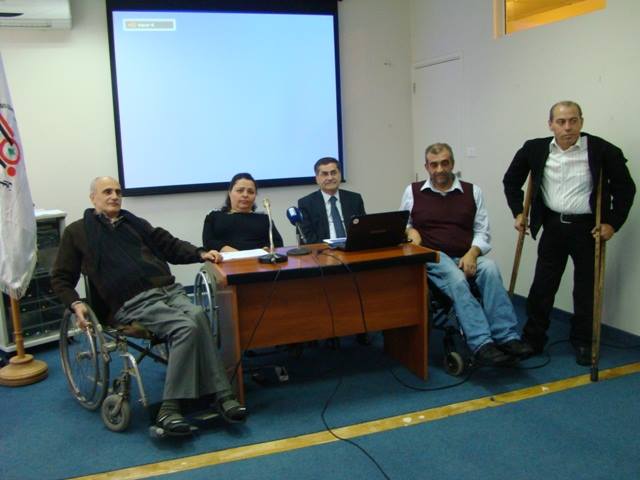
On the International Day of Persons with Disabilities, the Lebanese Wheelchair Union, in cooperation with the Ministry of Social Affairs, the Diakonia organization and the Legal Agenda, launched the Observatory for the Rights of Persons with Disabilities in Lebanon in the presence of the Chairman of the Human Rights Committee, MP Michel Moussa, President of the Lebanese Wheelchair Union, Silvana Al-Laqis, members of the Union’s Board of Directors, and a number of representatives of concerned institutions at the UNESCO Palace.
Remarks by Union President Silvana Lakkis
“The Observatory comes 14 years after the issuance of Law 220/2000 on the rights of the disabled, and most of its provisions are still not implemented,” said Silvana Lakkis, President of the Union, who spoke about the rights of the disabled in Lebanon. This observatory constitutes a civil society and civil society partnership with the public and private sectors to cooperate and search for solutions and thus move closer to justice.” Al-Lakkis launched the “Second Report of the Observatory for the Rights of the Disabled in Lebanon,” arguing that “this observatory is a way to get closer to justice, and as long as there is a large marginalized group in society, we cannot say that there is justice, and the goal is to bring the country to the top of justice where everyone practices his normal life.” “This observatory was established two years ago to promote the culture of rights on the one hand and to develop communication mechanisms between the citizen and the official, as the quality of complaints received about violations from the disabled is based on Law 220/2000, along with a network of friends who strived to open points for the observatory in their institutions,” she said. She explained that “the report actually provides documented information that is delivered to those concerned and is used in advocacy and awareness campaigns as well as for planning in terms of activating Law 220/2000, and we seek to develop monitoring methods and multiply their types to reach coverage of all rights based on the fact that the constitution equates all citizens and does not differentiate between them.”
Diakonia representative Raeda Hatoum
Raeda Hatoum, a representative of Diakonia, said: “The organization has been working in Lebanon for 5 years and is interested in 5 headings: human rights, economic justice, gender equality, peace and reconciliation, and we are in partnership with the Wheelchair Union to promote human rights in Lebanon to promote awareness-raising policies and accountability on our way to a more just society.” She thanked the Wheelchair Union that works in very difficult conditions.
MP Michel Moussa’s speech
For his part, MP Michel Moussa said in his speech: “On the day of the launch of the second observatory prepared by the Observatory for the Rights of Persons with Disabilities to monitor violations of Law 220/2000, it is necessary to develop and demand rights, specifically for those working in the subject of monitoring, which is a basis for improvement and development.” Moussa continued: “The idea of a law to protect the disabled started from the universal rights of the disabled, the most important of which are: The United Nations Charter, the Universal Declaration of Human Rights, the International Covenants on Civil and Political Rights and on Economic, Social and Cultural Rights, the Convention on the Rights of the Child, and other conventions of universal scope: Directive No. 99 of 1955 of the International Labor Organization on Vocational Rehabilitation of Persons with Disabilities and the Declaration on the Rights of Persons with Mental Retardation. Moussa said: “The preamble of the Lebanese Constitution adheres to the provisions of this legislation, as it gives Lebanese laws enforceability, and presents them before it in case of conflict between them. Paragraph C of the preamble of the Lebanese Constitution clearly stipulates equality in rights and duties among all citizens without discrimination or preference, and Article 7 of the Constitution states that all Lebanese are equal before the law and in another equally important aspect, Article 12 states that “every Lebanese has the right to assume public office without any advantage over others except in terms of merit.” “Law 220/2000 on the rights of persons with disabilities is an advanced and bold step that seeks to give rights that have been withheld for a long period of time, and it is not a house but can be developed, especially when applied,” he said, stressing that “the big issue in the country is the application of laws after their issuance, which is what this law suffers from, as well as others.” He stressed “the need for regulatory decrees to implement this law, as many of its files are related to more than one ministry at the same time, so it is necessary to accelerate the completion and implementation of these decrees through an initiative by the Council of Ministers in making the implementation of this law a social priority.” He believed that “the actual urge for implementation passes through the active demand of civil society, one of the pillars of which is an observatory that follows up and a report that tells the facts about what has been achieved and what has not been achieved, provided that this report is sent to the authorities and the concerned ministries for follow-up.” He concluded: “What is required is a long and militant work through a real partnership between the government, parliament and civil society in order to move forward in a country that suffers from political confusion.”